



Up-skilling and Learning on LinkedIn®

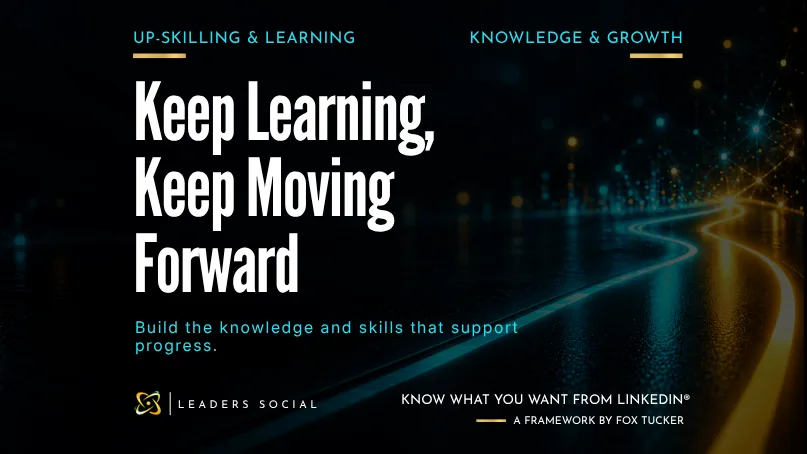
LinkedIn® offers endless opportunities for up-skilling and learning. Learn how to leverage the platform to advance your career by staying competitive and continuously improving.

A Framework by Fox Tucker

My Why Are You Really on LinkedIn®? framework is based around the simple idea: LinkedIn® becomes much easier to use when you understand what you actually need it to do for you.

More

My framework separates those reasons into two broad groups.

Transactional reasons: Connected to outcomes you want to achieve – across your career, commercial opportunities, promotion and demand, or the management of a brand or channel.

Intangible motivations: Things you build over time – your reputation, relationships, knowledge and growth, and contribution to others.

They are different, but they rarely operate in isolation.

What up-skilling and learning on LinkedIn® mean

Up-skilling and learning on LinkedIn® means using the platform to develop new knowledge, improve practical capability and learn from people who are already doing the work.

The value is not only in formal courses. Useful learning can come from practitioners, demonstrations, case studies, professional discussions and repeated exposure to better ways of working.

Used well, LinkedIn® can support continuous professional development and help you show that your skills are moving with your field.

How to use this page

Use this page to see what this LinkedIn® motivation can look like in practice, where to focus your activity, who to connect with, and how content and relationships can support it.

You do not need to use every section as a checklist. Start with what you are trying to achieve, then focus on the areas most useful to you.

The path from learning to capability

Step 1: Focus

Choose a specific skill or knowledge gap

Step 2: Learning

Use credible material and practitioners to build understanding

Step 3: Practice

Apply, discuss and test what you are learning

Step 4: Capability

Turn learning into something you can use confidently

Learning through LinkedIn® should connect discovery to application. Finding a useful course, post or expert is only the first step; the real value comes from testing the idea, applying it to your work and retaining enough of it to change what you can do.

My Why Are You Really on LinkedIn®? framework is based around the simple idea: LinkedIn® becomes much easier to use when you understand what you actually need it to do for you.

More

My framework separates those reasons into two broad groups.

Transactional reasons: Connected to outcomes you want to achieve – across your career, commercial opportunities, promotion and demand, or the management of a brand or channel.

Intangible motivations: Things you build over time – your reputation, relationships, knowledge and growth, and contribution to others.

They are different, but they rarely operate in isolation.

Get a clearer view of your LinkedIn® priorities

Take my free 2 – 3 minute assessment to identify your current primary goal and the motivations supporting it.

What up-skilling and learning might look like for you

You have a specific skill gap

You know there is something you need to understand or do better.

You learn well from practitioners

You value examples, demonstrations and professional experience.

You want feedback and discussion

You learn faster when ideas can be tested with other people.

You want learning to improve your work

You care about practical capability rather than collecting information or certificates.

How to use LinkedIn® for up-skilling and learning

Define the learning goal

Choose the capability or knowledge you actually want to improve.

Find credible sources

Follow practitioners, educators and organisations with direct expertise.

Study actively

Take notes, compare approaches and explain what you are learning in your own words.

Ask and discuss

Use professional conversations to test assumptions and understand practical detail.

Apply the skill

Use the learning in real work, projects or practice rather than leaving it theoretical.

Choose learning goals rather than consuming whatever appears interesting. Follow people and resources that support a current skill gap, save material deliberately and create a reason to use what you learn. Focused learning is easier to sustain than endless professional browsing.

Profile priorities

Your profile should reflect the skills you are building as well as the experience you already have, particularly where new capability is relevant to your current or future work.
Keep skills current

Make sure the skills shown on your profile reflect what you can actually do now.

Show evidence of application

Projects, outcomes and examples are stronger than simply listing completed learning.

Reflect your development

Use Featured and activity to show where your professional capability is growing.

How your content can support learning

Content can reinforce learning by helping you explain what you are discovering, compare approaches and connect theory with practical experience.
Explain what you are learning

Turning new material into your own explanation helps reveal whether you really understand it.

Share practical application

Examples of using a new skill make the learning more concrete and useful.

Compare approaches

Different methods and practitioner views can help you understand trade-offs and better practice.

Avoid performative learning

Posting certificates without showing any change in capability adds little evidence.

Do not consume endlessly

Learning needs application and feedback, not an infinite queue of saved posts and courses.

Sharing what you are learning can reinforce it, but avoid turning every lesson into a claim of expertise. Explain what you tried, what changed and what you still do not know. That makes the learning credible and can attract useful feedback from people with more experience.

How to build the right relationships

Learning improves when you have access to practitioners, mentors, peers and communities that can challenge your understanding and share real experience.
Learn from practitioners

People doing the work can show details that formal material often misses.

Ask focused questions

Specific questions make it easier for others to give useful guidance.

Build peer learning relationships

Peers at a similar stage can share resources, practice and feedback.

Give something back

Share useful resources, experience or support rather than making every learning relationship one-way.

Ask specific questions and show that you have already done some work before seeking help. People are more likely to offer useful guidance when they can see the effort behind the question. Good learning relationships are reciprocal over time.

Common up-skilling and learning mistakes

Your LinkedIn® activity becomes less useful when it is unfocused, performative or disconnected from the reason you are using the platform.

Learning without a clear objective

Broad curiosity can become unfocused consumption when there is no capability you are trying to build.

Mistaking information for skill

Knowing about something is different from being able to do it well.

Ignoring practice

New capability rarely develops without repeated use and feedback.

Keeping learning invisible from real work

Professional development matters more when it changes what you can contribute.

A common mistake is collecting courses, certificates and saved posts without changing behaviour. Another is mistaking exposure to an idea for competence. Use completion as a starting point and application as the real test.

Signs your learning is becoming useful

Look for signs that new knowledge is becoming practical capability – you can explain it, apply it, discuss it with confidence and use it in real work.
You can apply the skill independently

You rely less on step-by-step guidance and can use the capability in real work.

Your explanations improve

You can describe the subject clearly enough to help somebody else understand it.

Feedback becomes more advanced

Questions and conversations move from basics into judgement, trade-offs and better practice.

Your work changes

The new learning produces visible improvements in quality, speed or capability.

Learning is working when you can do something better, faster or with more confidence than before. Useful signals include applying a new skill at work, explaining it accurately to somebody else, solving a problem differently or getting a better outcome from the new approach.

Up-skilling and industry knowledge are closely connected, but they serve different learning needs.

Up-skilling and Learning on LinkedIn®

Develop a specific skill or capability you can apply in practice.

  • Centres on capability
  • Requires practice
  • Has a clearer learning objective
  • Produces evidence in your work
Gaining Industry Knowledge on LinkedIn®

Stay informed about developments, ideas and conversations shaping your field.

  • Centres on awareness and interpretation
  • Tracks external change
  • Can cover a broad field
  • Keeps professional knowledge current

Where they overlap: Curiosity, credible sources and continued learning support each.

Key difference: Up-skilling changes what you can do. Industry knowledge changes what you know about the field around you.

Introduction to Up-skilling and Learning on LinkedIn®

LinkedIn® is not just a networking tool; it’s a platform where professionals go to learn new skills and stay competitive. Whether you’re taking LinkedIn® Learning courses or following industry leaders, there are endless opportunities to improve your knowledge and abilities.

Framework: Up-skilling & Learning sits within Knowledge & Growth in the Why Are You Really on LinkedIn®? framework.

Those who use LinkedIn® for up-skilling are constantly absorbing new information, sharing what they’ve learned, and applying it to advance their career or business.

It’s about actively seeking growth and positioning yourself as someone who values continuous improvement.


Basic Action Points (Vitals):

  • Optimize your profile to highlight your areas of expertise and interest in learning
  • Engage with posts from industry leaders and thought leaders to stay updated
  • Build a network of professionals who share insights and resources on learning and development
  • Use relevant keywords in your profile to connect with learning opportunities
  • Regularly post or share content about your up-skilling journey or recent learning experiences

Specific Action Points for Up-skilling and Learning:

  • Take and complete LinkedIn® Learning courses and share your certificates on your profile
  • Follow and engage with thought leaders in your industry to learn from their insights
  • Join groups or forums dedicated to learning and professional development
  • Share articles, books, or courses you’ve found helpful to position yourself as someone who values learning
  • Post about your up-skilling journey, inviting discussions and sharing progress
How To Use This LinkedIn® Series?

[ls_why_fit]

LinkedIn® can be a huge a time-suck. It’s so much easier and more rewarding when you know why you’re using LinkedIn®. This series starts with Why Are You Really On LinkedIn®? and helps you drill down through to your Transactional Reasons and/or the Intanglible Motivators that drive you and your activities.

When you know your Why? LinkedIn® becomes much easier because you can just focus on the What To Do, be aware of the What Not To Do., and cut the time-suck.

By understanding why you’re really here, you’ll be able to use LinkedIn® more effectively and strategically – whether for immediate outcomes or long-term success.

Why am I on LinkedIn
Transactional LinkedIn
Intangible LinkedIn


.

Get a clearer view of your LinkedIn® priorities

Take my free 2 – 3 minute assessment to identify your current primary goal and the motivations supporting it.