




Building Credibility on LinkedIn®

Building credibility on LinkedIn® isn’t just about posting content—it’s about engaging with your network and becoming a trusted voice in your industry. Learn how to establish yourself as an expert.

A Framework by Fox Tucker

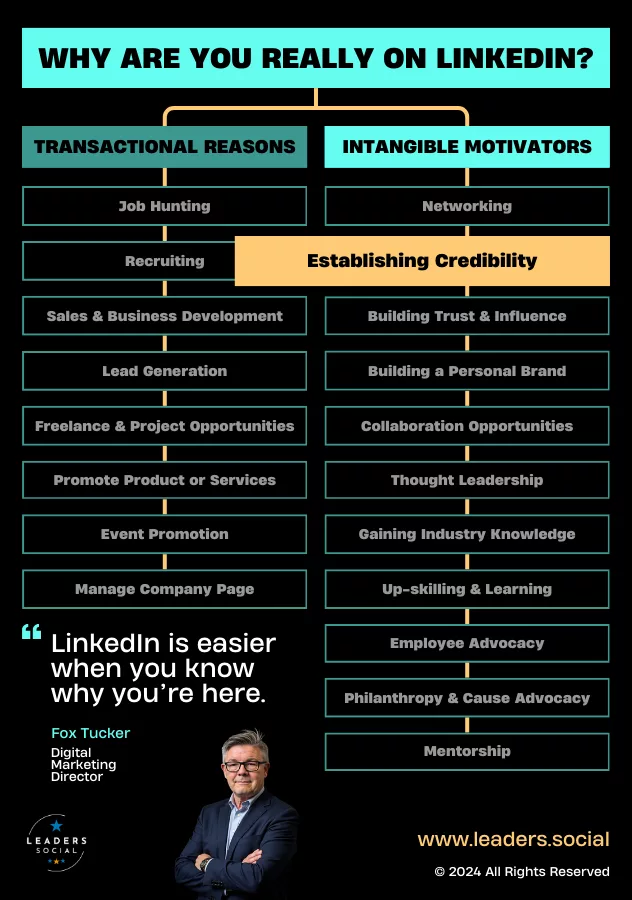
My Why Are You Really on LinkedIn®? framework is based around the simple idea: LinkedIn® becomes much easier to use when you understand what you actually need it to do for you.

More

My framework separates those reasons into two broad groups.

Transactional reasons: Connected to outcomes you want to achieve – across your career, commercial opportunities, promotion and demand, or the management of a brand or channel.

Intangible motivations: Things you build over time – your reputation, relationships, knowledge and growth, and contribution to others.

They are different, but they rarely operate in isolation.

What building credibility on LinkedIn® means

Building credibility on LinkedIn® means giving people repeated reasons to believe that you understand your field and can contribute something useful.

It is not created by claiming expertise. It grows through the quality of your profile, the substance of what you share, the way you contribute to discussions and the evidence other people can see around your work.

Used consistently, LinkedIn® can help you become someone others recognise as knowledgeable, dependable and worth listening to.

How to use this page

Use this page to see what this LinkedIn® motivation can look like in practice, where to focus your activity, who to connect with, and how content and relationships can support it.

You do not need to use every section as a checklist. Start with what you are trying to achieve, then focus on the areas most useful to you.

The path from expertise to credibility

Step 1: Positioning

Make your expertise and experience easy to understand

Step 2: Evidence

Show useful knowledge through content and participation

Step 3: Recognition

Others begin to associate you with the subject

Step 4: Credibility

Your judgement becomes easier to trust and reference

Credibility is cumulative. Your profile can establish the claim, but repeated evidence is what makes it believable: useful explanations, informed comments, visible experience and proof from other people. Aim for consistency between what you say you know and what somebody can actually verify.

My Why Are You Really on LinkedIn®? framework is based around the simple idea: LinkedIn® becomes much easier to use when you understand what you actually need it to do for you.

More

My framework separates those reasons into two broad groups.

Transactional reasons: Connected to outcomes you want to achieve – across your career, commercial opportunities, promotion and demand, or the management of a brand or channel.

Intangible motivations: Things you build over time – your reputation, relationships, knowledge and growth, and contribution to others.

They are different, but they rarely operate in isolation.

Get a clearer view of your LinkedIn® priorities

Take my free 2 – 3 minute assessment to identify your current primary goal and the motivations supporting it.

What building credibility might look like for you

You want to be recognised for your expertise

You want people to understand what you know and where your experience is strongest.

You want your work to speak for you

You prefer useful evidence and contribution to unsupported self-promotion.

You want stronger professional conversations

You want peers, clients and industry contacts to take your contributions seriously.

You want to be easier to trust before a meeting

You want your LinkedIn® presence to support credibility before direct contact.

How to use LinkedIn® to build credibility

Align your profile with your expertise

Make the subjects, experience and achievements behind your credibility easy to verify.

Share useful knowledge

Publish material that demonstrates understanding rather than simply announcing authority.

Contribute thoughtfully

Use comments and discussions to show judgement in public professional conversations.

Use proof

Support your positioning with case studies, outcomes, recommendations and evidence.

Engage with credible peers

Build relationships with people whose expertise and standards you respect.

Choose activities that leave evidence of judgement rather than simply increasing visibility. A thoughtful comment on the right discussion can strengthen credibility more than another generic post. Keep asking whether the activity helps somebody understand what you know, how you think or why your experience is relevant.

Profile priorities

Your profile should make your expertise, experience and evidence easy to verify. It should support what you say in posts and comments rather than forcing people to take your claims on trust.
Make expertise specific

Be clear about the subjects and problems you genuinely understand.

Show evidence

Use achievements, recommendations, projects and outcomes to support your positioning.

Use relevant professional language

Make it easier for people to connect your profile with the expertise you want to be known for.

How your content can support credibility

Useful content gives people repeated evidence of what you know, how you think and the quality of your judgement.
Explain things well

Clear explanations demonstrate understanding better than vague claims of expertise.

Use evidence and examples

Case studies, practical observations and real outcomes strengthen credibility.

Add informed commentary

Contribute useful thinking to industry developments and professional discussions.

Do not confuse confidence with credibility

Strong claims without enough evidence can make your positioning feel weaker rather than stronger.

Avoid borrowed authority

Repeating fashionable opinions adds less value than showing your own understanding and experience.

Credibility-building content should make your expertise observable. Explain decisions, trade-offs, lessons and practical details that somebody without your experience would struggle to articulate. Specificity is usually more convincing than broad advice because it gives readers something they can test against their own experience.

How to build the right relationships

Credibility grows faster when your expertise is visible in conversations with respected peers, clients and other knowledgeable professionals.
Engage with knowledgeable people

Useful exchanges with respected peers help demonstrate the quality of your thinking.

Let others validate your expertise

Recommendations, referrals and visible professional relationships can strengthen credibility.

Stay open to challenge

Credibility grows when you can discuss disagreement without becoming defensive.

Be consistent across settings

Your profile, content and direct conversations should reinforce the same professional standards.

Credibility often strengthens through public professional exchange. Engage with people whose standards you respect, contribute where you genuinely have something useful to add and be comfortable acknowledging limits or disagreement. Being credible does not require having an answer to everything.

Common credibility mistakes

Your LinkedIn® activity becomes less useful when it is unfocused, performative or disconnected from the reason you are using the platform.

Calling yourself an expert without enough evidence

Authority is more convincing when other people can see how you earned it.

Posting generic advice

Broad observations rarely demonstrate deep knowledge or judgement.

Ignoring comments and discussion

Credibility is also built through how you respond when other professionals engage with you.

Overstating experience

Inflated claims can damage trust quickly if the evidence does not support them.

The quickest way to weaken credibility is to overclaim. Generic thought-leadership language, unsupported expertise claims and commenting on every fashionable topic can make your positioning less believable. Narrower authority, backed by evidence and consistency, is usually stronger.

Signs your credibility is growing

Look for signs that other people increasingly recognise your expertise, seek your view and use your content or profile as evidence of what you know.
People seek your view

Contacts begin asking for your opinion on issues connected to your expertise.

Your content is referenced

Other people save, share or refer back to your explanations and observations.

Recommendations become more specific

Clients and colleagues describe the particular expertise or judgement they value in you.

Better professional opportunities appear

You are invited into conversations, projects or opportunities because of what you are known for.

Credibility is growing when people begin to associate you with specific subjects without being prompted. Look for more precise recommendations, invitations to contribute, references to your work and questions that assume your expertise. Those are stronger signals than raw follower or impression counts.

Credibility and trust are closely related, but they are not the same thing.

Building Credibility on LinkedIn®

Demonstrate that your knowledge, experience and judgement are credible.

  • Centres on expertise and evidence
  • Shows what you know
  • Uses proof and professional judgement
  • Can form before a personal relationship
Building Trust and Influence on LinkedIn®

Build confidence that people can rely on you and your contributions over time.

  • Centres on reliability and confidence
  • Builds through repeated behaviour
  • Depends heavily on consistency
  • Strengthens influence over time

Where they overlap: Consistency, useful content, evidence and professional behaviour support each.

Key difference: Credibility answers whether you know what you are talking about. Trust adds the judgement that you are reliable, fair and worth following.

Introduction to Building Credibility on LinkedIn®

LinkedIn® is a platform for professionals to establish themselves as experts in their field. Whether you’re a consultant, entrepreneur, or industry leader, building credibility means showing your audience that you know your stuff.

Framework: Establishing Credibility sits within Reputation in the Why Are You Really on LinkedIn®? framework.

The goal isn’t just to be seen, but to be trusted. People who build credibility on LinkedIn® are consistent in sharing valuable content, engaging with others thoughtfully, and presenting themselves in a way that aligns with their expertise.

It’s about more than just posting – it’s about creating conversations and being someone others look to for advice and insight in your field.


Basic Action Points (Vitals):

  • Optimize your profile to clearly reflect your expertise and achievements
  • Engage with industry content and contribute thoughtful comments
  • Build a network of professionals who can vouch for your expertise
  • Use relevant keywords in your profile and posts to be easily found by your audience
  • Regularly post or engage with content to maintain visibility

Specific Action Points for Building Credibility:

  • Share articles, case studies, or insights that demonstrate your knowledge
  • Comment on industry trends or news to position yourself as a thought leader
  • Engage with other experts to foster conversations and showcase your understanding of the field
  • Use LinkedIn®’s publishing platform to write long-form posts or articles that share your expertise
  • Encourage recommendations or endorsements from clients and colleagues
How To Use This LinkedIn® Series?

[ls_why_fit]

LinkedIn® can be a huge a time-suck. It’s so much easier and more rewarding when you know why you’re using LinkedIn®. This series starts with Why Are You Really On LinkedIn®? and helps you drill down through to your Transactional Reasons and/or the Intanglible Motivators that drive you and your activities.

When you know your Why? LinkedIn® becomes much easier because you can just focus on the What To Do, be aware of the What Not To Do., and cut the time-suck.

By understanding why you’re really here, you’ll be able to use LinkedIn® more effectively and strategically – whether for immediate outcomes or long-term success.

Why am I on LinkedIn
Transactional LinkedIn
Intangible LinkedIn


.

Get a clearer view of your LinkedIn® priorities

Take my free 2 – 3 minute assessment to identify your current primary goal and the motivations supporting it.