



Building Trust and Influence on LinkedIn®

A Framework by Fox Tucker

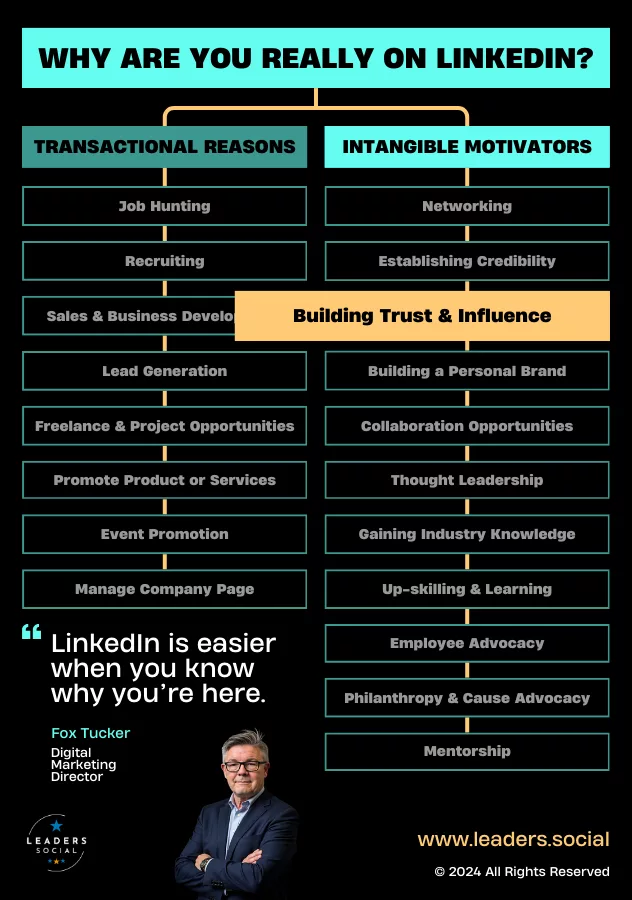
My Why Are You Really on LinkedIn®? framework is based around the simple idea: LinkedIn® becomes much easier to use when you understand what you actually need it to do for you.

More

My framework separates those reasons into two broad groups.

Transactional reasons: Connected to outcomes you want to achieve – across your career, commercial opportunities, promotion and demand, or the management of a brand or channel.

Intangible motivations: Things you build over time – your reputation, relationships, knowledge and growth, and contribution to others.

They are different, but they rarely operate in isolation.

What building trust and influence on LinkedIn® means

Building trust and influence on LinkedIn® means becoming someone whose judgement and contributions people are willing to pay attention to over time.

Trust grows through consistency – useful content, thoughtful engagement, credible expertise and professional behaviour that matches what you claim to stand for.

Influence follows when people begin to rely on your view, involve you in important conversations and allow your ideas to shape how they think or act.

How to use this page

Use this page to see what this LinkedIn® motivation can look like in practice, where to focus your activity, who to connect with, and how content and relationships can support it.

You do not need to use every section as a checklist. Start with what you are trying to achieve, then focus on the areas most useful to you.

The path from credibility to influence

Step 1: Credibility

People see evidence that you understand your field

Step 2: Consistency

Your behaviour and contributions reinforce that confidence

Step 3: Reliance

People begin to seek or value your judgement

Step 4: Influence

Your ideas begin to shape conversations and decisions

Trust develops after credibility. People may believe you know your subject quite quickly; trusting your judgement takes repeated exposure to how you behave, what you prioritise and whether your words match your actions. Consistency across profile, content, comments and private conversations matters more than occasional high-performing posts.

My Why Are You Really on LinkedIn®? framework is based around the simple idea: LinkedIn® becomes much easier to use when you understand what you actually need it to do for you.

More

My framework separates those reasons into two broad groups.

Transactional reasons: Connected to outcomes you want to achieve – across your career, commercial opportunities, promotion and demand, or the management of a brand or channel.

Intangible motivations: Things you build over time – your reputation, relationships, knowledge and growth, and contribution to others.

They are different, but they rarely operate in isolation.

Get a clearer view of your LinkedIn® priorities

Take my free 2 – 3 minute assessment to identify your current primary goal and the motivations supporting it.

What building trust and influence might look like for you

You want people to rely on your judgement

You care about becoming a dependable professional voice rather than simply being visible.

You want to shape professional conversations

You want your contribution to affect how others think about issues in your field.

You want your values and expertise to be understood

You want people to know what you stand for as well as what you know.

You want influence that lasts

You are more interested in sustained professional trust than temporary attention.

How to use LinkedIn® to build trust and influence

Make your positioning credible

Align your profile with the expertise, values and judgement you want people to associate with you.

Share substantive thinking

Publish ideas and analysis that give people reasons to understand and trust your judgement.

Contribute constructively

Use comments and discussions to show how you handle disagreement and complexity.

Build relationships with respected peers

Influence strengthens when you are part of credible professional conversations.

Stay consistent

Make sure your behaviour, claims and public activity reinforce each other over time.

Use LinkedIn® in ways that make your judgement easier to assess. Respond thoughtfully, credit other people, correct mistakes when necessary and avoid changing your position simply to chase attention. Influence becomes more durable when people understand the standards behind what you say.

Profile priorities

Your profile should give people confidence in who you are, what you know and what you stand for. It should support the judgement they form from your content and interactions.
Make your expertise clear

People should quickly understand the subjects on which your judgement is grounded.

Show evidence and values

Use experience, outcomes and recommendations to support the way you position yourself.

Keep the profile aligned with your voice

Your profile should feel consistent with the ideas and behaviour people see elsewhere.

How your content can support trust and influence

Content can show your judgement, values and expertise repeatedly enough for people to understand what they can expect from you.
Share considered views

Explain why you think something, not just what you think.

Add value to difficult discussions

Influence grows when you can make complex issues clearer or more useful.

Be consistent in substance

Repeated quality builds more trust than sporadic high-volume posting.

Avoid performative certainty

Pretending every issue is simple can weaken trust with knowledgeable audiences.

Do not mistake attention for influence

High reach does not automatically mean people trust or act on your judgement.

Content that builds trust should help people understand how you think, not just what you know. Explain reasoning, acknowledge trade-offs and avoid pretending every issue has a simple answer. Readers are more likely to trust a professional whose judgement feels consistent and proportionate.

How to build the right relationships

Influence becomes stronger when it grows through real professional relationships, useful exchanges and respect rather than follower count alone.
Earn trust through behaviour

How you respond, disagree and follow through matters as much as what you publish.

Engage with respected voices

Meaningful exchanges with credible people can strengthen the quality of your network and conversations.

Listen as well as speak

Influence is stronger when people can see that you understand other views.

Protect long-term credibility

Do not trade trust for short-term attention, controversy or promotion.

Trust is relational, so how you treat people matters. Follow through on conversations, respond without turning every interaction into an opportunity and give useful attention before expecting anything back. Influence tends to follow when people repeatedly experience you as useful, fair and reliable.

Common trust and influence mistakes

Your LinkedIn® activity becomes less useful when it is unfocused, performative or disconnected from the reason you are using the platform.

Chasing follower numbers

A large audience does not prove that people trust your judgement.

Posting opinions without substance

Influence weakens when views are not supported by experience, evidence or reasoning.

Being inconsistent under pressure

Trust can disappear quickly when behaviour contradicts your stated values.

Turning influence into constant promotion

People stop relying on a voice that always leads back to a sales message.

Trying to look influential can work against becoming influential. Chasing controversy, overstating certainty, manufacturing engagement or treating follower count as authority may increase visibility without increasing trust. Protect the consistency of your judgement even when a louder approach might perform better.

Signs your trust and influence are growing

Look for signs that people increasingly seek your view, engage more deeply with your ideas and involve you in conversations where your judgement matters.
People ask for your opinion

Your network increasingly seeks your judgement on issues connected to your field.

Conversations become deeper

Replies and messages move beyond surface engagement into substantive discussion.

Your ideas are repeated or referenced

Other people carry your thinking into their own conversations and content.

You are invited into higher-value discussions

Panels, collaborations, advisory conversations or senior introductions begin to appear.

Trust is growing when people rely on you, not merely notice you. Strong signals include repeat engagement from respected contacts, unsolicited referrals, private requests for your view and people acting on or repeating your recommendations. Influence becomes visible in behaviour, not just reactions.

Trust and influence build on credibility, but they go further than proving expertise.

Building Trust and Influence on LinkedIn®

Earn confidence in your judgement and increase the weight your ideas carry.

  • Centres on confidence and reliance
  • Builds through repeated behaviour
  • Shapes conversations and decisions
  • Depends on long-term consistency
Building Credibility on LinkedIn®

Demonstrate that your expertise and professional knowledge are credible.

  • Centres on expertise and evidence
  • Shows what you know
  • Builds professional authority
  • Can exist before broader influence

Where they overlap: Evidence, consistency, useful content and professional behaviour matter to each.

Key difference: Credibility establishes that you know your subject. Trust and influence determine whether people rely on your judgement and let it affect their thinking.

Introduction to Building Trust and Influence on LinkedIn®

Building trust and influence on LinkedIn® is about becoming a voice that people listen to and rely on for insights and advice. Trust isn’t built overnight – it’s earned through consistent engagement, sharing valuable content, and demonstrating genuine expertise. Those who focus on building influence know that it’s not just about gaining followers; it’s about becoming someone whose opinions and insights shape conversations in their industry.

Framework: Building Trust & Influence sits within Reputation in the Why Are You Really on LinkedIn®? framework.

Trustworthy influencers on LinkedIn® don’t push products or services; they engage thoughtfully, add value, and connect with others on a deeper level.


Basic Action Points (Vitals):

  • Optimize your profile to reflect your expertise and thought leadership
  • Engage thoughtfully with others by commenting on posts and offering insights
  • Build relationships with key players in your industry to grow your influence
  • Use relevant keywords to ensure you’re easily found by those seeking industry leaders
  • Regularly post high-quality content that reflects your knowledge and values

Specific Action Points for Building Trust and Influence:

  • Share long-form posts or articles that provide in-depth insights into your field
  • Host LinkedIn® events or webinars to showcase your expertise and engage your network
  • Comment on key industry discussions and provide meaningful input
  • Collaborate with other thought leaders in your field by engaging with their content or co-creating pieces
  • Encourage endorsements and recommendations that reflect your influence
How To Use This LinkedIn® Series?

[ls_why_fit]

LinkedIn® can be a huge a time-suck. It’s so much easier and more rewarding when you know why you’re using LinkedIn®. This series starts with Why Are You Really On LinkedIn®? and helps you drill down through to your Transactional Reasons and/or the Intanglible Motivators that drive you and your activities.

When you know your Why? LinkedIn® becomes much easier because you can just focus on the What To Do, be aware of the What Not To Do., and cut the time-suck.

By understanding why you’re really here, you’ll be able to use LinkedIn® more effectively and strategically – whether for immediate outcomes or long-term success.

Why am I on LinkedIn
Transactional LinkedIn
Intangible LinkedIn


.

Get a clearer view of your LinkedIn® priorities

Take my free 2 – 3 minute assessment to identify your current primary goal and the motivations supporting it.