
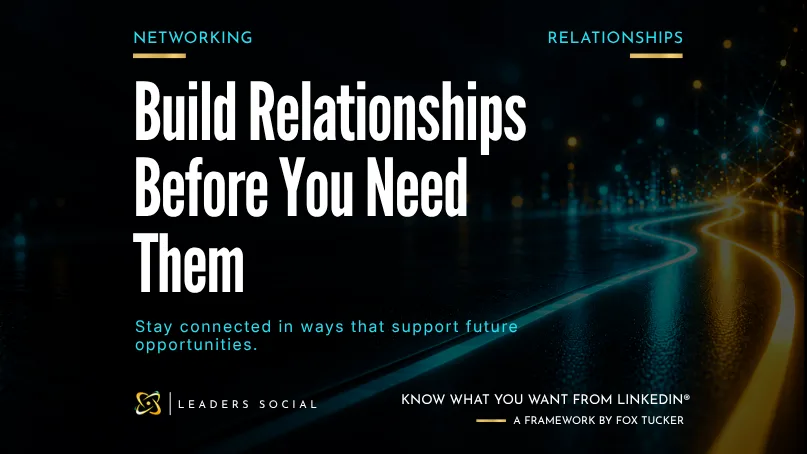




My Why Are You Really on LinkedIn®? framework is based around the simple idea: LinkedIn® becomes much easier to use when you understand what you actually need it to do for you.

More

My framework separates those reasons into two broad groups.

Transactional reasons: Connected to outcomes you want to achieve – across your career, commercial opportunities, promotion and demand, or the management of a brand or channel.

Intangible motivations: Things you build over time – your reputation, relationships, knowledge and growth, and contribution to others.

They are different, but they rarely operate in isolation.

What networking on LinkedIn® means

Networking on LinkedIn® can be valuable even when you do not have an immediate job, sales or business need.

The aim is to build and maintain professional relationships that create future security, information and access. That means staying connected with past colleagues, clients, recruiters, peers and people across your industry before you need something from them.

Used consistently, LinkedIn® can give you a stronger professional safety net and make future opportunities easier to reach.

How to use this page

Use this page to see what this LinkedIn® motivation can look like in practice, where to focus your activity, who to connect with, and how content and relationships can support it.

You do not need to use every section as a checklist. Start with what you are trying to achieve, then focus on the areas most useful to you.

The path from connection to future opportunity

Step 1: Visibility

Stay present in the professional circles that matter to you

Step 2: Familiarity

People continue to recognise your work and interests

Step 3: Connection

Useful exchanges keep relationships alive

Step 4: Security

Your network becomes easier to activate when circumstances change

Networking for future security works before you need anything. The value comes from maintaining enough relevant relationships that opportunities, information and introductions can move through your network naturally later. If you only become active when you need a job, client or favour, the network has had no time to build strength.

My Why Are You Really on LinkedIn®? framework is based around the simple idea: LinkedIn® becomes much easier to use when you understand what you actually need it to do for you.

More

My framework separates those reasons into two broad groups.

Transactional reasons: Connected to outcomes you want to achieve – across your career, commercial opportunities, promotion and demand, or the management of a brand or channel.

Intangible motivations: Things you build over time – your reputation, relationships, knowledge and growth, and contribution to others.

They are different, but they rarely operate in isolation.

Get a clearer view of your LinkedIn® priorities

Take my free 2 – 3 minute assessment to identify your current primary goal and the motivations supporting it.

What networking for future security might look like for you

You want future career security

You are building relationships now so you are not starting from zero if your situation changes.

You value professional relationships

You want to stay connected with people you respect across your industry and career.

You want broader access

You want more routes into information, people and opportunities beyond your immediate circle.

You want to stay professionally visible

You want your network to remember what you do even when you are not actively looking for anything.

How to use LinkedIn® for networking

Keep your profile current

Make it easy for people to understand your role, experience and professional direction.

Stay in touch

Comment, reply and occasionally reconnect with people you already know.

Add relevant people

Build connections across your industry, adjacent sectors and useful professional communities.

Stay visible naturally

Share useful updates, observations or work that helps your network remember what you know.

Reconnect before you need something

Maintain relationships with past colleagues, clients and recruiters without waiting for urgency.

Treat networking as relationship maintenance rather than connection collecting. Stay visible enough that people remember what you do, notice changes in other people’s careers and create occasional reasons to reconnect. Small, genuine interactions spread over time are more useful than bursts of activity driven by immediate need.

Profile priorities

Your profile should make it easy for people in your wider professional network to understand what you do, where your experience sits and the kinds of conversations or opportunities that may be relevant to you.
Keep your direction clear

Your profile should make your current role, experience and interests easy to understand.

Give people useful proof

Show enough evidence of your work that old and new contacts can place you professionally.

Stay discoverable

Use the language people in your field are likely to recognise when they encounter or search for you.

How your content can support networking

Content helps you stay visible to people you already know and gives new contacts useful reasons to understand your interests, experience and professional direction.
Share useful professional updates

Give your network occasional reasons to understand what you are working on or learning.

Join relevant conversations

Thoughtful comments can maintain visibility without requiring frequent original posts.

Show continuing relevance

Use content to demonstrate that your knowledge and interests are current.

Do not post only when you need help

A sudden burst of visibility during a job search or crisis can feel purely transactional.

Avoid irrelevant visibility

Being seen matters less than being remembered for something professionally useful.

Content can keep your professional identity visible between direct conversations. Share material that gives your network a reason to remember what you know, what you are working on and where your interests are heading. You do not need to publish constantly; useful periodic signals can be enough to keep relationships warm.

How to build the right relationships

Build a broad but relevant network, then keep the relationships alive through useful interaction rather than waiting until you need help.
Reconnect with history

Past colleagues, clients and professional contacts already have a reason to know you.

Engage without an ask

Keep relationships alive through useful interaction rather than constant requests.

Broaden deliberately

Add people from adjacent roles, sectors and communities rather than cloning your existing network.

Follow through

When somebody helps, introduces or advises you, close the loop and maintain the relationship.

Keep valuable relationships alive before there is a transaction attached to them. Congratulate people, respond to meaningful updates, make introductions and occasionally restart dormant conversations. The strongest future-security network is one where contact does not feel unusual when a real need eventually appears.

Common networking mistakes

Your LinkedIn® activity becomes less useful when it is unfocused, performative or disconnected from the reason you are using the platform.

Only networking when you need something

Relationships are harder to activate when you have been invisible for years.

Collecting connections without maintaining them

A large network has limited value when very few people recognise you.

Keeping the network too narrow

Only connecting with close peers can limit access to new industries, roles and information.

Treating every interaction as an opportunity

Networking works better when not every conversation is turned into an immediate ask.

The main mistake is treating networking as something to switch on only when you need an outcome. Another is measuring success by connection count rather than relationship strength and relevance. Thousands of weak connections are less useful than a network where a reasonable number of people actually know who you are and would respond.

Signs your network is becoming more useful

Look for signs that your network is becoming easier to activate, more relevant to your professional direction and more willing to exchange information, introductions and opportunities.
People remember what you do

Contacts can place your experience and professional interests without a long reintroduction.

Conversations restart easily

You can reconnect with past contacts without the exchange feeling cold.

Useful introductions happen

People begin connecting you with others, information or opportunities that fit.

Your network feels broader and stronger

You have credible relationships across more than one employer, team or immediate circle.

Your network is working when opportunities and information arrive without a cold start. Former colleagues reconnect, people introduce you to others, recruiters or clients remember you at the right moment and you can reach relevant people through warm routes. Those are signs that the network has retained real social capital.

Networking and collaboration can start with the same relationships, but they have different aims.

Networking on LinkedIn®

Build and maintain professional relationships that may create future value.

  • Builds long-term professional security
  • Can remain informal and open-ended
  • Maintains broad relationship value
  • Does not require an immediate project
Collaboration Opportunities on LinkedIn®

Develop a specific partnership, joint project or shared opportunity.

  • Centres on a shared activity or goal
  • Needs clearer mutual value
  • Usually becomes more specific
  • Requires active coordination

Where they overlap: Trust, relevance and complementary professional relationships matter to each.

Key difference: Networking can remain open-ended. Collaboration becomes more concrete when two or more people decide to do something together.

Introduction to Networking on LinkedIn®

Not everyone on LinkedIn® is actively job hunting or growing a business – some are simply networking to build future security. It’s about creating a safety net of connections, ensuring that if you ever need a new opportunity, you’ll have a strong network to tap into. This type of networking isn’t urgent but is incredibly valuable for long-term career stability.

Framework: Networking for Future Security sits within Relationships in the Why Are You Really on LinkedIn®? framework.

Networking for future security means staying engaged with your connections, maintaining relationships, and continuing to build your professional network even when you don’t have an immediate need.


Basic Action Points (Vitals):

  • Optimize your LinkedIn® profile to reflect your current role and long-term career goals
  • Regularly engage with your network by commenting, liking, and sharing posts
  • Build a network of professionals across different industries to create a diverse safety net
  • Use relevant keywords to ensure your profile is discoverable when opportunities arise
  • Stay visible by posting content or engaging with others, even if you’re not currently looking for new roles

Specific Action Points for Networking for Future Security:

  • Attend LinkedIn® events or webinars to stay connected with your industry and build new relationships
  • Follow up with past colleagues or clients to maintain relationships
  • Join industry-specific groups to stay engaged with relevant professionals
  • Share updates or insights to keep your network aware of your career progression
  • Connect with recruiters and hiring managers even when you’re not actively job hunting
How To Use This LinkedIn® Series?

[ls_why_fit]

LinkedIn® can be a huge a time-suck. It’s so much easier and more rewarding when you know why you’re using LinkedIn®. This series starts with Why Are You Really On LinkedIn®? and helps you drill down through to your Transactional Reasons and/or the Intanglible Motivators that drive you and your activities.

When you know your Why? LinkedIn® becomes much easier because you can just focus on the What To Do, be aware of the What Not To Do., and cut the time-suck.

By understanding why you’re really here, you’ll be able to use LinkedIn® more effectively and strategically – whether for immediate outcomes or long-term success.

Why am I on LinkedIn
Transactional LinkedIn
Intangible LinkedIn


.

Get a clearer view of your LinkedIn® priorities

Take my free 2 – 3 minute assessment to identify your current primary goal and the motivations supporting it.