




Using LinkedIn® to Promote Products or Services

Showcase your products and services on LinkedIn® and connect with decision-makers who value real solutions

A Framework by Fox Tucker

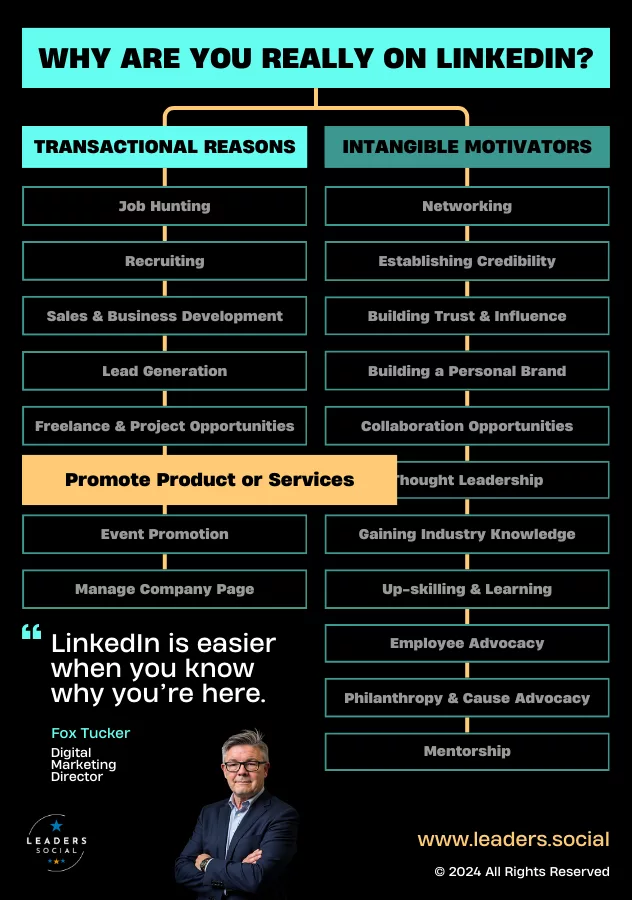
My Why Are You Really on LinkedIn®? framework is based around the simple idea: LinkedIn® becomes much easier to use when you understand what you actually need it to do for you.

More

My framework separates those reasons into two broad groups.

Transactional reasons: Connected to outcomes you want to achieve – across your career, commercial opportunities, promotion and demand, or the management of a brand or channel.

Intangible motivations: Things you build over time – your reputation, relationships, knowledge and growth, and contribution to others.

They are different, but they rarely operate in isolation.

What promoting products or services on LinkedIn® means

Promoting products or services on LinkedIn® means helping the right people understand what you offer, why it matters and where it fits their needs.

Promotion works best when it gives buyers useful reasons to pay attention. That can include education, proof, customer outcomes, product expertise and relevant discussion around the problem being solved.

Used well, LinkedIn® can support demand without turning every post into an advert.

How to use this page

This page shows what lead generation on LinkedIn® involves, where to focus your activity, who to connect with, and how your content and relationships can support it.

You do not need to use every section as a checklist. Start with what you are trying to achieve, then focus on the areas most useful to you.

The path from awareness to demand

Step 1: Awareness

The right audience notices the offer

Step 2: Relevance

They recognise a problem or need the offer addresses

Step 3: Proof

Evidence gives them confidence to explore further

Step 4: Action

Interest turns into an enquiry, demo, visit or conversation

Promotion works best when buyers can move through a clear sequence: notice the offer, recognise its relevance, see enough proof to believe the claims and then understand what to do next. If awareness is high but action is weak, the missing piece is often relevance or evidence rather than more reach.

My Why Are You Really on LinkedIn®? framework is based around the simple idea: LinkedIn® becomes much easier to use when you understand what you actually need it to do for you.

More

My framework separates those reasons into two broad groups.

Transactional reasons: Connected to outcomes you want to achieve – across your career, commercial opportunities, promotion and demand, or the management of a brand or channel.

Intangible motivations: Things you build over time – your reputation, relationships, knowledge and growth, and contribution to others.

They are different, but they rarely operate in isolation.

Get a clearer view of your LinkedIn® priorities

Take my free 2 – 3 minute assessment to identify your current primary goal and the motivations supporting it.

What product or service promotion might look like for you

You have a defined buyer audience

You know who the offer is for and the problems it is designed to solve.

You need to explain value

The offer benefits from education, examples or proof rather than a simple advert.

You need stronger credibility

Buyers need evidence before they are ready to enquire or take a next step.

You want more demand

You want LinkedIn® activity to contribute to enquiries, demos, visits or sales conversations.

How to use LinkedIn® to promote products or services

Define the buyer

Be specific about who the promotion is intended to reach.

Explain the problem and value

Help buyers understand why the offer matters before asking them to act.

Use proof

Support claims with customers, outcomes, demonstrations or evidence.

Engage around interest

Use comments and questions to identify where genuine interest exists.

Make the next step clear

Give interested people an appropriate route to enquire, visit, book or talk.

Treat each activity as part of the buyer journey. Content should help people understand the problem, proof should reduce uncertainty and engagement should reveal where real interest exists. Promotion becomes much stronger when every post, comment and call to action has a clear job rather than simply increasing exposure.

Profile priorities

Your profile should make clear who you help, what problems you solve and why somebody should start a conversation with you.

Connect your role to the offer

Make it clear why you are credible to talk about the product or service.

Show relevant evidence

Use customer outcomes, experience and proof that support the claims being made.

Make the value proposition consistent

Your profile should reinforce the same problems, buyers and value the campaign is built around.

How your content can support product or service promotion

Content can create demand by helping buyers understand the problem, the value of solving it and the evidence behind your offer.
Educate before promoting

Use useful material that helps buyers understand the issue your offer addresses.

Show proof and outcomes

Customer stories, demonstrations and evidence make promotional claims stronger.

Answer buying questions

Create material around the practical concerns buyers have before they act.

Avoid repetitive adverts

A feed dominated by promotional messages gives people little reason to keep paying attention.

Do not hide the offer completely

Useful content should still make the commercial relevance clear when a product or service genuinely helps.

Product and service content should make the offer easier to understand and easier to trust. Lead with buyer problems, practical outcomes, demonstrations, customer evidence and the questions people ask before they buy. The strongest promotional content gives people useful information even before they are ready to take the next step.

How to build the right relationships

Build relationships with buyers, customers, partners, advocates and people whose trust can help the offer reach the right market.
Engage around the buyer problem

Start with what the audience cares about rather than opening with product features.

Use customer voices

Credible customer evidence can carry more weight than brand claims alone.

Notice signs of interest

Questions, repeat engagement and profile activity can indicate that somebody wants to know more.

Move interested people appropriately

Use a demo, call, landing page or other next step that matches the buying stage.

Commercial relationships are strongest when the offer enters a conversation at the right time. Engage around the buyer problem first, notice questions and repeat interest, then make the product or service relevant to that need. A good relationship makes promotion feel useful rather than imposed.

Common product or service promotion mistakes

Lead generation becomes less effective when activity prioritises volume and immediate pitching over relevance and trust.

Posting adverts instead of value

Repeated product messages quickly become easy to ignore.

Talking about features without buyer relevance

Features matter only when the audience understands what they improve or solve.

Making unsupported claims

Strong promotional language without evidence can weaken trust.

Using one message for every buyer

Different roles and buying stages often need different reasons to care.

The biggest mistake is making the product the centre of every message. Buyers care first about the problem, outcome and evidence. Repetitive adverts, feature lists without relevance and unsupported claims may create visibility but give people little reason to trust or act.

Signs your promotion is gaining traction

Look for signs that the right buyers are paying attention, asking better questions and moving towards a clear commercial next step.
Relevant engagement increases

People from the intended market interact with product, service and problem-led content.

Buying questions appear

Comments and messages become more specific about fit, use, price, timing or implementation.

Traffic and enquiries improve

More interested people take the next step to visit, enquire, book or talk.

Sales conversations arrive warmer

Prospects already understand more about the offer before speaking to someone.

Look beyond impressions. Better signals are relevant people engaging with the offer, more specific buying questions, stronger traffic to product or service pages and warmer enquiries where prospects already understand the value. Those behaviours show that promotion is creating demand rather than just attention.

Product or service promotion and lead generation often work together, but they are not the same job.

Using LinkedIn® to Promote Products or Services

Create awareness and demand around a specific offer.

  • Centres on a product or service
  • Builds awareness and demand
  • Uses education and proof
  • Can support campaigns at scale
Lead Generation on LinkedIn®

Create qualified opportunities and business conversations.

  • Centres on prospects and opportunities
  • Builds one-to-one commercial conversations
  • Uses targeting and relationship signals
  • Feeds a pipeline

Where they overlap: Relevant audiences, useful content, trust and proof matter to each.

Key difference: Promotion makes the offer easier to understand and want. Lead generation turns relevant interest into identifiable opportunities.

Introduction to Promoting Products or Services on LinkedIn®

Promoting products or services on LinkedIn® is about showing value, building trust, and creating connections with the right audience. Unlike other platforms, LinkedIn® allows you to position your offerings in a professional context where decision-makers are actively looking for solutions.

Framework: Promoting Products or Services sits within Promotion & Demand in the Why Are You Really on LinkedIn®? framework.

Whether you’re launching a new product or showcasing existing services, LinkedIn® provides tools to amplify your reach and generate meaningful engagement.


Basic Action Points (Vitals):

  • Optimize your LinkedIn® profile to clearly communicate your expertise and how your products or services solve specific problems.
  • Post consistently about your offerings, focusing on value rather than direct selling.
  • Use visuals like videos, infographics, or product demonstrations to make your posts stand out.
  • Engage with comments and messages to build relationships and answer questions about your offerings.
  • Include strategic keywords related to your product or service to improve discoverability.

Specific Action Points for Promoting Products or Services:

  • Write posts highlighting key features and benefits of your products or services, tailored to the needs of your audience.
  • Share case studies or testimonials that demonstrate the impact of your offerings.
  • Use LinkedIn®’s Showcase Pages to create dedicated spaces for different products or services.
  • Experiment with LinkedIn® Ads to promote your content directly to decision-makers in your industry.
  • Host LinkedIn® Live sessions or webinars to demonstrate your offerings and engage directly with your audience.

Advanced Tips for Promoting Products or Services:

  • Leverage LinkedIn® Analytics to track which posts resonate most with your audience and adjust your strategy accordingly.
  • Use LinkedIn®’s Event feature to create product launch events or informational sessions and invite your network.
  • Incorporate lead magnets—such as free trials, downloadable resources, or exclusive discounts—in your posts to encourage conversions.
  • Partner with influencers or thought leaders in your industry to amplify your message.
  • Create and manage LinkedIn® ad campaigns using advanced targeting options to reach specific demographics or roles.

Why This Works:

LinkedIn® connects you with decision-makers and professionals who value expertise and insight. By positioning your products and services as solutions to real challenges, you’ll attract attention, build trust, and drive results.
How To Use This LinkedIn® Series?

[ls_why_fit]

LinkedIn® can be a huge a time-suck. It’s so much easier and more rewarding when you know why you’re using LinkedIn®. This series starts with Why Are You Really On LinkedIn®? and helps you drill down through to your Transactional Reasons and/or the Intanglible Motivators that drive you and your activities.

When you know your Why? LinkedIn® becomes much easier because you can just focus on the What To Do, be aware of the What Not To Do., and cut the time-suck.

By understanding why you’re really here, you’ll be able to use LinkedIn® more effectively and strategically – whether for immediate outcomes or long-term success.

Why am I on LinkedIn
Transactional LinkedIn
Intangible LinkedIn


.

Get a clearer view of your LinkedIn® priorities

Take my free 2 – 3 minute assessment to identify your current primary goal and the motivations supporting it.