
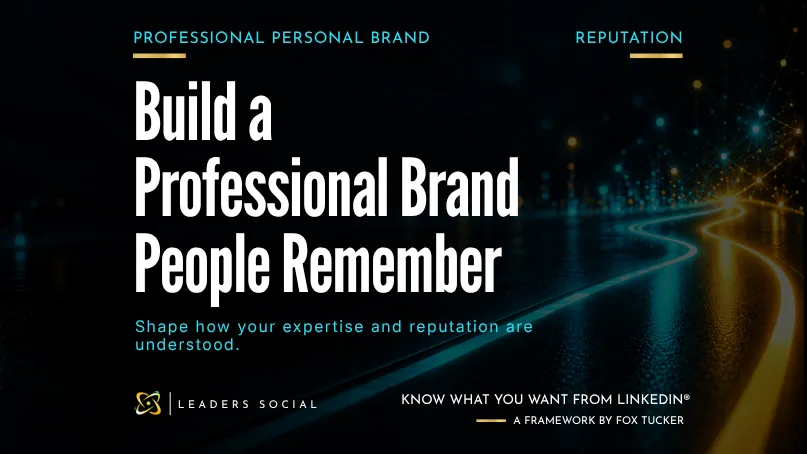




Building a Professional Personal Brand on LinkedIn®

A Framework by Fox Tucker

My Why Are You Really on LinkedIn®? framework is based around the simple idea: LinkedIn® becomes much easier to use when you understand what you actually need it to do for you.

More

My framework separates those reasons into two broad groups.

Transactional reasons: Connected to outcomes you want to achieve – across your career, commercial opportunities, promotion and demand, or the management of a brand or channel.

Intangible motivations: Things you build over time – your reputation, relationships, knowledge and growth, and contribution to others.

They are different, but they rarely operate in isolation.

What building a professional personal brand on LinkedIn® means

Building a professional personal brand on LinkedIn® means shaping a clear and memorable professional identity around what you know, how you work and what you want to be associated with.

It is more than visibility. A strong professional personal brand helps people recognise your values, strengths and style across your profile, content and interactions.

Used well, LinkedIn® can make your professional identity easier to understand, remember and trust.

How to use this page

Use this page to see what this LinkedIn® motivation can look like in practice, where to focus your activity, who to connect with, and how content and relationships can support it.

You do not need to use every section as a checklist. Start with what you are trying to achieve, then focus on the areas most useful to you.

The path from identity to recognition

Step 1: Identity

Clarify what you want to be known for

Step 2: Expression

Show that identity consistently through profile and activity

Step 3: Recognition

People begin to remember the same themes and strengths

Step 4: Association

Relevant opportunities increasingly connect with that identity

A professional personal brand forms from repeated signals. Your profile sets expectations, your content shows what you care about and your interactions reveal how you behave. The aim is not to manufacture a persona but to make the most relevant parts of your professional identity easier for other people to recognise and remember.

My Why Are You Really on LinkedIn®? framework is based around the simple idea: LinkedIn® becomes much easier to use when you understand what you actually need it to do for you.

More

My framework separates those reasons into two broad groups.

Transactional reasons: Connected to outcomes you want to achieve – across your career, commercial opportunities, promotion and demand, or the management of a brand or channel.

Intangible motivations: Things you build over time – your reputation, relationships, knowledge and growth, and contribution to others.

They are different, but they rarely operate in isolation.

How to use LinkedIn® is easier when you know why you’re using it.

Take my free 2–3 minute assessment to find your focus and get a personalised 30-day action plan.

What building a professional personal brand might look like for you

You want a clearer professional identity

You want people to understand what makes your work, expertise or approach distinctive.

You want to be memorable

You want recognition that goes beyond a job title or employer name.

You want your reputation to feel authentic

You want your public professional presence to match how you actually work and think.

You want opportunities that fit who you are

You want the right people to associate you with the work and values you want more of.

How to use LinkedIn® to build your professional personal brand

Clarify your positioning

Make the expertise, values and direction behind your professional identity easy to understand.

Use a recognisable voice

Share material that reflects how you genuinely think and communicate.

Choose your associations carefully

Engage with subjects and communities that fit the professional identity you want to strengthen.

Behave consistently

Comments and conversations should feel like the same person people meet on your profile.

Use evidence

Let real work, outcomes and recommendations support the identity you present.

Prioritise consistency over constant reinvention. Decide which subjects, strengths and professional qualities you want people to associate with you, then make sure your profile, content and participation keep reinforcing them. You can still be varied without becoming difficult to place.

Profile priorities

Your profile is one of the clearest expressions of your professional personal brand. It should make your values, expertise, strengths and direction feel coherent rather than assembled from generic career language.
Make the identity coherent

Headline, About, experience and featured material should reinforce the same professional direction.

Use proof rather than adjectives

Show the work and outcomes behind the qualities you want people to associate with you.

Let personality support professionalism

Show enough of your voice and values to be recognisable without losing professional relevance.

How your content can support your professional personal brand

Content gives people repeated evidence of your voice, interests, expertise and values, helping the professional identity around you become more recognisable.
Repeat meaningful themes

Consistent subject areas help people remember what you are associated with.

Use your own voice

Distinctive language and examples make your professional identity easier to recognise.

Share experiences that reveal values

Stories and lessons can show how you work and what matters to you.

Avoid copying somebody else’s brand

Borrowed tone and positioning make it harder to build a recognisable identity of your own.

Do not overshare without professional relevance

Personal material should support the identity you want people to understand.

Your content is one of the clearest ways to make a professional brand distinctive. Use your own experience, language, examples and judgement rather than copying the style of whoever is currently performing well. Familiar themes are useful; repetition becomes valuable when each contribution adds something new.

How to build the right relationships

Your professional personal brand is strengthened by the people and communities you engage with, especially where there is genuine alignment in values, expertise or interests.
Engage where there is real alignment

Build relationships with people whose work, standards or interests genuinely connect with yours.

Be recognisably yourself

Consistency between public interaction and your profile strengthens trust.

Collaborate selectively

Joint work can strengthen your professional identity when the association makes sense.

Let relationships add proof

Recommendations and credible professional connections can reinforce how others see you.

Your brand is partly what other people experience when they interact with you. Be recognisably the same person in comments, messages and meetings that your profile suggests you are. Strong professional brands are reinforced by relationships because other people can describe them consistently.

Common professional personal brand mistakes

Your LinkedIn® activity becomes less useful when it is unfocused, performative or disconnected from the reason you are using the platform.

Trying to appeal to everybody

A vague identity is difficult to remember and hard to associate with specific value.

Using generic personal-brand language

Words like passionate or innovative mean little without visible evidence.

Changing tone and positioning constantly

Recognition becomes harder when the signals around you keep shifting.

Making the brand more important than the work

Professional identity should be supported by substance, not replace it.

Personal branding becomes weak when it turns into performance. Constantly changing themes, copying other creators, forcing personal stories into every post or trying to appear expert on too many subjects can make you less memorable. Coherence matters more than relentless visibility.

Signs your professional personal brand is becoming clearer

Look for signs that people increasingly describe you in the way you intend, remember what you stand for and associate you with the right subjects or strengths.
People describe you consistently

Others increasingly use the same themes or strengths when talking about your work.

Your profile and content feel connected

The identity presented in different parts of LinkedIn® reinforces itself.

Relevant people remember you

Contacts associate you with particular expertise, values or ways of working.

Opportunities fit better

More enquiries, introductions or invitations align with what you actually want to be known for.

A strong personal brand reduces the amount of explanation you need to do. People begin introducing you with the qualities or subjects you want to be known for, relevant opportunities arrive with less prompting and new contacts already have an accurate sense of who you are before you speak.

A professional personal brand and credibility reinforce each other, but they solve different problems.

Building a Professional Personal Brand on LinkedIn®

Shape a recognisable professional identity around your expertise, values and voice.

  • Centres on identity and recognition
  • Includes voice and values
  • Creates memorable associations
  • Helps differentiate you
Building Credibility on LinkedIn®

Demonstrate that your knowledge and professional judgement are credible.

  • Centres on expertise and evidence
  • Builds professional authority
  • Shows knowledge in use
  • Reduces doubt

Where they overlap: Evidence, consistency and useful contribution strengthen each.

Key difference: Your professional personal brand answers how people remember and describe you. Credibility answers whether they believe the expertise behind that identity.

Introduction to Building a Professional Personal Brand on LinkedIn®

Building a professional personal brand on LinkedIn® is about creating a unique persona that resonates with your audience. It’s more than just being visible – it’s about being memorable and trustworthy. A strong personal brand reflects your values, skills, and passions, helping you stand out in a crowded marketplace.

Framework: Building a Professional Personal Brand sits within Reputation in the Why Are You Really on LinkedIn®? framework.

People who focus on building a professional personal brand are intentional about the image they create, carefully curating what they post and how they engage with others.

The key to personal branding is authenticity. It’s as much about showing who you are, not just what you do.


Basic Action Points (Vitals):

  • Optimize your LinkedIn® profile to clearly reflect your personal brand, including your values and skills
  • Engage with others in a way that reflects your tone and messaging
  • Build a network of professionals who align with your professional personal brand
  • Use relevant keywords to ensure your profile matches the brand image you’re projecting
  • Regularly post content that reflects your professional personal brand and what you stand for

Specific Action Points for Building a Professional Personal Brand:

  • Share stories or insights that highlight your unique skills and values
  • Post content that aligns with your professional personal brand, whether it’s thought leadership, tips, or personal experiences
  • Collaborate with others whose professional personal brands complement yours to build mutual credibility
  • Use LinkedIn®’s publishing platform to create long-form articles that deepen your brand message
  • Encourage endorsements or recommendations that reinforce your professional personal brand
How To Use This LinkedIn® Series?

[ls_why_fit]

LinkedIn® can be a huge a time-suck. It’s so much easier and more rewarding when you know why you’re using LinkedIn®. This series starts with Why Are You Really On LinkedIn®? and helps you drill down through to your Transactional Reasons and/or the Intanglible Motivators that drive you and your activities.

When you know your Why? LinkedIn® becomes much easier because you can just focus on the What To Do, be aware of the What Not To Do., and cut the time-suck.

By understanding why you’re really here, you’ll be able to use LinkedIn® more effectively and strategically – whether for immediate outcomes or long-term success.

Why am I on LinkedIn
Transactional LinkedIn
Intangible LinkedIn


.

How to use LinkedIn® is easier when you know why you’re using it.

Take my free 2–3 minute assessment to find your focus and get a personalised 30-day action plan.