

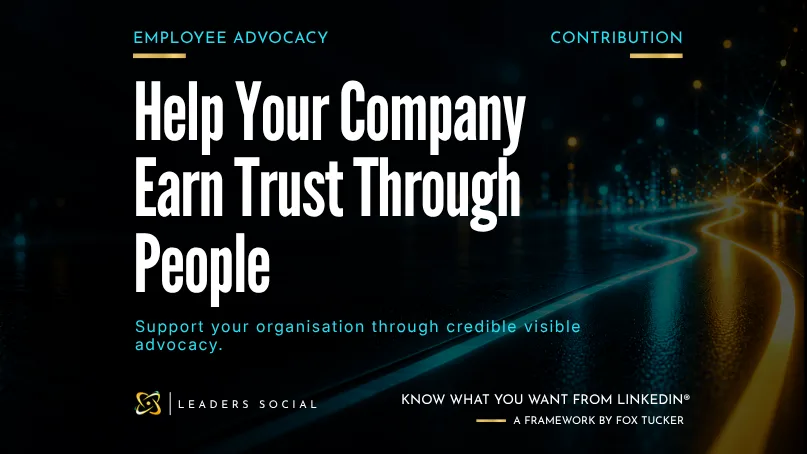




Employee Advocacy on LinkedIn®

Employee advocacy on LinkedIn® is about actively supporting your company’s mission, values, and goals.

A Framework by Fox Tucker

My Why Are You Really on LinkedIn®? framework is based around the simple idea: LinkedIn® becomes much easier to use when you understand what you actually need it to do for you.

More

My framework separates those reasons into two broad groups.

Transactional reasons: Connected to outcomes you want to achieve – across your career, commercial opportunities, promotion and demand, or the management of a brand or channel.

Intangible motivations: Things you build over time – your reputation, relationships, knowledge and growth, and contribution to others.

They are different, but they rarely operate in isolation.

What employee advocacy on LinkedIn® means

Employee advocacy on LinkedIn® means employees choosing to share useful company-related ideas, stories and expertise through their own professional presence.

The strongest advocacy does not look like copied corporate promotion. It works when employees add their own experience and judgement to themes that genuinely connect with their role.

Used well, LinkedIn® can help employees strengthen their own professional reputation while extending the organisation’s visibility and credibility through trusted individual voices.

How to use this page

Use this page to see what this LinkedIn® motivation can look like in practice, where to focus your activity, who to connect with, and how content and relationships can support it.

You do not need to use every section as a checklist. Start with what you are trying to achieve, then focus on the areas most useful to you.

The path from employee voice to organisational reach

Step 1: Identity

Employees have credible professional profiles of their own

Step 2: Contribution

They add useful personal experience to relevant company themes

Step 3: Reach

Trusted employee networks extend company visibility

Step 4: Advocacy

Individual voices strengthen how the organisation is understood

Employee advocacy works when personal credibility and company visibility reinforce each other. The strongest advocacy feels like a real employee choosing to share something useful or meaningful, not a corporate message copied into a personal feed. Your own reputation is part of what gives the company message weight.

My Why Are You Really on LinkedIn®? framework is based around the simple idea: LinkedIn® becomes much easier to use when you understand what you actually need it to do for you.

More

My framework separates those reasons into two broad groups.

Transactional reasons: Connected to outcomes you want to achieve – across your career, commercial opportunities, promotion and demand, or the management of a brand or channel.

Intangible motivations: Things you build over time – your reputation, relationships, knowledge and growth, and contribution to others.

They are different, but they rarely operate in isolation.

How to use LinkedIn® is easier when you know why you’re using it.

Take my free 2–3 minute assessment to find your focus and get a personalised 30-day action plan.

What employee advocacy might look like for you

You want company stories to feel more human

You see value in employees adding experience and voice to organisational themes.

You want trusted reach beyond the Company Page

Employee networks can expose useful material to audiences the brand may not reach alone.

You want credibility as well as reach

You care about trusted individual voices, not just amplification volume.

You want employees to benefit too

Advocacy should strengthen individual professional reputation as well as the organisation.

How to use LinkedIn® for employee advocacy

Strengthen employee profiles

Make sure participants have credible professional identities before asking them to advocate.

Provide useful source material

Give employees strong stories, research, projects and themes they can genuinely add to.

Encourage personal voice

Let employees explain why something matters to them rather than copying company text.

Set clear guardrails

Make expectations, confidentiality and brand boundaries easy to understand.

Recognise participation

Support employees who contribute well without turning activity into a forced quota.

Choose moments where you can add something personal: why a project mattered, what you learned, what changed for customers or what makes a company achievement worth noticing. Advocacy is stronger when employees contribute their own judgement rather than simply amplifying every company post.

Profile priorities

Your profile should make your own role, expertise and professional identity clear. Advocacy is more credible when the employee has a real voice rather than appearing to be a company distribution channel.
Keep the employee identity first

The profile should represent the person’s career and expertise, not read like a company brochure.

Make employment and expertise clear

People should understand the employee’s role and why their view is relevant.

Show individual contribution

Featured work and activity should include material that reflects the person’s own experience.

How your content can support employee advocacy

Employee content can add human experience, expertise and credibility to company themes that might otherwise feel purely corporate.
Add personal experience

Employee advocacy is strongest when people explain what a company theme means from where they sit.

Share useful company evidence

Projects, research, customer outcomes and people stories give employees something substantive to discuss.

Let expertise lead

Connect advocacy with subjects employees genuinely know rather than asking everybody to promote everything.

Avoid copy-and-paste advocacy

Identical posts from multiple employees quickly look coordinated and reduce credibility.

Do not make participation feel compulsory

Forced advocacy can damage trust with employees and audiences.

Employee advocacy content should sound like the person posting it. Add experience, explanation or a personal observation so the post gives your network a reason to care. Reposting company copy word for word may increase distribution, but it does little to build trust in the employee sharing it.

How to build the right relationships

Employee advocacy works best when employees, leaders, customers and industry contacts interact naturally around useful company and professional themes.
Respect employee networks

Employees own their professional relationships and should decide how they engage them.

Support, do not script

Provide useful source material and guardrails without removing individual judgement.

Connect leaders and employees

Visible interaction across levels can make company themes feel more credible and human.

Recognise genuine contribution

Acknowledge employees who add useful professional value rather than simply measuring posting volume.

Advocacy works best when relationships already exist. Engage with colleagues, customers and industry contacts as a professional first, then let company stories sit naturally within those relationships. People are more receptive when they know the person sharing the message is not there only to promote the organisation.

Common employee advocacy mistakes

Your LinkedIn® activity becomes less useful when it is unfocused, performative or disconnected from the reason you are using the platform.

Turning employees into distribution channels

Advocacy loses trust when individual voice disappears.

Measuring only reach

Large impression numbers say little about relevance, credibility or employee benefit.

Ignoring employee reputation

Advocacy should help participants build their own professional standing as well.

Using weak company content as the source

Employees cannot rescue material that is not useful or interesting in the first place.

Employee advocacy weakens when participation feels compulsory, repetitive or over-controlled. If every employee shares the same wording at the same time, the activity can look coordinated rather than credible. Give people something worth talking about and enough freedom to make it their own.

Signs employee advocacy is working

Look for signs that employee voices are extending relevant reach, creating credible engagement and strengthening the connection between individual expertise and the organisation.
Employee participation feels natural

People contribute in their own voice without needing constant prompting.

Relevant external audiences engage

Customers, candidates and industry contacts respond to employee-led company themes.

Employee profiles strengthen

Participants build their own credibility and professional visibility.

Company content travels further through people

Useful themes reach networks the official Page would struggle to access alone.

Good advocacy creates value for the employee and the organisation. Look for stronger engagement from relevant external contacts, employees being recognised for useful contributions, company stories travelling beyond the Page itself and more natural conversations with customers, partners or potential hires.

Employee advocacy and Company Page management reinforce each other, but they are different channels.

Employee Advocacy on LinkedIn®

Help employees extend credible company visibility through their own professional activity.

  • Uses employee profiles and networks
  • Depends on personal participation
  • Adds human credibility
  • Can extend trusted reach
LinkedIn® Company Page Management: Core Responsibilities

Manage the organisation’s official LinkedIn® presence and publishing channel.

  • Uses the official company presence
  • Controls company publishing
  • Builds Page followers
  • Supports several business audiences

Where they overlap: Company themes, reputation and useful content can strengthen each.

Key difference: Employee advocacy depends on trusted individual voices. Company Page management uses the organisation’s owned presence.

Introduction to Employee Advocacy on LinkedIn®

Employee advocacy is about being an active supporter of your company’s mission, values, and goals on LinkedIn®. Even if you’re not an admin for the company page, you have a powerful role in shaping how others see your organization. Every time you share, comment, or engage with company content, you’re amplifying its reach, increasing visibility, and helping to build trust.

Framework: Employee Advocacy sits within Contribution in the Why Are You Really on LinkedIn®? framework.

Advocates who are intentional about sharing company updates, success stories, and industry insights make a real impact. Whether you’re sharing a recent project, posting about a team achievement, or reacting to product updates, you’re adding credibility. LinkedIn® users trust recommendations and insights from people they know, so your engagement makes a difference.

Being a strong advocate isn’t just beneficial for the company—it can boost your own professional reputation, too. You’re seen as a committed team player, someone engaged with the company’s mission and dedicated to supporting its success.


Action Points to Maximize Your Employee Advocacy

  • Engage with Company Content: Regularly like, comment on, or share posts from your company’s page to boost their visibility. This engagement increases reach and makes the content more visible to your network.
  • Share Success Stories and Milestones: Post about company wins, product launches, or any recent achievements. Add a few personal words to emphasize why these milestones matter, both to you and to the industry.
  • Highlight Company Values: When your company takes a stand on important issues or invests in a cause, share these updates. You’re reinforcing the values your company stands for and helping others see the bigger picture.
  • Create Original Content: Write a post or article on LinkedIn® sharing your perspective on a company initiative, project, or value. This adds authenticity to your advocacy and gives your network an inside view of what matters to you and your team.
  • Support Product and Service Announcements: When there’s a new product launch or service update, share it with your network, adding a personal perspective on why you’re excited about it or how it can help others.
  • Engage with Leadership Posts: When leaders from your company post on LinkedIn®, amplify their message by engaging with it. This shows that you’re in tune with the leadership vision and helps connect your network to the company’s direction.

Do Not Let One Person Become the Whole Programme

A September 2026 MagicPost study illustrates how easily employee advocacy can become concentrated in one highly visible person. Across its selected corpus of 1,333,072 LinkedIn® posts from 39,729 professionals, one person generated between 70% and 96% of measured advocacy reach at several named companies.

More distributed examples included HubSpot, where the largest contributor accounted for 29% of reach, AWS at 35%, Clay at 38% and Google at 40%. The report also showed how concentration increased after prominent contributors left: Salesforce moved from 29% to 54%, while ColdIQ moved from 63% to 96%.

The exact percentages should be treated cautiously. MagicPost’s sample over-indexes B2B, technology, sales and creator-oriented profiles, and the company sells employee-advocacy software. It is not a census of LinkedIn®.

The strategic risk is still clear. A business with one prolific founder or executive does not necessarily have an employee-advocacy system. If that person leaves, slows down or changes direction, much of the visible reach can disappear with them.

A resilient programme gives several employees distinct areas in which they can contribute from real expertise. The goal is not identical corporate posts from more accounts; it is broader participation in recognisable individual voices.

MagicPost — Employee Advocacy on LinkedIn®: What 1.3M Posts Reveal, Naïlé Titah, 7 September 2026.

Employee advocacy on LinkedIn® helps your company grow, but it also strengthens your own professional network and shows your dedication to your role. It’s a powerful way to connect with others and make an impact, even if you don’t manage the official company page.
How To Use This LinkedIn® Series?

[ls_why_fit]

LinkedIn® can be a huge a time-suck. It’s so much easier and more rewarding when you know why you’re using LinkedIn®. This series starts with Why Are You Really On LinkedIn®? and helps you drill down through to your Transactional Reasons and/or the Intanglible Motivators that drive you and your activities.

When you know your Why? LinkedIn® becomes much easier because you can just focus on the What To Do, be aware of the What Not To Do., and cut the time-suck.

By understanding why you’re really here, you’ll be able to use LinkedIn® more effectively and strategically – whether for immediate outcomes or long-term success.

Why am I on LinkedIn
Transactional LinkedIn
Intangible LinkedIn


.

How to use LinkedIn® is easier when you know why you’re using it.

Take my free 2–3 minute assessment to find your focus and get a personalised 30-day action plan.