





Sales and Business Development on LinkedIn®

LinkedIn® is a powerful tool for sales and business development, but it’s all about building relationships. Find out how to engage with decision-makers and turn connections into customers.

A Framework by Fox Tucker

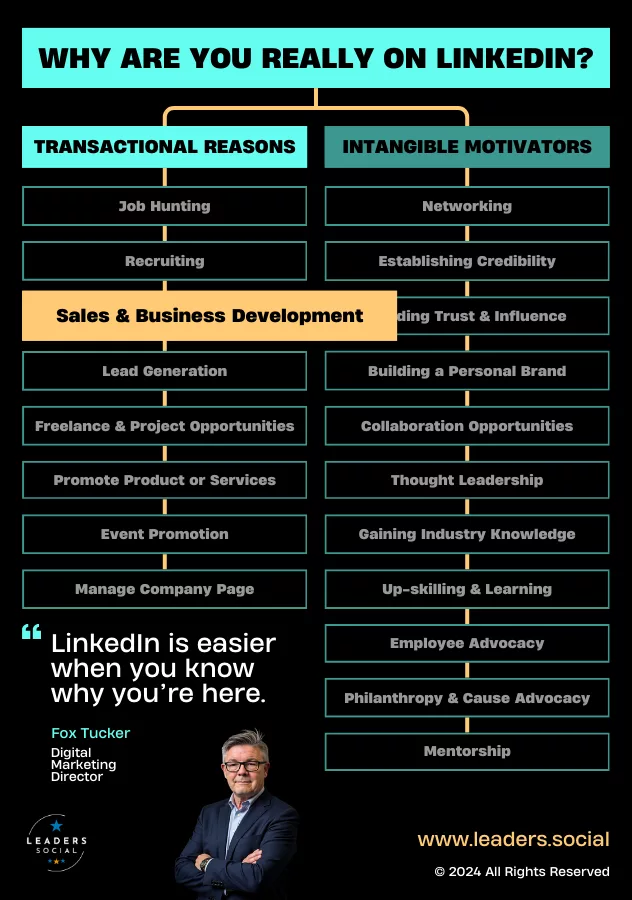
My Why Are You Really on LinkedIn®? framework is based around the simple idea: LinkedIn® becomes much easier to use when you understand what you actually need it to do for you.

More

My framework separates those reasons into two broad groups.

Transactional reasons: Connected to outcomes you want to achieve – across your career, commercial opportunities, promotion and demand, or the management of a brand or channel.

Intangible motivations: Things you build over time – your reputation, relationships, knowledge and growth, and contribution to others.

They are different, but they rarely operate in isolation.

What sales and business development on LinkedIn® means

Sales and business development on LinkedIn® starts where commercial relevance becomes more concrete. You are identifying people and organisations worth developing, understanding their needs and building relationships that can progress into business.

That means paying attention to decision-makers, buying influences, account activity and the problems your offer can genuinely solve.

Used well, LinkedIn® helps you stay close to important accounts, create better commercial conversations and move credible opportunities forward without treating every connection as a sales target.

How to use this page

This page shows what lead generation on LinkedIn® involves, where to focus your activity, who to connect with, and how your content and relationships can support it.

You do not need to use every section as a checklist. Start with what you are trying to achieve, then focus on the areas most useful to you.

The path from commercial relevance to opportunity

Step 1: Target

Identify the right accounts and people

Step 2: Credibility

Give them reasons to take you and your offer seriously

Step 3: Conversation

Start a relevant commercial discussion

Step 4: Opportunity

Move a real need towards the next sales step

Sales development is rarely a straight line from connection to sale. Treat the account and relationship as something to understand before trying to advance it: identify who matters, learn what is changing, establish relevance, uncover a real need and agree an appropriate next step. LinkedIn® is particularly useful between conversations, where visibility and account intelligence help you stay informed without forcing contact.

My Why Are You Really on LinkedIn®? framework is based around the simple idea: LinkedIn® becomes much easier to use when you understand what you actually need it to do for you.

More

My framework separates those reasons into two broad groups.

Transactional reasons: Connected to outcomes you want to achieve – across your career, commercial opportunities, promotion and demand, or the management of a brand or channel.

Intangible motivations: Things you build over time – your reputation, relationships, knowledge and growth, and contribution to others.

They are different, but they rarely operate in isolation.

Get a clearer view of your LinkedIn® priorities

Take my free 2 – 3 minute assessment to identify your current primary goal and the motivations supporting it.

What sales and business development might look like for you

You have named markets or accounts

You know which organisations or buyer groups are commercially important.

You need access to decision-makers

You want to reach people who can influence or approve a purchase.

You want to develop active opportunities

You need conversations that can move into a formal sales process.

You need stronger commercial credibility

You want prospects to recognise your expertise before a direct sales conversation.

How to use LinkedIn® for sales and business development

Prioritise accounts

Focus attention on organisations and people with a genuine commercial fit.

Strengthen credibility

Make your profile and company presence support the value you are taking to market.

Use relevant content

Share ideas and evidence around the problems buyers already care about.

Engage around real signals

Use account activity, role changes and relevant interaction to improve timing.

Move conversations forward

Use personalised outreach when there is a credible reason to talk.

Good sales and business development activity should improve your understanding of an account or help a credible opportunity move forward. Before connecting, commenting or messaging, ask what you know about the person, their organisation and the commercial reason for the interaction. Activity without that relevance quickly becomes generic prospecting.

Profile priorities

Your profile should make clear who you help, what problems you solve and why somebody should start a conversation with you.

Make commercial relevance obvious

Buyers should quickly understand the problems you solve and the markets you know.

Show credible proof

Use outcomes, clients, case studies or evidence that supports your claims.

Support the buyer conversation

Your profile should reinforce the same value and expertise you use in outreach.

How your content can support sales and business development

Content can help buyers recognise your expertise, understand your point of view and become more familiar with you before direct sales activity.
Address buyer priorities

Publish around the issues, risks and decisions that matter to the people you want to reach.

Use evidence

Case studies, outcomes and practical examples make commercial claims easier to believe.

Support active conversations

Use content as a useful follow-up when it genuinely helps a prospect think through a problem.

Avoid constant product pitching

Repeated promotional posts give buyers little reason to pay attention unless they are already in-market.

Do not confuse reach with sales value

Large audiences matter less than the right buyers recognising and trusting you.

For sales and business development, content is less about generating the largest possible audience and more about supporting commercial credibility. Publish material that helps target buyers understand how you think, shows familiarity with their problems and gives existing prospects useful evidence to take into internal conversations. Case studies, customer outcomes and informed observations can reduce uncertainty long before a proposal is discussed.

How to build the right relationships

Develop relationships with buyers, influencers, partners and people connected to the accounts you want to grow.
Research before outreach

Understand the person, account and likely priorities before starting a sales conversation.

Engage around relevance

Use real business signals and useful interaction rather than generic social activity.

Build more than one relationship

Complex sales often involve several people inside the same account.

Know when to move channels

Once a genuine opportunity exists, move to the channel and process that best supports the sale.

Commercial relationships progress when each interaction earns the right to have the next one. Use LinkedIn® to notice changes, understand priorities, respond to relevant activity and stay useful between direct conversations. When a genuine need or opportunity is established, move the discussion to the channel that best suits the sale rather than trying to conduct the entire process in LinkedIn messages.

Common sales and business development mistakes

Lead generation becomes less effective when activity prioritises volume and immediate pitching over relevance and trust.

Pitching before relevance is established

A sales message is easy to ignore when the recipient has no clear reason to care.

Targeting job titles instead of real buyers

A title alone does not prove that somebody owns the problem or buying decision.

Treating every connection as pipeline

Connections only become commercially useful when there is need, fit and timing.

Staying on LinkedIn® too long

Once a genuine sales process exists, the platform should support it rather than constrain it.

Weak LinkedIn® sales activity often treats access as intent. A connection, profile view or content engagement does not mean somebody is ready to buy. Other common failures are depending on one contact inside an account, sending generic follow-ups and pushing for a meeting before a relevant business need is understood.

Signs your sales activity is gaining traction

Look for signs that target accounts are recognising you, engaging with relevant material and moving into more substantive commercial conversations.
Target accounts engage

Relevant buyers and influencers increasingly view, reply to or interact with your activity.

Conversations become commercial

Discussions move from general networking into real needs, priorities and buying questions.

More stakeholders appear

You begin engaging with several people connected to the same account or opportunity.

Opportunities progress

LinkedIn® conversations move into calls, proposals or formal next steps.

Measure movement in real commercial relationships. Useful signs include better access to buying groups, more substantive replies, clearer understanding of account needs, introductions to additional stakeholders and agreed next steps outside LinkedIn®. Likes and connection counts may support visibility, but they are weak measures of sales progress.

Sales and business development and lead generation can support the same commercial goal, but they play different roles.

Sales and Business Development on LinkedIn®

Develop active commercial conversations and move opportunities towards a sale.

  • Focuses on active commercial conversations
  • Works with accounts and buying stakeholders
  • Moves opportunities towards a sale
  • Often follows a defined sales process
Lead Generation on LinkedIn®

Attract interest, build familiarity and create opportunities for future conversations.

  • Builds awareness and trust over time
  • Attracts and engages relevant prospects
  • Creates future conversations
  • Often content and relationship led

Where they overlap: Relevant prospects, trust and good relationships matter to each.

Key difference: Sales and business development takes qualified opportunities further through the sales process. Lead generation creates and develops the initial interest.

Introduction to Sales and Business Development on LinkedIn®

LinkedIn® is a goldmine for sales and business development, offering unparalleled access to decision-makers and potential customers. However, success rarely comes from pitching hard or closing deals immediately – it’s about building trust and forming relationships.

Framework: Sales & Business Development sits within Revenue & Opportunities in the Why Are You Really on LinkedIn®? framework.

Sales and business development require strategic approaches to transform initial interest into meaningful opportunities. While lead generation focuses on attracting prospects, sales and business development turn those prospects into customers by addressing their specific needs and challenges.
Sale and Business Development on LinkedIn

Basic Action Points (Vitals):

These foundational actions apply to anyone using LinkedIn® for sales or business development.

  • Optimize your profile to clearly showcase your role and the solutions you provide. Highlight achievements that demonstrate how you’ve helped others succeed.
  • Engage with content shared by your target audience. Like, comment on, and share their posts to stay visible, focusing on thoughtful, meaningful contributions.
  • Build a strategic network by connecting with decision-makers and influencers in your industry.
  • Use strategic keywords in your headline, summary, and posts to make your profile discoverable.
  • Post value-driven content regularly to highlight the benefits of your products or services and address common challenges your audience faces.

Use ChatGTP To Supercharge Your LinkedIn®:

Explore how ChatGTP can supercharge your LinkedIn® with my 10 ChatGPT Prompts for Sales and Business Development on LinkedIn®.


Specific Action Points for Sales and Business Development:

Take your LinkedIn® strategy further with these targeted actions:

  • Use LinkedIn®’s advanced search tools to identify key decision-makers and personalize your connection requests.
  • Write posts that address common pain points your audience experiences. Use storytelling to demonstrate how you’ve helped others overcome these challenges.
  • Showcase client success stories through testimonials or case studies. Focus on results and share quotes or snippets from satisfied customers.
  • Send personalized messages that focus on starting a conversation, not making a sale. Ask thoughtful questions to understand their challenges and needs.
  • Leverage LinkedIn®’s Sales Navigator to track engagement and prioritize warm leads. Use its features to stay organized and target the right opportunities.

Consider Using LinkedIn® Sales Navigator

For those ready to take their sales strategy to the next level, LinkedIn® Sales Navigator provides advanced features to help you identify opportunities, stay organized, and convert leads into customers:

  • Leverage LinkedIn®’s Sales Navigator
    • Create custom lead lists, track engagement, and prioritize high-value prospects.
    • Set alerts for updates on key decision-makers and companies.
  • Focus on Warm Leads
    • Identify leads engaging with your content and tailor your outreach to their interests.
  • Segment Your Outreach
    • Group prospects into categories based on their industry, location, or level of engagement.
    • Customize messaging for each segment.
  • Track Your Results
    • Regularly review connection requests, message responses, and engagement rates.
    • Use insights to refine your approach.
  • Engage Beyond LinkedIn®
    • Transition established relationships to email, video calls, or other platforms to deepen trust.

Sales & Business Development VS Lead Generation

Both functions are essential, but they operate at different stages of the customer journey. Strong collaboration between these areas ensures seamless progression from prospect to customer.

  • Sales & Business Development: Focuses on building relationships, solving problems, and closing deals.
  • Lead Generation: Focuses on attracting attention and creating opportunities.

Learn how these strategies overlap and when to use each for maximum impact: Lead Generation vs Sales & Business Development : What’s the Difference?
How To Use This LinkedIn® Series?

[ls_why_fit]

LinkedIn® can be a huge a time-suck. It’s so much easier and more rewarding when you know why you’re using LinkedIn®. This series starts with Why Are You Really On LinkedIn®? and helps you drill down through to your Transactional Reasons and/or the Intanglible Motivators that drive you and your activities.

When you know your Why? LinkedIn® becomes much easier because you can just focus on the What To Do, be aware of the What Not To Do., and cut the time-suck.

By understanding why you’re really here, you’ll be able to use LinkedIn® more effectively and strategically – whether for immediate outcomes or long-term success.

Why am I on LinkedIn
Transactional LinkedIn
Intangible LinkedIn


.

Get a clearer view of your LinkedIn® priorities

Take my free 2 – 3 minute assessment to identify your current primary goal and the motivations supporting it.