






Job Hunting on LinkedIn®

If you're using LinkedIn® for job hunting, there's more to it than just sending out applications. Your activity on the platform speaks volumes. Learn how to stand out by engaging with your network and presenting yourself as a top candidate in your industry.

A Framework by Fox Tucker

My Why Are You Really on LinkedIn®? framework is based around the simple idea: LinkedIn® becomes much easier to use when you understand what you actually need it to do for you.

More

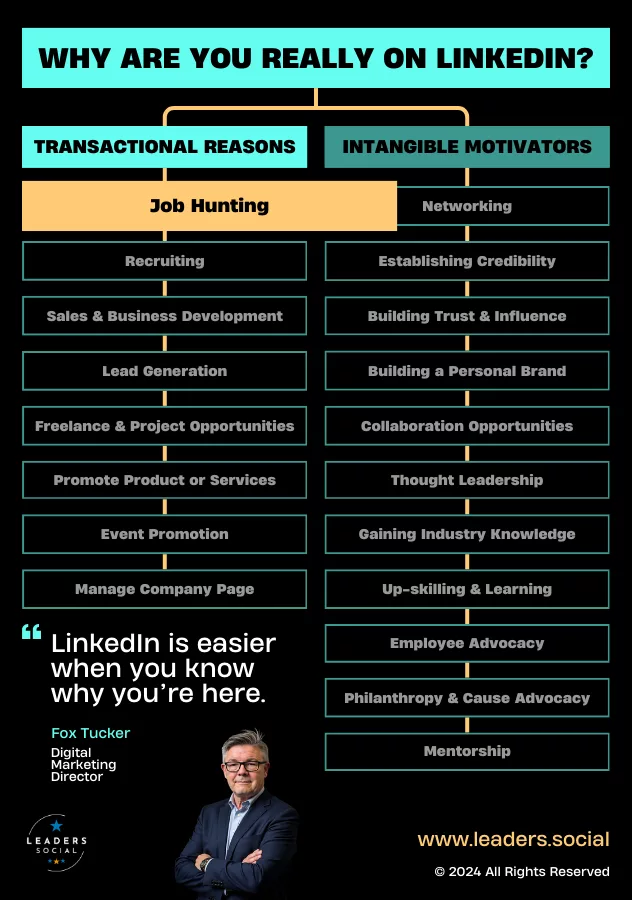
My framework separates those reasons into two broad groups.

Transactional reasons: Connected to outcomes you want to achieve – across your career, commercial opportunities, promotion and demand, or the management of a brand or channel.

Intangible motivations: Things you build over time – your reputation, relationships, knowledge and growth, and contribution to others.

They are different, but they rarely operate in isolation.

What job hunting on LinkedIn® means

Job hunting on LinkedIn® is about more than finding vacancies. Your profile, network and activity can help employers and recruiters understand what you do, what you know and where you could add value.

Treating LinkedIn® only as a job board leaves most of that visibility unused. Relevant connections, useful participation and a profile aligned with the roles you want can make you easier to discover before you ever submit an application.

Used consistently, LinkedIn® can help you become a stronger candidate in the market, not just another applicant in a queue.

How to use this page

This page shows what lead generation on LinkedIn® involves, where to focus your activity, who to connect with, and how your content and relationships can support it.

You do not need to use every section as a checklist. Start with what you are trying to achieve, then focus on the areas most useful to you.

The path from visibility to opportunity

Step 1: Positioning

Your profile makes the role and value you offer clear

Step 2: Visibility

Recruiters and employers start to notice you

Step 3: Conversation

Relevant people engage, reply or introduce you

Step 4: Opportunity

A suitable role or interview becomes possible

Job hunting on LinkedIn® works best when your profile, activity and network all point towards the kind of opportunity you want. Applications are only one route; visibility, relationships and evidence of expertise can create opportunities before a formal application is submitted.

My Why Are You Really on LinkedIn®? framework is based around the simple idea: LinkedIn® becomes much easier to use when you understand what you actually need it to do for you.

More

My framework separates those reasons into two broad groups.

Transactional reasons: Connected to outcomes you want to achieve – across your career, commercial opportunities, promotion and demand, or the management of a brand or channel.

Intangible motivations: Things you build over time – your reputation, relationships, knowledge and growth, and contribution to others.

They are different, but they rarely operate in isolation.

Get a clearer view of your LinkedIn® priorities

Take my free 2 – 3 minute assessment to identify your current primary goal and the motivations supporting it.

What job hunting might look like for you

You have specific roles in mind

You know the kind of work, seniority or sector you want to move towards.

You want to be easier to discover

You want recruiters and hiring managers to find you for relevant opportunities.

You want better access to employers

You want to build relationships inside organisations where you could work.

You want stronger opportunities

You are looking for roles that fit your skills and direction rather than applying everywhere.

How to use LinkedIn® for job hunting

Align your profile

Make your target roles, experience and useful evidence easy to understand.

Build a relevant network

Connect with recruiters, hiring managers, peers and people inside target organisations.

Show what you know

Use posts and comments to demonstrate expertise and current industry awareness.

Use search deliberately

Follow target organisations, save searches and monitor suitable roles.

Start useful conversations

Build familiarity before asking about roles or referrals.

Be deliberate about the roles, sectors and employers you are targeting. Align your profile, follow relevant companies, engage with people in the field and use search alerts so your activity steadily improves your chances of being discovered or referred.

Profile priorities

Your profile should make clear who you help, what problems you solve and why somebody should start a conversation with you.

Match the roles you want

Use your headline, About section and experience to make your target direction obvious.

Show credible evidence

Use achievements, outcomes and relevant examples rather than vague claims.

Use the right language

Include the terms recruiters and employers are likely to use when searching for people like you.

How your content can support job hunting

Content can help employers and recruiters see how you think, what you know and how closely your experience fits the work you want.
Show useful expertise

Comment on and publish around the work, problems and changes relevant to your target roles.

Demonstrate current knowledge

Show that you understand what is happening in your sector rather than relying only on past experience.

Make your value visible

Share examples, lessons and observations that reinforce what you could bring to an employer.

Do not turn every post into a job request

Repeatedly announcing that you are looking can make your activity feel one-dimensional.

Avoid broad, unrelated content

Attention is less useful when it does not reinforce the work you want to be known for.

Content can support a job search by showing how you think, what you know and where your interests are strongest. You do not need to announce that you are looking in every post; useful professional activity can make you easier to notice and easier to assess.

How to build the right relationships

Build relationships with people who understand your market, work inside target organisations or can help you understand where suitable opportunities are likely to appear.
Connect with a reason

Personalise invitations around shared work, sectors, interests or relevant activity.

Engage before asking

Use comments and useful exchanges to create familiarity before asking about roles or introductions.

Learn from insiders

People inside target organisations can help you understand teams, priorities and hiring patterns.

Keep relationships alive

Do not disappear once an application is submitted or a role is filled.

Use conversations to learn before asking for help. Reconnect with people you know, ask informed questions and build familiarity with hiring managers or employees where there is a genuine reason. Referrals are more likely when the relationship has substance.

Common job hunting mistakes

Lead generation becomes less effective when activity prioritises volume and immediate pitching over relevance and trust.

Using LinkedIn® only as a job board

Applications alone miss the visibility and relationship-building advantages of the platform.

Keeping a generic profile

A profile aimed at everyone makes it harder for recruiters to understand where you fit.

Connecting without relevance

A large network is less useful when it contains few people connected to your target roles or sectors.

Appearing only when you need a job

Starting from a cold profile and inactive network makes the search harder than it needs to be.

Common mistakes include applying too broadly, changing your profile for every vacancy, contacting people only when you need something and presenting a generic professional identity. A focused search usually produces stronger signals than a high volume of poorly matched applications.

Signs your job hunting is gaining traction

Look for signs that the right employers, recruiters and professional contacts are noticing you and treating you as a credible candidate.
Relevant profile views increase

More recruiters, hiring managers or people from target organisations are viewing your profile.

Better conversations start

Messages and discussions become more closely related to your target roles or expertise.

Introductions and referrals appear

People begin connecting you with vacancies, hiring teams or useful contacts.

Opportunities fit better

The roles reaching you become closer to the work, level or sector you actually want.

Progress appears before an offer. Look for more relevant profile views, recruiter approaches, referrals, better conversations with target employers and a higher proportion of applications turning into interviews.

Job hunting and networking can support each other, but they have different primary aims.

Job Hunting on LinkedIn®

Find and secure a suitable role.

  • Targets roles and employers
  • Optimises for recruiter discovery
  • Uses applications and hiring conversations
  • Often has a clearer time horizon
Networking on LinkedIn®

Build professional relationships that may create future value and security.

  • Builds relationships more broadly
  • Creates future access and information
  • Does not require an immediate vacancy
  • Can continue regardless of job status

Where they overlap: Visibility, trust and relevant relationships matter to each.

Key difference: Job hunting has a defined career outcome. Networking can remain valuable even when you are not looking for a role.

Introduction to Job Hunting on LinkedIn®

Looking for a job? LinkedIn®’s become the go-to place for this. The reason is pretty straightforward: you’re not just updating your resume, you’re showing potential employers how you network, share knowledge, and build a professional presence.

Framework: Job Hunting sits within Career & Talent in the Why Are You Really on LinkedIn®? framework.

Some might treat LinkedIn® like a job board, but that’s a mistake. Employers and recruiters are watching what you post, who you connect with, and how engaged you are with your industry. Are you just here for a new gig, or are you making yourself visible as someone who’s active in the field? That difference matters.

People who get the most out of job hunting on LinkedIn® know it’s not about applying for every open position. It’s about making yourself someone who stands out even when you’re not actively applying. If you’re connecting with people in your industry, contributing to conversations, and showing what you know, you’re already ahead of the game.
Job Hunting on LinkedIn

Basic Action Points (Vitals):

  • Optimize your LinkedIn® profile (professional photo, headline, summary, skills, etc.)
  • Actively engage with posts in your industry (comment, react, and share insights)
  • Build and maintain a strong network (connect with relevant professionals, send personalized invitations)
  • Use keywords strategically to be discoverable (in your profile, posts, and engagement)
  • Regularly post or engage to keep your presence active (without focusing on frequency, focus on quality)

Specific Action Points for Job Hunting:

  • Follow companies where you want to work and engage with their content
  • Join relevant industry groups and participate in discussions
  • Reach out to hiring managers or employees at target companies to build connections
  • Tailor your LinkedIn® profile to match the roles you’re seeking (keywords, relevant experience, skills)
  • Use LinkedIn®’s job search tools and set alerts for roles that fit your criteria
How To Use This LinkedIn® Series?

[ls_why_fit]

LinkedIn® can be a huge a time-suck. It’s so much easier and more rewarding when you know why you’re using LinkedIn®. This series starts with Why Are You Really On LinkedIn®? and helps you drill down through to your Transactional Reasons and/or the Intanglible Motivators that drive you and your activities.

When you know your Why? LinkedIn® becomes much easier because you can just focus on the What To Do, be aware of the What Not To Do., and cut the time-suck.

By understanding why you’re really here, you’ll be able to use LinkedIn® more effectively and strategically – whether for immediate outcomes or long-term success.

Why am I on LinkedIn
Transactional LinkedIn
Intangible LinkedIn


.

Get a clearer view of your LinkedIn® priorities

Take my free 2 – 3 minute assessment to identify your current primary goal and the motivations supporting it.