




Philanthropy and Cause Advocacy on LinkedIn®

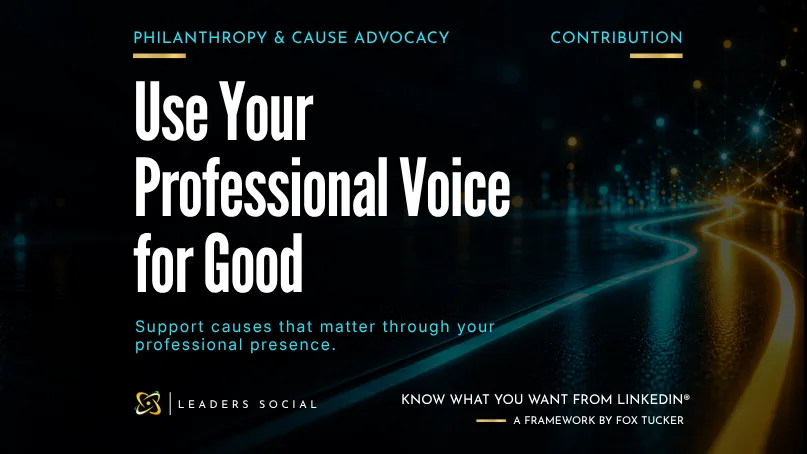
Philanthropy and cause advocacy are key motivators for many LinkedIn® users. Learn how to use the platform to promote social responsibility and make a positive impact in your industry.

A Framework by Fox Tucker

My Why Are You Really on LinkedIn®? framework is based around the simple idea: LinkedIn® becomes much easier to use when you understand what you actually need it to do for you.

More

My framework separates those reasons into two broad groups.

Transactional reasons: Connected to outcomes you want to achieve – across your career, commercial opportunities, promotion and demand, or the management of a brand or channel.

Intangible motivations: Things you build over time – your reputation, relationships, knowledge and growth, and contribution to others.

They are different, but they rarely operate in isolation.

What philanthropy and cause advocacy on LinkedIn® mean

Philanthropy and cause advocacy on LinkedIn® mean using your professional presence to support issues, organisations or communities you genuinely care about.

This can include raising awareness, sharing expertise, supporting campaigns, contributing time or resources and connecting causes with people who can help.

Used well, LinkedIn® can help you contribute without turning a meaningful cause into personal promotion.

How to use this page

Use this page to see what this LinkedIn® motivation can look like in practice, where to focus your activity, who to connect with, and how content and relationships can support it.

You do not need to use every section as a checklist. Start with what you are trying to achieve, then focus on the areas most useful to you.

The path from commitment to contribution

Step 1: Commitment

Choose causes you genuinely understand and support

Step 2: Awareness

Share credible information and useful stories

Step 3: Connection

Bring supporters, expertise and organisations together

Step 4: Contribution

Help attention turn into practical support or action

Cause advocacy works when people can see a credible connection between the issue, your values and your actions. Posting support is only one part of that. The stronger signal is consistency between what you say matters and what you or your organisation actually do.

My Why Are You Really on LinkedIn®? framework is based around the simple idea: LinkedIn® becomes much easier to use when you understand what you actually need it to do for you.

More

My framework separates those reasons into two broad groups.

Transactional reasons: Connected to outcomes you want to achieve – across your career, commercial opportunities, promotion and demand, or the management of a brand or channel.

Intangible motivations: Things you build over time – your reputation, relationships, knowledge and growth, and contribution to others.

They are different, but they rarely operate in isolation.

Get a clearer view of your LinkedIn® priorities

Take my free 2 – 3 minute assessment to identify your current primary goal and the motivations supporting it.

What cause advocacy might look like for you

You want to support something beyond yourself

You care about a cause, community or organisation and want your professional presence to help.

You can add useful awareness

Your network may benefit from credible information or stories about the issue.

You can connect people and resources

You may be able to introduce expertise, supporters, organisations or opportunities.

You want attention to lead somewhere useful

You care about practical contribution rather than symbolic posting alone.

How to use LinkedIn® for philanthropy and cause advocacy

Understand the issue

Use credible sources and people close to the work before speaking with authority.

Share useful information

Explain the issue clearly and point people towards credible organisations and evidence.

Amplify the right voices

Give space to people and organisations with direct experience rather than making yourself the centre.

Connect useful people

Introduce supporters, expertise or resources when you can add practical value.

Make action clear

Where appropriate, show people how they can contribute, volunteer, donate or learn more.

Be specific about the cause, the action you want to support and why it matters. Share progress, recognise the people doing the work and use your professional network to increase awareness, participation or access to resources rather than treating the cause as a branding exercise.

Profile priorities

Your profile can make relevant commitments and voluntary work visible where they form a genuine part of your professional identity, without allowing the cause to become a branding device.
Keep commitments proportionate

Show voluntary or cause-related work where it genuinely forms part of your professional identity.

Use accurate language

Avoid overstating your role, impact or connection with an organisation.

Point towards the cause

Use profile space to direct attention to credible organisations or work rather than only to yourself.

How your content can support a cause

Content can give a cause useful visibility, explain why it matters and direct attention towards organisations, evidence and actions that deserve support.
Use credible evidence

Share information from organisations and people with direct knowledge of the issue.

Explain practical relevance

Help your network understand why the issue matters and what useful action is possible.

Amplify affected voices

Make space for people and organisations closer to the issue rather than speaking over them.

Avoid making the cause about you

Personal visibility should not become the main outcome of advocacy.

Do not exaggerate for engagement

Emotional overstatement can damage trust and misrepresent the issue.

Content should help people understand the issue, see evidence of progress and know how they can contribute. Use stories and outcomes carefully, especially when other people or communities are involved. Keep the focus on the cause rather than on how generous or socially aware the poster appears.

How to build the right relationships

Cause advocacy becomes stronger when you connect with credible organisations, practitioners, supporters and people who can contribute useful expertise, access or resources.
Build relationships with credible organisations

Understand how established groups are already working on the issue before creating your own activity.

Listen to people close to the work

Direct experience should shape how you talk about the cause.

Use introductions carefully

Connect people when there is a clear practical benefit rather than simply expanding the network.

Stay involved beyond one post

Longer-term support is usually more useful than occasional high-visibility advocacy.

Cause advocacy is stronger when it is built with the people and organisations closest to the issue. Listen before speaking for others, share credit and make space for informed voices. Long-term relationships are usually more credible than appearing only when a cause becomes visible.

Common cause advocacy mistakes

Your LinkedIn® activity becomes less useful when it is unfocused, performative or disconnected from the reason you are using the platform.

Performative advocacy

Support looks weak when the post creates more value for the author than for the cause.

Sharing inaccurate claims

Good intentions do not remove the need to verify information.

Speaking for people unnecessarily

Amplification is often more useful than replacing the voices directly affected.

Stopping at awareness

Visibility matters less when there is no route towards useful support or action.

Weak advocacy often becomes performative: broad statements, little evidence of action and messaging centred on the organisation or individual rather than the cause. Another risk is speaking with confidence about an issue without enough knowledge or connection to the people affected.

Signs your advocacy is creating useful impact

Look for signs that attention is turning into useful action – informed discussion, stronger connections, volunteers, resources, introductions or support for the organisations involved.
Useful organisations gain attention

More people discover credible groups, resources or initiatives connected to the cause.

Conversations become better informed

Discussion moves beyond slogans into evidence, experience and practical questions.

People take meaningful action

Introductions, volunteering, resources or other support emerge from the activity.

Your involvement remains trusted

People see your advocacy as consistent and proportionate rather than opportunistic.

Success should be judged by useful movement around the cause. Look for stronger participation, credible partnerships, better-informed discussion, resources reaching the right people and sustained involvement after the initial post. Attention matters only when it helps something meaningful happen.

Cause advocacy and employee advocacy can each support something larger than the individual, but they are different forms of contribution.

Philanthropy and Cause Advocacy on LinkedIn®

Support a cause, community or organisation you genuinely care about.

  • Centres on a cause or community
  • Can be independent of your employer
  • May involve volunteering or resources
  • Should direct value towards the cause
Employee Advocacy on LinkedIn®

Help extend an employer’s visibility and credibility through employee participation.

  • Centres on the employer
  • Connects company themes with employee voice
  • Supports organisational reputation
  • Depends on employee participation

Where they overlap: Personal voice, credibility and responsible participation matter to each.

Key difference: Cause advocacy is centred on an issue or social purpose. Employee advocacy is centred on the organisation and its professional activity.

Introduction to Philanthropy and Cause Advocacy on LinkedIn®

Many LinkedIn® users are motivated by more than just business or career growth – they want to promote social causes and align their professional image with philanthropic efforts.

Framework: Philanthropy & Cause Advocacy sits within Contribution in the Why Are You Really on LinkedIn®? framework.

Whether it’s corporate social responsibility or personal involvement in a cause, these individuals and organizations use LinkedIn® to amplify their message and create a positive impact.

Promoting causes on LinkedIn® isn’t just about raising awareness—it’s about building a community that shares your values and making a tangible difference through the platform.


Basic Action Points (Vitals):

  • Optimize your profile or company page to reflect your commitment to causes
  • Engage with posts and content related to your chosen cause
  • Build a network of individuals and organizations that share similar values
  • Use relevant keywords to ensure your advocacy is discoverable
  • Regularly post about the cause and share updates on your philanthropic efforts

Specific Action Points for Philanthropy and Cause Advocacy:

  • Highlight any corporate social responsibility (CSR) initiatives in your company or personal posts
  • Share stories or results from charitable efforts or advocacy work
  • Encourage engagement and participation from your network in supporting your cause
  • Partner with other advocates, organizations, or influencers to amplify your message
  • Post calls to action that invite your network to contribute or get involved
How To Use This LinkedIn® Series?

[ls_why_fit]

LinkedIn® can be a huge a time-suck. It’s so much easier and more rewarding when you know why you’re using LinkedIn®. This series starts with Why Are You Really On LinkedIn®? and helps you drill down through to your Transactional Reasons and/or the Intanglible Motivators that drive you and your activities.

When you know your Why? LinkedIn® becomes much easier because you can just focus on the What To Do, be aware of the What Not To Do., and cut the time-suck.

By understanding why you’re really here, you’ll be able to use LinkedIn® more effectively and strategically – whether for immediate outcomes or long-term success.

Why am I on LinkedIn
Transactional LinkedIn
Intangible LinkedIn


.

Get a clearer view of your LinkedIn® priorities

Take my free 2 – 3 minute assessment to identify your current primary goal and the motivations supporting it.