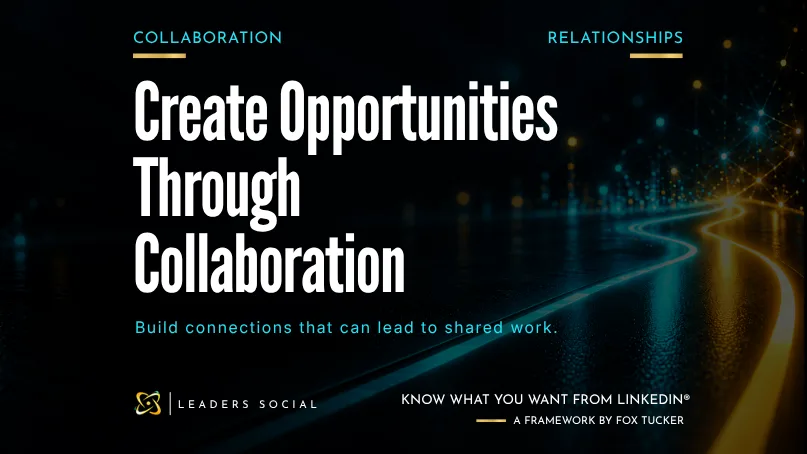




Collaboration Opportunities on LinkedIn®

LinkedIn® is a powerful tool for finding collaboration opportunities. Discover how to connect with professionals in your industry and foster meaningful partnerships.

A Framework by Fox Tucker

My Why Are You Really on LinkedIn®? framework is based around the simple idea: LinkedIn® becomes much easier to use when you understand what you actually need it to do for you.

More

My framework separates those reasons into two broad groups.

Transactional reasons: Connected to outcomes you want to achieve – across your career, commercial opportunities, promotion and demand, or the management of a brand or channel.

Intangible motivations: Things you build over time – your reputation, relationships, knowledge and growth, and contribution to others.

They are different, but they rarely operate in isolation.

What collaboration opportunities on LinkedIn® mean

Collaboration on LinkedIn® means finding people whose skills, audience, resources or ideas complement your own and developing something useful together.

The value is not in collecting contacts. It comes from spotting genuine alignment, understanding what each person can contribute and moving from a loose connection into a specific shared opportunity.

Used well, LinkedIn® can help you find partners for content, events, projects, referrals, research and commercial initiatives that would be harder to create alone.

How to use this page

Use this page to see what this LinkedIn® motivation can look like in practice, where to focus your activity, who to connect with, and how content and relationships can support it.

You do not need to use every section as a checklist. Start with what you are trying to achieve, then focus on the areas most useful to you.

The path from connection to collaboration

Step 1: Discovery

You find people with complementary strengths or interests

Step 2: Alignment

A conversation reveals a credible reason to work together

Step 3: Definition

The shared value and contribution become clear

Step 4: Collaboration

The relationship moves into a concrete joint activity

Collaboration usually starts before anybody proposes a formal project. People notice complementary expertise, exchange ideas, test whether they work well together and only then identify something worth building jointly. LinkedIn® is useful because much of that compatibility can become visible through content and conversation first.

My Why Are You Really on LinkedIn®? framework is based around the simple idea: LinkedIn® becomes much easier to use when you understand what you actually need it to do for you.

More

My framework separates those reasons into two broad groups.

Transactional reasons: Connected to outcomes you want to achieve – across your career, commercial opportunities, promotion and demand, or the management of a brand or channel.

Intangible motivations: Things you build over time – your reputation, relationships, knowledge and growth, and contribution to others.

They are different, but they rarely operate in isolation.

Get a clearer view of your LinkedIn® priorities

Take my free 2 – 3 minute assessment to identify your current primary goal and the motivations supporting it.

What collaboration opportunities might look like for you

You want complementary expertise

You are looking for people who can add skills, reach or resources you do not have alone.

You see value in joint ideas

You are open to co-created content, events, projects, research or referrals.

You care about fit and trust

You want collaborators whose standards and reputation align with yours.

You want opportunities that benefit everyone

You are looking for partnerships where the value exchange is credible on each side.

How to use LinkedIn® to create collaboration opportunities

Make your expertise visible

Help potential collaborators understand what you can contribute.

Find complementary people

Look beyond direct peers to people with adjacent strengths, audiences or resources.

Show what interests you

Publish around themes, projects and questions that could attract aligned partners.

Explore fit before proposing

Use discussion to understand goals, standards and practical compatibility.

Define a concrete next step

Move from general interest into a clear shared activity when the fit is real.

Make it easy for potential collaborators to understand what you can contribute and where you are open to working with others. Engage with people whose skills complement rather than duplicate yours, and look for specific intersections where combining expertise could create more value than working separately.

Profile priorities

Your profile should make your expertise, interests and current work clear enough that potential collaborators can see where there may be a useful fit.
Show what you bring

Make your skills, experience and current priorities easy for potential collaborators to understand.

Give evidence of reliability

Projects, outcomes and recommendations help reduce uncertainty about working with you.

Make interests visible

Use featured work and profile language to show the subjects or projects you are open to exploring.

How your content can support collaboration

Content can reveal your expertise, interests and current priorities, making it easier for people with complementary skills or audiences to recognise a reason to work together.
Share work in progress selectively

Ideas, questions and current themes can help aligned people recognise where they could contribute.

Show complementary gaps

Make it visible where outside expertise, partners or contributors could add value.

Highlight previous joint work

Past collaborations show how you work with others and what good partnership looks like to you.

Do not make vague public asks

Broad calls to collaborate often attract low-fit responses and create more noise than value.

Avoid collaboration for visibility alone

Shared activity is stronger when there is a real purpose beyond borrowing each other’s audience.

Content can act as an open invitation to the right collaborators when it shows what you are thinking about, building or trying to solve. Share enough substance that another professional can see where their experience might connect with yours. Collaboration is easier when the opportunity is visible rather than hidden behind a vague statement that you are open to partnerships.

How to build the right relationships

The strongest collaborations usually grow from relevant professional relationships where trust and mutual value already exist.
Look for complementary strengths

The best fit often comes from people who add something different rather than duplicate what you already do.

Check standards and reliability

Reputation, communication and follow-through matter once shared work begins.

Define mutual value

Each side should understand what they gain and what they are expected to contribute.

Start small when needed

A limited first project can test fit before a larger commitment.

Test the working relationship in small ways before making large commitments. Exchange ideas, make an introduction, contribute to a discussion or try a limited piece of work together. Those interactions reveal reliability, communication style and whether the collaboration creates genuine mutual value.

Common collaboration mistakes

Your LinkedIn® activity becomes less useful when it is unfocused, performative or disconnected from the reason you are using the platform.

Choosing people for reach alone

Audience size does not compensate for poor fit, weak reliability or unclear mutual value.

Keeping the idea too vague

Enthusiasm fades when nobody can define what the collaboration actually involves.

Ignoring expectations

Unspoken assumptions about time, ownership or promotion can damage the relationship.

Forcing collaboration too early

Some professional relationships need more trust before joint work makes sense.

Weak collaboration outreach often starts with a vague request to work together without a clear reason. Another mistake is focusing on audience size rather than complementary value. A smaller partner with the right expertise, trust and working style may be far more useful than a highly visible but poorly matched one.

Signs collaboration opportunities are developing

Look for signs that people are moving beyond general networking and beginning to propose shared work, introductions or ideas with a clear mutual benefit.
People bring you specific ideas

Contacts start suggesting concrete ways your work could connect.

Introductions become more relevant

Your network begins connecting you with people whose strengths genuinely complement yours.

Small joint activities work well

Early collaborations create useful outcomes without unnecessary friction.

Repeat collaboration appears

People choose to work with you again or recommend you as a reliable partner.

Collaboration is gaining traction when conversations move from mutual interest to specific shared possibilities. Look for introductions, joint ideas, invitations to contribute, small experiments and repeat work together. The strongest signal is that each side can explain why the collaboration creates value that neither would produce as easily alone.

Collaboration can grow from networking, but the two have different end points.

Collaboration Opportunities on LinkedIn®

Develop a specific shared activity, project or partnership.

  • Centres on a shared outcome
  • Needs clear mutual value
  • Requires active contribution
  • Usually has defined next steps
Networking on LinkedIn®

Build and maintain professional relationships that may create future value.

  • Builds broad relationship value
  • Can remain informal
  • Supports future access and security
  • Does not require immediate action

Where they overlap: Trust, relevance and professional relationships matter to each.

Key difference: Networking can remain open-ended. Collaboration becomes concrete when people agree to create or do something together.

Introduction to Collaboration Opportunities on LinkedIn®

LinkedIn® isn’t just a place to promote yourself – it’s also where great partnerships and collaborations are born.

Framework: Collaboration Opportunities sits within Relationships in the Why Are You Really on LinkedIn®? framework.

People who use LinkedIn® to create collaboration opportunities know that it’s about finding the right people to team up with, whether for projects, partnerships, or joint ventures. By engaging with others, sharing ideas, and showcasing your work, you can attract collaborators who complement your skills and vision.

The key is being clear about what you bring to the table and staying open to conversations that could lead to meaningful partnerships.


Basic Action Points (Vitals):

  • Optimize your profile to highlight your collaboration skills and what value you bring
  • Engage with posts and content from potential collaborators and industry peers
  • Build a network of professionals whose work aligns with your own goals
  • Use relevant keywords in your profile to attract the right kind of connections
  • Regularly post content that reflects your areas of expertise and invites collaboration

Specific Action Points for Creating Collaboration Opportunities:

  • Join groups related to your niche and actively participate in discussions to meet potential collaborators
  • Post about your ongoing projects and mention that you’re open to collaboration
  • Reach out to professionals whose work you admire and suggest potential areas for collaboration
  • Engage with content from professionals you’d like to work with, showing your genuine interest in their work
  • Attend LinkedIn® events or webinars and use them as a starting point for collaborative conversations


How To Use This LinkedIn® Series?

[ls_why_fit]

LinkedIn® can be a huge a time-suck. It’s so much easier and more rewarding when you know why you’re using LinkedIn®. This series starts with Why Are You Really On LinkedIn®? and helps you drill down through to your Transactional Reasons and/or the Intanglible Motivators that drive you and your activities.

When you know your Why? LinkedIn® becomes much easier because you can just focus on the What To Do, be aware of the What Not To Do., and cut the time-suck.

By understanding why you’re really here, you’ll be able to use LinkedIn® more effectively and strategically – whether for immediate outcomes or long-term success.

Why am I on LinkedIn
Transactional LinkedIn
Intangible LinkedIn


.

Get a clearer view of your LinkedIn® priorities

Take my free 2 – 3 minute assessment to identify your current primary goal and the motivations supporting it.