







Freelance Opportunities on LinkedIn®

Freelancers on LinkedIn® need more than just a strong profile. Learn how to showcase your work, build relationships, and find clients for your freelance projects.

A Framework by Fox Tucker

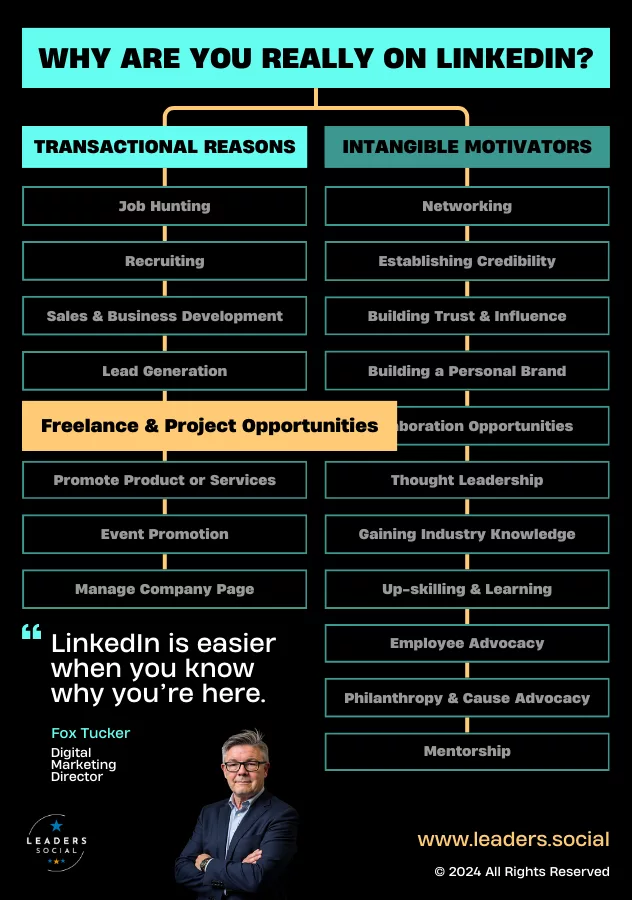
My Why Are You Really on LinkedIn®? framework is based around the simple idea: LinkedIn® becomes much easier to use when you understand what you actually need it to do for you.

More

My framework separates those reasons into two broad groups.

Transactional reasons: Connected to outcomes you want to achieve – across your career, commercial opportunities, promotion and demand, or the management of a brand or channel.

Intangible motivations: Things you build over time – your reputation, relationships, knowledge and growth, and contribution to others.

They are different, but they rarely operate in isolation.

What freelance and project opportunities on LinkedIn® means

Using LinkedIn® for freelance and project opportunities means making it easier for potential clients, collaborators and referrers to understand what you do and when they should think of you.

A strong portfolio matters, but so does visibility. The people who commission work often choose from professionals they already know, have seen or have been referred to.

Used consistently, LinkedIn® can help turn your expertise and relationships into a steadier flow of relevant project conversations.

How to use this page

This page shows what lead generation on LinkedIn® involves, where to focus your activity, who to connect with, and how your content and relationships can support it.

You do not need to use every section as a checklist. Start with what you are trying to achieve, then focus on the areas most useful to you.

The path from expertise to project opportunity

Step 1: Positioning

Make your specialist value easy to understand

Step 2: Visibility

The right people repeatedly see your expertise

Step 3: Conversation

A client or referrer starts a relevant discussion

Step 4: Project

The discussion develops into paid work or a referral

Freelance opportunities usually come from a combination of clear positioning, visible proof and relationships. Potential clients need to understand what you do, see evidence that you can deliver and feel enough confidence to start a conversation.

My Why Are You Really on LinkedIn®? framework is based around the simple idea: LinkedIn® becomes much easier to use when you understand what you actually need it to do for you.

More

My framework separates those reasons into two broad groups.

Transactional reasons: Connected to outcomes you want to achieve – across your career, commercial opportunities, promotion and demand, or the management of a brand or channel.

Intangible motivations: Things you build over time – your reputation, relationships, knowledge and growth, and contribution to others.

They are different, but they rarely operate in isolation.

Get a clearer view of your LinkedIn® priorities

Take my free 2 – 3 minute assessment to identify your current primary goal and the motivations supporting it.

What freelance opportunities might look like for you

You want more of the right clients

You are looking for work that fits your skills, rates and preferred type of project.

You need your expertise to feel credible

Potential clients need evidence that you can deliver the work well.

You rely on conversations and referrals

Much of your work comes through people who already know or trust you.

You want a steadier pipeline

You want fewer gaps between projects and less dependence on last-minute prospecting.

How to use LinkedIn® for freelance and project opportunities

Clarify your offer

Make it obvious what you do, who you help and the kind of projects you take on.

Show proof

Use portfolio work, outcomes and client evidence to reduce uncertainty.

Demonstrate expertise

Share useful thinking that shows how you approach the problems clients hire you to solve.

Build a client network

Connect with buyers, collaborators and people likely to recommend your work.

Stay visible between projects

Keep relationships warm before you need the next piece of work.

Make your availability and offer easy to understand, then keep showing relevant expertise through your profile, content and conversations. Freelancing works better when people can quickly connect a specific problem with the work you provide.

Profile priorities

Your profile should make clear who you help, what problems you solve and why somebody should start a conversation with you.

State what you do clearly

Avoid broad labels that make clients work to understand your specialist value.

Show relevant proof

Use projects, outcomes, testimonials and examples that match the work you want more of.

Use client language

Describe your work using the problems and services potential clients are likely to recognise.

How your content can support freelance opportunities

Content can keep your expertise visible between projects and show potential clients how you think before they decide to contact you.
Share useful expertise

Publish around the problems clients hire you to solve and the decisions involved.

Show your work

Use project lessons, before-and-after examples and outcomes where confidentiality allows.

Demonstrate your approach

Help potential clients understand how you work, not just the finished result.

Do not make every post a sales pitch

Useful expertise builds familiarity better than repeatedly announcing availability.

Avoid attracting work you do not want

The topics you publish can shape the projects people associate with you.

Use content to show how you solve problems, not just to announce that you are available. Project examples, lessons, before-and-after outcomes and practical advice can help potential clients judge fit before they contact you.

How to build the right relationships

Build relationships with clients, past clients, collaborators, agencies, peers and people who regularly refer specialist work.
Stay connected after delivery

Past clients can become repeat buyers, advocates and referral sources.

Build complementary relationships

Other specialists and agencies can create project opportunities you would not reach alone.

Engage without always selling

Useful interaction keeps you familiar without making every conversation commercial.

Make availability easy to discuss

When the timing is right, be clear about the kind of work you can take on.

Keep client relationships active after a project ends. Follow up, stay visible and make it easy for past clients to refer or rehire you. Repeat work and introductions often come from relationships that continue beyond the delivery itself.

Common freelance lead-generation mistakes

Lead generation becomes less effective when activity prioritises volume and immediate pitching over relevance and trust.

Being too broad

Trying to appeal to every possible client makes specialist value harder to see.

Showing work without explaining value

A portfolio is stronger when clients understand the problem, approach and outcome.

Going quiet when busy

Stopping all visibility during projects can leave the pipeline empty when the work ends.

Relying only on cold outreach

Relationship-led referrals and repeat work are often stronger than starting every project search from zero.

Common mistakes include presenting yourself too broadly, relying only on job listings, hiding your availability and failing to show proof of previous work. A potential client should not have to guess what you do or whether you can deliver.

Signs your freelance activity is gaining traction

Look for signs that more suitable clients and referrers understand what you do and approach you with work that fits.
Enquiries become more relevant

Potential clients approach you about work closer to your specialist offer.

Referrals increase

Past clients and professional contacts introduce you to suitable opportunities.

Less explanation is needed

Prospects arrive with a clearer understanding of your work and value.

Pipeline gaps reduce

New conversations begin before current projects finish.

Look for more relevant enquiries, repeat work, referrals and conversations where prospects already understand your expertise. The strongest signal is a growing proportion of opportunities that arrive warm rather than needing to be chased.

Freelance opportunities and lead generation overlap, but the freelance goal is narrower and tied directly to project-based work.

Freelance Opportunities on LinkedIn®

Create paid freelance or project opportunities around your own specialist services.

  • Centres on personal expertise
  • Uses portfolio and project proof
  • Relies heavily on referrals and repeat work
  • Targets suitable briefs and clients
Lead Generation on LinkedIn®

Create qualified opportunities for a wider commercial offer or business.

  • Can support a wider organisation
  • May involve larger sales teams
  • Can feed a formal sales pipeline
  • May cover products as well as services

Where they overlap: Visibility, proof, relationships and relevant conversations matter to each.

Key difference: Freelance activity is centred on you as the service provider and the projects you personally want to win.

Introduction to Freelance Opportunities on LinkedIn®

LinkedIn® isn’t just for full-time jobs – it’s also a great platform to find freelance work and short-term projects. Whether you’re a designer, writer, consultant, or developer, you can use LinkedIn® to connect with potential clients and showcase your expertise.

Framework: Freelance & Project Opportunities sits within Revenue & Opportunities in the Why Are You Really on LinkedIn®? framework.

The trick is to make it clear on your profile and in your posts that you’re available for freelance work and that you have a portfolio of successful projects to back it up.

Freelancers who succeed on LinkedIn® know that building relationships is key. By consistently sharing your work and engaging with others in your field, you can attract the right kind of clients without having to chase every lead.

Freelancing on LinkedIn

Basic Action Points (Vitals):

  • Optimize your profile to highlight your freelance services and portfolio
  • Engage with posts from potential clients and industry professionals
  • Build a network of potential clients and collaborators in your industry
  • Use relevant keywords in your profile to ensure clients can find you when searching for freelancers
  • Regularly post content showcasing your work and expertise

Specific Action Points for Project/Freelance Opportunities:

  • Share completed projects or testimonials to demonstrate your skills
  • Join LinkedIn® groups related to your niche and participate in discussions
  • Use LinkedIn®’s job search filters to find freelance opportunities
  • Reach out to past clients for referrals or repeat work
  • Create posts offering tips or insights that relate to your area of expertise to attract attention from potential clients

How To Use This LinkedIn® Series?

[ls_why_fit]

LinkedIn® can be a huge a time-suck. It’s so much easier and more rewarding when you know why you’re using LinkedIn®. This series starts with Why Are You Really On LinkedIn®? and helps you drill down through to your Transactional Reasons and/or the Intanglible Motivators that drive you and your activities.

When you know your Why? LinkedIn® becomes much easier because you can just focus on the What To Do, be aware of the What Not To Do., and cut the time-suck.

By understanding why you’re really here, you’ll be able to use LinkedIn® more effectively and strategically – whether for immediate outcomes or long-term success.

Why am I on LinkedIn
Transactional LinkedIn
Intangible LinkedIn


.

Get a clearer view of your LinkedIn® priorities

Take my free 2 – 3 minute assessment to identify your current primary goal and the motivations supporting it.