






LinkedIn® Company Page Management: Core Responsibilities

Managing a LinkedIn® company page is more than just posting updates. Discover how to build your brand’s reputation and engage with employees and industry leaders alike.

A Framework by Fox Tucker

My Why Are You Really on LinkedIn®? framework is based around the simple idea: LinkedIn® becomes much easier to use when you understand what you actually need it to do for you.

More

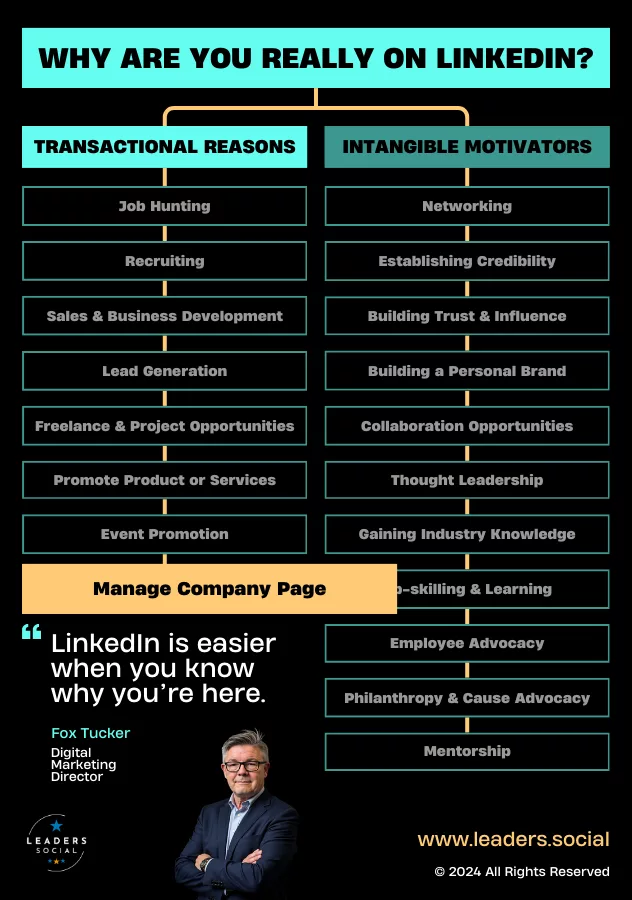
My framework separates those reasons into two broad groups.

Transactional reasons: Connected to outcomes you want to achieve – across your career, commercial opportunities, promotion and demand, or the management of a brand or channel.

Intangible motivations: Things you build over time – your reputation, relationships, knowledge and growth, and contribution to others.

They are different, but they rarely operate in isolation.

What managing a Company Page on LinkedIn® means

Managing a LinkedIn® Company Page means giving the organisation a clear, credible and useful presence on the platform.

The Page is more than a publishing channel. It supports reputation, employer visibility, products and services, employee activity and the way people assess the organisation before they ever speak to someone inside it.

Used consistently, a Company Page can become a reliable source of proof, information and visibility for the wider business.

How to use this page

This page shows what lead generation on LinkedIn® involves, where to focus your activity, who to connect with, and how your content and relationships can support it.

You do not need to use every section as a checklist. Start with what you are trying to achieve, then focus on the areas most useful to you.

The path from company presence to business value

Step 1: Foundation

The Page clearly represents the organisation

Step 2: Visibility

Relevant audiences regularly encounter useful company activity

Step 3: Credibility

People see proof, expertise and consistent participation

Step 4: Value

The Page supports reputation, talent, demand and relationships

Managing a Company Page is a long-term reputation and communication job, not a publishing rota. The Page needs to make the organisation easy to understand, keep important audiences informed and create enough consistency that people know what to expect from the brand.

My Why Are You Really on LinkedIn®? framework is based around the simple idea: LinkedIn® becomes much easier to use when you understand what you actually need it to do for you.

More

My framework separates those reasons into two broad groups.

Transactional reasons: Connected to outcomes you want to achieve – across your career, commercial opportunities, promotion and demand, or the management of a brand or channel.

Intangible motivations: Things you build over time – your reputation, relationships, knowledge and growth, and contribution to others.

They are different, but they rarely operate in isolation.

Get a clearer view of your LinkedIn® priorities

Take my free 2 – 3 minute assessment to identify your current primary goal and the motivations supporting it.

What Company Page management might look like for you

You need a credible company presence

Customers, candidates and partners use the Page to assess the organisation.

You have company stories and expertise to share

The organisation has useful material that deserves a consistent publishing home.

You serve several audiences

Customers, employees, candidates, partners and industry peers may all use the Page differently.

You want the Page to support wider business goals

The Page should contribute to reputation, demand, talent and visibility rather than operate in isolation.

How to use LinkedIn® to manage a Company Page

Optimise the Page

Keep company information, positioning, industry and key details accurate and useful.

Publish with purpose

Use content themes tied to real audiences and business priorities.

Build the right followers

Focus on relevant people rather than follower volume alone.

Support employee participation

Give employees material and reasons to extend company visibility credibly.

Review performance

Use Page data to understand what reaches and interests the audiences that matter.

Treat Page activity as a mix of positioning, publishing, engagement and maintenance. Keep company information accurate, publish material with a clear audience and purpose, respond where conversation matters and regularly review what the Page is signalling about the business.

Profile priorities

Your profile should make clear who you help, what problems you solve and why somebody should start a conversation with you.

Make the organisation clear

Visitors should immediately understand what the company does, who it serves and where it operates.

Keep trust signals current

Accurate information, branding and proof make the Page more credible.

Use discoverable language

Company descriptions and specialties should use terms relevant audiences are likely to recognise.

How content can support your Company Page

Company Page content should make the organisation easier to understand, trust and remember across the audiences it wants to reach.
Show expertise and evidence

Use useful company knowledge, customer proof, projects, people and outcomes.

Represent the organisation accurately

Content should reflect the real business rather than a polished version disconnected from it.

Serve more than one audience deliberately

Use a planned mix for customers, employees, candidates, partners and industry stakeholders.

Do not turn the Page into a press-release feed

Corporate announcements alone give most followers little reason to stay interested.

Avoid posting without a clear audience

Content becomes inconsistent when every post is aimed at everybody.

Company Page content should explain what the organisation is doing, what it knows and why that matters to the audiences it serves. Mix company news, expertise, people, customer evidence and useful industry material so the Page feels active and credible rather than promotional.

How to build the right relationships

Connect the Page with employees, customers, partners and leaders whose own activity can strengthen the organisation’s visibility and credibility.
Work with employee voices

Employees can extend reach and credibility when sharing material that is genuinely relevant to them.

Recognise customers and partners

Useful collaboration and proof can strengthen relationships beyond the Page itself.

Support leadership visibility

Company and executive activity should reinforce each other rather than operate separately.

Respond as an organisation

Comments and messages are opportunities to show that the Page is actively managed.

The Page should support relationships, not replace them. Respond to comments, acknowledge customers and partners, involve employees and connect company activity with the people behind it. Strong Pages feel connected to a wider professional community rather than broadcasting into it.

Common Company Page management mistakes

Lead generation becomes less effective when activity prioritises volume and immediate pitching over relevance and trust.

Treating the Page as a noticeboard

Posting updates without a clear audience or purpose creates activity without much value.

Ignoring Page optimisation

Outdated descriptions, industries or details weaken discoverability and trust.

Relying only on follower count

Growth matters less when followers are not relevant to the organisation’s real audiences.

Separating the Page from employees

Ignoring employee and executive activity leaves a major source of trusted reach unused.

Common failures are treating the Page as a noticeboard, posting only promotional updates, ignoring comments and relying on employees to create reach without giving them anything worth engaging with. An active Page can still be weak if the activity has no clear audience or purpose.

Signs your Company Page is gaining traction

Look for signs that the Page is reaching more of the right people and supporting wider business activity, not just producing impressions.
Relevant followers grow

More customers, candidates, partners and industry stakeholders choose to follow the Page.

Content reaches the right audiences

Useful company material earns attention from people connected to real business priorities.

Employees and leaders participate

Company content increasingly connects with trusted individual voices.

The Page supports business activity

People use the Page as part of evaluating, contacting, applying to or engaging with the organisation.

Success looks like stronger attention from relevant audiences, more useful engagement, better employee participation and clearer links between Page activity and business outcomes such as enquiries, recruitment interest, partnerships or customer trust.

Company Page management and employee advocacy can reinforce each other, but they are different responsibilities.

LinkedIn® Company Page Management: Core Responsibilities

Manage the organisation’s official LinkedIn® presence and publishing channel.

  • Uses the official company presence
  • Controls Page positioning and publishing
  • Builds followers and company visibility
  • Supports several business audiences
Employee Advocacy on LinkedIn®

Help employees extend credible visibility through their own professional activity.

  • Uses employee profiles and networks
  • Depends on voluntary participation
  • Adds human credibility and reach
  • Can amplify company themes

Where they overlap: Company content, reputation and trusted employee voices can strengthen each.

Key difference: The Company Page is an owned organisational asset. Employee advocacy relies on individuals choosing to participate through their own profiles and networks.

Introduction to Managing a Company Page on LinkedIn®

Managing a LinkedIn® Company Page means maintaining purpose, ownership, publishing, participation and measurement—not merely scheduling updates. For the complete current operating framework, see Building a High-Performance LinkedIn® Company Page. You’re building your brand’s reputation, showcasing its values, and creating a space where employees, customers, and industry insiders can engage with what your company has to offer.

Framework: Managing a Company Page sits within Brand & Channel Management in the Why Are You Really on LinkedIn®? framework.

Effective management depends on consistent ownership, useful material and appropriate participation from the company and its people. If you need Fox Tucker to hold that system together, review the Company Page Management service.

Publishing is only one responsibility. Page managers should also review comments, respond where the organization can add value and identify conversations that require an internal subject specialist.

Basic Action Points (Vitals):

  • Optimize your company page (company description, logo, industry, website link, etc.)
  • Engage with relevant industry content and comments from your audience
  • Build a following by connecting with industry professionals and employees
  • Use keywords in the company’s description and updates to improve discoverability
  • Regularly post updates, industry news, or employee stories to keep the page active and engaging

Specific Action Points for Managing a Company Page:

  • Create a content calendar to ensure consistency in posting
  • Share employee-generated content to humanize your brand and build internal advocacy
  • Give employees access to relevant company material while keeping participation voluntary and authentic
  • Use LinkedIn® Analytics to track what types of posts perform best and adjust accordingly
  • Respond to comments and questions on your posts to foster engagement and community

How To Use This LinkedIn® Series?

[ls_why_fit]

LinkedIn® can be a huge a time-suck. It’s so much easier and more rewarding when you know why you’re using LinkedIn®. This series starts with Why Are You Really On LinkedIn®? and helps you drill down through to your Transactional Reasons and/or the Intanglible Motivators that drive you and your activities.

When you know your Why? LinkedIn® becomes much easier because you can just focus on the What To Do, be aware of the What Not To Do., and cut the time-suck.

By understanding why you’re really here, you’ll be able to use LinkedIn® more effectively and strategically – whether for immediate outcomes or long-term success.

Why am I on LinkedIn
Transactional LinkedIn
Intangible LinkedIn


.

Get a clearer view of your LinkedIn® priorities

Take my free 2 – 3 minute assessment to identify your current primary goal and the motivations supporting it.