






Recruiting on LinkedIn®

Recruiting on LinkedIn® requires more than just posting jobs. Learn how to engage with potential candidates and build a strong employer brand to attract the best talent.

A Framework by Fox Tucker

My Why Are You Really on LinkedIn®? framework is based around the simple idea: LinkedIn® becomes much easier to use when you understand what you actually need it to do for you.

More

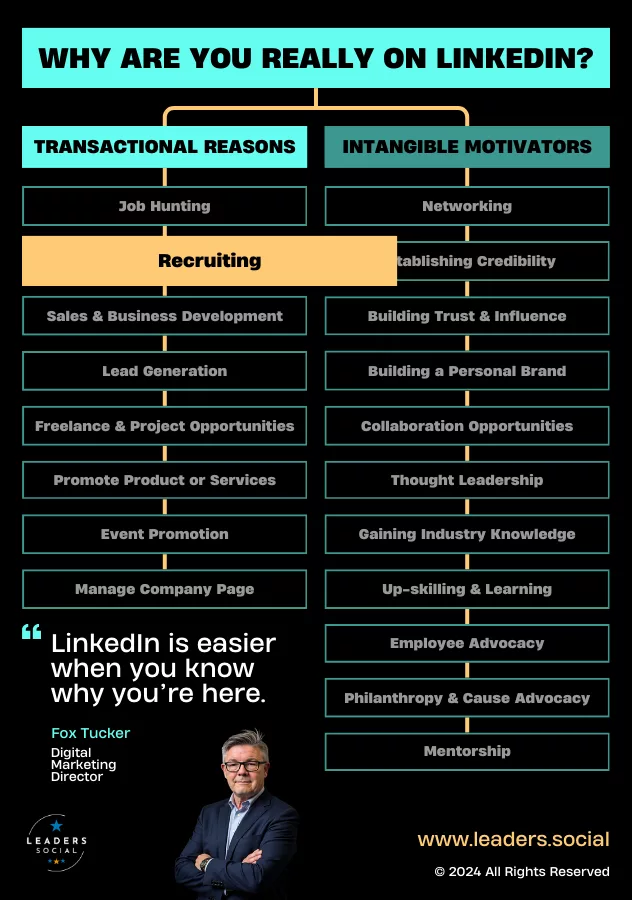
My framework separates those reasons into two broad groups.

Transactional reasons: Connected to outcomes you want to achieve – across your career, commercial opportunities, promotion and demand, or the management of a brand or channel.

Intangible motivations: Things you build over time – your reputation, relationships, knowledge and growth, and contribution to others.

They are different, but they rarely operate in isolation.

What recruiting on LinkedIn® means

Recruiting on LinkedIn® means finding, attracting and engaging people who could be a strong fit for your organisation.

Posting a vacancy is only one part of that. Candidates also judge the people, reputation and culture behind the role. Your activity can help potential hires understand what the organisation values and whether a conversation is worth having.

Used well, LinkedIn® can support a stronger talent pipeline and make outreach feel more credible and relevant.

How to use this page

This page shows what lead generation on LinkedIn® involves, where to focus your activity, who to connect with, and how your content and relationships can support it.

You do not need to use every section as a checklist. Start with what you are trying to achieve, then focus on the areas most useful to you.

The path from visibility to candidate conversation

Step 1: Awareness

Relevant people become aware of the organisation or opportunity

Step 2: Interest

Your people and content make the opportunity feel credible

Step 3: Conversation

A candidate engages, replies or asks for more detail

Step 4: Candidate

The conversation moves into a genuine recruitment process

Recruiting on LinkedIn® works best when employer visibility, recruiter credibility and candidate relationships support each other. The strongest candidates may not be actively applying, so your job is often to create familiarity and trust before a vacancy becomes urgent.

My Why Are You Really on LinkedIn®? framework is based around the simple idea: LinkedIn® becomes much easier to use when you understand what you actually need it to do for you.

More

My framework separates those reasons into two broad groups.

Transactional reasons: Connected to outcomes you want to achieve – across your career, commercial opportunities, promotion and demand, or the management of a brand or channel.

Intangible motivations: Things you build over time – your reputation, relationships, knowledge and growth, and contribution to others.

They are different, but they rarely operate in isolation.

Get a clearer view of your LinkedIn® priorities

Take my free 2 – 3 minute assessment to identify your current primary goal and the motivations supporting it.

What recruiting might look like for you

You need access to specific talent

You are looking for people with particular skills, experience or sector knowledge.

You want a stronger talent pipeline

You do not want every search to start from scratch when a vacancy appears.

You want better candidate responses

You want outreach to feel relevant enough that good people are willing to talk.

You want candidates to trust the opportunity

You need the organisation and its people to look credible before someone considers moving.

How to use LinkedIn® for recruiting

Make recruiter profiles credible

Candidates will often check the person contacting them before replying.

Search with precision

Use role, skills, sector and experience criteria to find relevant people.

Show the work and culture

Use useful content to help candidates understand the organisation beyond the vacancy.

Personalise outreach

Give candidates a clear reason why the role or organisation may be relevant to them.

Build relationships early

Stay connected with strong people before a specific role needs filling.

Use LinkedIn® to understand talent markets, identify relevant people, stay visible to potential candidates and make your organisation easier to assess. Combine search and outreach with content and engagement so candidates see more than a job description.

Profile priorities

Your profile should make clear who you help, what problems you solve and why somebody should start a conversation with you.

Make your role obvious

Candidates should quickly understand who you recruit for and what kinds of roles you handle.

Build personal credibility

A clear, professional profile makes direct outreach easier to trust.

Reflect the organisation

Your profile should reinforce the employer story rather than feel disconnected from it.

How your content can support recruiting

Content can help potential candidates understand the work, people, culture and opportunities behind an organisation before a recruiter contacts them.
Show the reality of the work

Share useful material about teams, projects, challenges and the skills that matter.

Feature employee voices

Let people inside the organisation provide credible evidence of the working environment.

Explain opportunities well

Give candidates enough substance to decide whether a role or team is worth exploring.

Do not publish only vacancies

A stream of job posts gives people little reason to follow the organisation between hiring campaigns.

Avoid employer-brand slogans without proof

Candidates are more likely to trust specific evidence than polished claims about culture.

Recruitment content should help candidates understand the work, culture, people and expectations behind the role. Employee stories, team achievements, practical role information and leadership visibility can answer questions that a vacancy advert cannot.

How to build the right relationships

Build relationships with strong candidates, employees, alumni and professional communities before every interaction becomes a recruitment pitch.
Approach with relevance

Explain why the person’s background makes the conversation worth having.

Respect timing

A strong candidate may be worth knowing even when they are not ready to move.

Stay useful between vacancies

Share relevant information and maintain contact without turning every interaction into a job pitch.

Use employee connections

Warm introductions and credible employee voices can make recruitment conversations stronger.

Recruiting relationships benefit from respect and timing. Engage before approaching where possible, personalise messages and be clear about why the opportunity may be relevant. Even when somebody is not interested now, a good interaction can preserve the relationship for later.

Common recruiting mistakes

Lead generation becomes less effective when activity prioritises volume and immediate pitching over relevance and trust.

Sending generic recruiter messages

Candidates quickly recognise messages that could have been sent to anyone.

Relying only on vacancy posts

Job posts alone do little to build interest with people who are not actively applying.

Ignoring recruiter credibility

Candidates often check the sender before deciding whether to respond.

Treating every candidate as immediately available

Good people may need time and repeated contact before the timing is right.

Weak recruiting activity treats candidates like inventory. Generic messages, vague roles, overreliance on keyword matching and poor follow-up can damage employer reputation quickly. A candidate who says no today may still remember how professionally they were treated.

Signs your recruiting is gaining traction

Look for signs that stronger candidates are noticing the organisation, responding to outreach and staying connected even when the timing is not immediate.
Response quality improves

More relevant candidates reply and conversations become less dependent on repeated follow-up.

Candidates arrive warmer

People already know something about the organisation, team or work before the first conversation.

Talent pools become stronger

You have more relevant people to approach when a suitable role opens.

Referrals increase

Candidates and employees begin introducing other people who could be a strong fit.

Look for stronger response quality, more warm candidate conversations, better referrals and a growing pool of relevant people who already know the organisation. Hiring outcomes matter, but the health of the talent network is an earlier signal.

Recruiting and employee advocacy can support the same talent goals, but they do different jobs.

Recruiting on LinkedIn®

Identify, attract and engage potential candidates.

  • Targets potential candidates
  • Uses search and direct outreach
  • Supports active hiring needs
  • Moves into a recruitment process
Employee Advocacy on LinkedIn®

Help employees represent and amplify the organisation through their own professional activity.

  • Starts with employees
  • Builds organisational visibility
  • Shares credible internal voices
  • Can support many business goals

Where they overlap: Credibility, culture and employee voices can strengthen each.

Key difference: Recruiting moves people towards a hiring conversation. Employee advocacy helps create the visibility and trust that can make those conversations easier.

Introduction to Recruiting on LinkedIn®

If you’re using LinkedIn® to find the best talent, you’re not just sourcing resumes – you’re gauging how potential hires present themselves, engage with others, and contribute to their industry.

Framework: Recruiting sits within Career & Talent in the Why Are You Really on LinkedIn®? framework.

Recruiters who succeed on LinkedIn® go beyond job postings; they use their network to spot passive candidates, assess cultural fit through profiles, and follow professionals who consistently demonstrate their skills and expertise.

The best recruiters know LinkedIn® is a place to engage. If you’re commenting on industry content, posting about your company’s culture, or sharing insights from current employees, you’re already showcasing what your company stands for – and attracting the right talent without actively headhunting.
Recruiting on LinkedIn

Basic Action Points (Vitals):

  • Optimize your LinkedIn® profile (include your role as a recruiter, professional photo, headline, summary, etc.)
  • Actively engage with posts in your industry and talent pool (comment, react, and share insights)
  • Build and maintain a strong network (connect with relevant professionals and personalize invitations)
  • Use keywords strategically in your profile and posts for visibility
  • Regularly post or engage to keep your presence active (without focusing on frequency, focus on quality)

Specific Action Points for Recruiting:

  • Join relevant industry and talent-related groups to find niche candidates
  • Create and share posts that highlight your company culture, values, and unique benefits
  • Follow industry influencers and top talent in your field to stay on top of trends
  • Engage with content from potential candidates to start a dialogue before approaching them
  • Use LinkedIn® Recruiter tools to filter and reach out to passive candidates
How To Use This LinkedIn® Series?

[ls_why_fit]

LinkedIn® can be a huge a time-suck. It’s so much easier and more rewarding when you know why you’re using LinkedIn®. This series starts with Why Are You Really On LinkedIn®? and helps you drill down through to your Transactional Reasons and/or the Intanglible Motivators that drive you and your activities.

When you know your Why? LinkedIn® becomes much easier because you can just focus on the What To Do, be aware of the What Not To Do., and cut the time-suck.

By understanding why you’re really here, you’ll be able to use LinkedIn® more effectively and strategically – whether for immediate outcomes or long-term success.

Why am I on LinkedIn
Transactional LinkedIn
Intangible LinkedIn


.

Get a clearer view of your LinkedIn® priorities

Take my free 2 – 3 minute assessment to identify your current primary goal and the motivations supporting it.