




Mentorship and Guidance on LinkedIn®

LinkedIn® isn’t just for advancing your career—it’s also for helping others succeed. Discover how mentorship and guidance can be powerful motivators for engaging on LinkedIn.

A Framework by Fox Tucker

My Why Are You Really on LinkedIn®? framework is based around the simple idea: LinkedIn® becomes much easier to use when you understand what you actually need it to do for you.

More

My framework separates those reasons into two broad groups.

Transactional reasons: Connected to outcomes you want to achieve – across your career, commercial opportunities, promotion and demand, or the management of a brand or channel.

Intangible motivations: Things you build over time – your reputation, relationships, knowledge and growth, and contribution to others.

They are different, but they rarely operate in isolation.

What mentorship and guidance on LinkedIn® mean

Mentorship and guidance on LinkedIn® mean using your experience to help other professionals think through decisions, develop skills and move forward with greater confidence.

That support can be formal or informal. It may happen through direct conversations, useful comments, introductions, shared resources or longer-term mentoring relationships.

Used well, LinkedIn® can help you make your experience useful to people who are earlier in their career, changing direction or dealing with challenges you already understand.

How to use this page

Use this page to see what this LinkedIn® motivation can look like in practice, where to focus your activity, who to connect with, and how content and relationships can support it.

You do not need to use every section as a checklist. Start with what you are trying to achieve, then focus on the areas most useful to you.

The path from experience to useful guidance

Step 1: Experience

Know where your own experience can genuinely help

Step 2: Understanding

Listen to the other person’s goals and situation

Step 3: Guidance

Share useful reasoning, lessons and options

Step 4: Development

Help the other person build stronger judgement of their own

Mentorship on LinkedIn® is strongest when experience becomes useful to somebody else. The value is not in presenting yourself as a mentor; it is in making good judgement, practical lessons and relevant introductions available to people who can benefit from them.

My Why Are You Really on LinkedIn®? framework is based around the simple idea: LinkedIn® becomes much easier to use when you understand what you actually need it to do for you.

More

My framework separates those reasons into two broad groups.

Transactional reasons: Connected to outcomes you want to achieve – across your career, commercial opportunities, promotion and demand, or the management of a brand or channel.

Intangible motivations: Things you build over time – your reputation, relationships, knowledge and growth, and contribution to others.

They are different, but they rarely operate in isolation.

Get a clearer view of your LinkedIn® priorities

Take my free 2 – 3 minute assessment to identify your current primary goal and the motivations supporting it.

What mentorship and guidance might look like for you

People already ask for your advice

Colleagues or contacts regularly come to you for guidance on areas you know well.

You have experience worth passing on

You can draw on real decisions, mistakes and lessons rather than generic advice.

You enjoy helping people develop

You are interested in supporting capability and confidence, not simply giving answers.

You want to contribute beyond your own work

You see value in helping other professionals progress.

How to use LinkedIn® for mentorship and guidance

Make relevant experience clear

Help people understand where your background is strong enough to support useful guidance.

Listen before advising

Understand the person’s goals, constraints and current thinking first.

Share transferable lessons

Explain experiences in ways other people can adapt to their own situations.

Support the right people

Focus your time where there is a genuine fit between your experience and their needs.

Encourage independence

Use questions and reasoning to help people develop their own judgement.

Focus on specific ways you can help. Answer thoughtful questions, share lessons from experience, make introductions where appropriate and be clear about the areas where your guidance is strongest. Useful mentorship is usually more focused than broad motivational advice.

Profile priorities

Your profile should make the experience behind your guidance clear, without positioning you as an authority on areas where you have little direct knowledge.
Show relevant experience

Make the work, roles and decisions behind your guidance easy to understand.

Stay within your competence

Avoid implying expertise in areas where your experience is limited.

Feature useful contribution

Recommendations, talks, mentoring work or relevant content can demonstrate how you help others.

How your content can support mentorship

Content can turn experience into useful guidance by explaining lessons, decisions and practical principles that others can apply.
Share lessons with context

Explain what happened, what you learned and why the lesson may matter to somebody else.

Use questions as well as answers

Good guidance often helps people think more clearly rather than handing them a fixed solution.

Show more than success

Mistakes, trade-offs and changed decisions can be some of the most useful mentoring material.

Avoid presenting your path as universal

What worked for you may not fit another person’s goals, market or circumstances.

Do not turn guidance into self-promotion

The value should sit with the person learning, not with demonstrating how experienced you are.

Content can scale mentorship when it answers recurring questions or explains lessons that many people may need. Share practical experiences, mistakes, decisions and principles that help others think more clearly. Keep the emphasis on usefulness rather than positioning yourself as the hero of the story.

How to build the right relationships

Mentoring works best when expectations, trust and boundaries are clear, and when the relationship supports the other person’s development rather than dependence.
Set expectations early

Be clear about the kind of support you can offer and how much time you can realistically give.

Listen to the individual situation

Useful guidance depends on understanding the person rather than projecting your own career onto them.

Protect boundaries

Mentoring should remain sustainable and professionally appropriate for everyone involved.

Encourage independent judgement

Help people understand how to think through future decisions themselves.

Good mentoring relationships need trust, boundaries and continuity. Ask enough questions to understand what the other person actually needs, avoid assuming your own path is the right one for them and follow up when you have agreed to help.

Common mentorship and guidance mistakes

Your LinkedIn® activity becomes less useful when it is unfocused, performative or disconnected from the reason you are using the platform.

Giving advice before understanding the problem

Fast answers can miss the real issue or the person’s actual constraints.

Overgeneralising from your own experience

A single career path does not automatically create a universal rule.

Creating dependency

Good mentoring should strengthen the other person’s judgement rather than make them reliant on yours.

Ignoring boundaries

Unclear expectations around time and availability can make mentoring difficult to sustain.

A common mistake is giving advice before understanding the situation. Another is treating mentorship as a way to display seniority. Good guidance should help the other person make a better decision, not simply demonstrate how much experience you have.

Signs your guidance is creating value

Look for signs that people are becoming more capable, confident and independent – not simply returning to you for every answer.
People make stronger decisions

Mentees become more confident in weighing options and choosing a direction.

Questions become more advanced

Conversations move from basic answers into judgement, trade-offs and strategy.

People need less direct support

The other person becomes more independent as their own capability grows.

Your guidance is referred thoughtfully

People recommend you because the support was useful, relevant and grounded in experience.

Mentorship is working when people become more capable, confident or connected because of the help you provided. Useful signals include thoughtful follow-up questions, progress on a decision or skill, successful introductions and people returning because they trust your judgement.

Mentorship and up-skilling can support the same development, but the relationship is different.

Mentorship and Guidance on LinkedIn®

Use experience and judgement to help another person develop.

  • Centres on guidance and judgement
  • Depends on a relationship
  • Uses lived professional experience
  • Supports broader decision-making
Up-skilling and Learning on LinkedIn®

Build a specific skill or capability through learning and practice.

  • Centres on a skill or capability
  • Requires practice and application
  • Can be self-directed
  • Has a clearer learning objective

Where they overlap: Learning, reflection and professional growth matter to each.

Key difference: Mentorship is a relationship through which guidance is provided. Up-skilling is the capability-development process itself.

Introduction to Mentorship and Guidance on LinkedIn®

Some professionals use LinkedIn® not just to advance their own careers, but to help others succeed. These users are motivated by the desire to mentor and guide the next generation of leaders in their field. By sharing their experiences, offering advice, and creating connections, they aim to give back to the professional community.

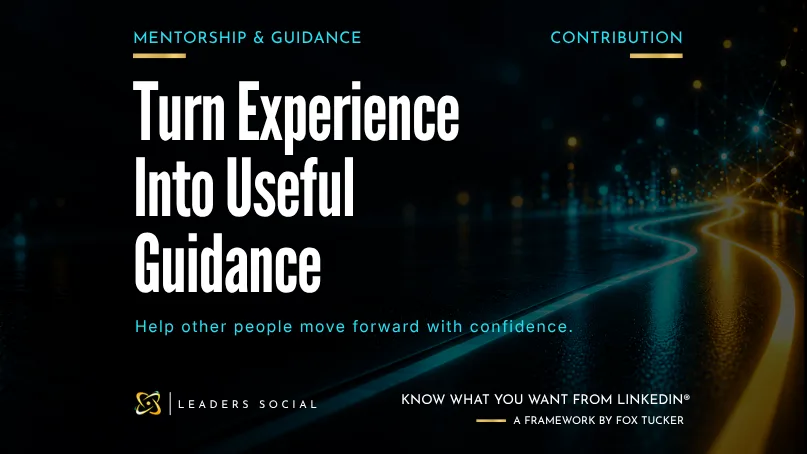
Framework: Mentorship & Guidance sits within Contribution in the Why Are You Really on LinkedIn®? framework.

Mentorship on LinkedIn® helps build lasting relationships and positions you as a trusted and experienced guide in your industry.


Basic Action Points (Vitals):

  • Optimize your profile to reflect your experience and openness to mentorship
  • Engage with posts from professionals seeking advice or guidance
  • Build a network of emerging professionals or mentees in your industry
  • Use relevant keywords to ensure your profile is discoverable for those seeking mentorship
  • Regularly post or share mentorship-related content to show your willingness to help

Specific Action Points for Mentorship and Guidance:

  • Join LinkedIn® groups or forums dedicated to mentorship and career development
  • Share stories or lessons from your career to inspire and guide others
  • Offer to mentor individuals in your field by reaching out directly or through posts
  • Post advice or tips regularly, addressing common challenges faced by newer professionals
  • Encourage mentees to connect with you and seek advice through LinkedIn
How To Use This LinkedIn® Series?

[ls_why_fit]

LinkedIn® can be a huge a time-suck. It’s so much easier and more rewarding when you know why you’re using LinkedIn®. This series starts with Why Are You Really On LinkedIn®? and helps you drill down through to your Transactional Reasons and/or the Intanglible Motivators that drive you and your activities.

When you know your Why? LinkedIn® becomes much easier because you can just focus on the What To Do, be aware of the What Not To Do., and cut the time-suck.

By understanding why you’re really here, you’ll be able to use LinkedIn® more effectively and strategically – whether for immediate outcomes or long-term success.

Why am I on LinkedIn
Transactional LinkedIn
Intangible LinkedIn
.

Get a clearer view of your LinkedIn® priorities

Take my free 2 – 3 minute assessment to identify your current primary goal and the motivations supporting it.