



Using LinkedIn® for Event Promotion

Maximize your event’s reach on LinkedIn® and connect with the right audience before, during, and after.

A Framework by Fox Tucker

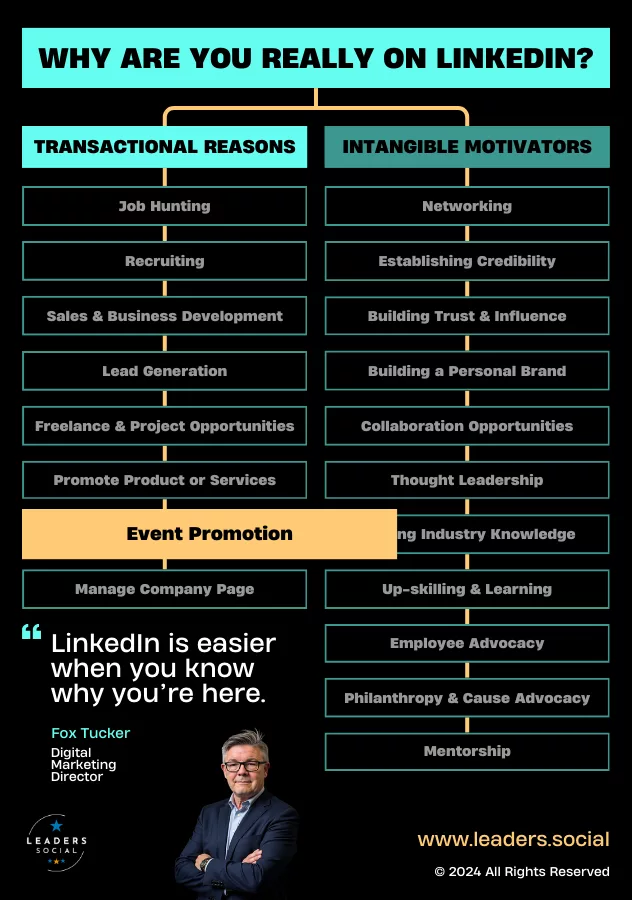
My Why Are You Really on LinkedIn®? framework is based around the simple idea: LinkedIn® becomes much easier to use when you understand what you actually need it to do for you.

More

My framework separates those reasons into two broad groups.

Transactional reasons: Connected to outcomes you want to achieve – across your career, commercial opportunities, promotion and demand, or the management of a brand or channel.

Intangible motivations: Things you build over time – your reputation, relationships, knowledge and growth, and contribution to others.

They are different, but they rarely operate in isolation.

What event promotion on LinkedIn® means

Event promotion on LinkedIn® means reaching the right audience before the event, building reasons to attend and extending the value of the event after it happens.

A registration link alone is rarely enough. People need to understand who the event is for, what they will gain and why the speakers or subject deserve their time.

Used well, LinkedIn® can support awareness, registrations, live participation and follow-up conversations from the same event.

How to use this page

This page shows what lead generation on LinkedIn® involves, where to focus your activity, who to connect with, and how your content and relationships can support it.

You do not need to use every section as a checklist. Start with what you are trying to achieve, then focus on the areas most useful to you.

The path from awareness to event value

Step 1: Awareness

The right audience discovers the event

Step 2: Interest

The topic, speakers or outcome feels relevant

Step 3: Attendance

People register and take part

Step 4: Follow-up

The event creates content, relationships and further conversations

Event promotion works across three stages: give the right people a reason to notice the event, build enough relevance and trust for them to register, then keep engagement going before and after the event. Promotion should support the whole event journey, not just the launch announcement.

My Why Are You Really on LinkedIn®? framework is based around the simple idea: LinkedIn® becomes much easier to use when you understand what you actually need it to do for you.

More

My framework separates those reasons into two broad groups.

Transactional reasons: Connected to outcomes you want to achieve – across your career, commercial opportunities, promotion and demand, or the management of a brand or channel.

Intangible motivations: Things you build over time – your reputation, relationships, knowledge and growth, and contribution to others.

They are different, but they rarely operate in isolation.

Get a clearer view of your LinkedIn® priorities

Take my free 2 – 3 minute assessment to identify your current primary goal and the motivations supporting it.

What event promotion might look like for you

You need the right attendees

Quality of audience matters as much as registration volume.

The event has useful expertise to share

Speakers, topics or research can create material before and after the event.

You want engagement around the event

You want people discussing the subject rather than only clicking a registration link.

You want value beyond event day

The event should create follow-up conversations, content or demand after it finishes.

How to use LinkedIn® for event promotion

Define the audience

Know which roles, sectors or communities should care about the event.

Promote the value, not just the date

Use topics, speakers and practical outcomes to create reasons to attend.

Use speakers and employees

Give credible people material they can share with their own networks.

Build momentum

Use a sequence of useful posts rather than repeating the same registration message.

Extend the event afterwards

Turn sessions, questions and takeaways into follow-up content and conversations.

Plan promotion around audience questions: why attend, why now, who is involved and what will people gain. Use updates, speakers, agenda points, social proof and reminders to reduce uncertainty and keep the event visible without repeating the same message.

Profile priorities

Your profile should make clear who you help, what problems you solve and why somebody should start a conversation with you.

Make your event role clear

Speakers, hosts and organisers should make their relevance to the subject obvious.

Support speaker credibility

Profiles should give attendees confidence that the people involved know the subject.

Connect profiles to the event topic

Recent activity can reinforce why the event is worth someone’s time.

How your content can support event promotion

Content can build event demand by turning speakers, themes, questions and takeaways into useful material before and after the event.
Lead with audience value

Explain what attendees will learn, solve or understand rather than repeating logistics.

Use speakers as content sources

Quotes, short ideas and previews can create interest without giving everything away.

Repurpose after the event

Turn sessions and audience questions into useful follow-up material.

Do not repeat the same registration post

Repetition without new value quickly becomes easy to ignore.

Avoid promoting only from the brand account

People often trust and notice relevant individuals more than repeated company posts.

Strong event content gives people fresh reasons to care. Speaker clips, agenda insights, practical takeaways, attendee stories and post-event highlights can each serve a different stage of the decision. Repetition works better when the angle changes.

How to build the right relationships

Use speakers, employees, partners, attendees and professional communities to build credible reach around the event.
Activate people early

Give speakers and partners enough time and material to share the event naturally.

Engage interested attendees

Reply to questions and comments rather than treating promotion as one-way broadcasting.

Recognise warm signals

Repeated engagement with event content can identify people worth following up with.

Continue after the event

Use follow-up conversations to strengthen relationships created around the event topic.

Engage with prospective attendees before the event and continue the conversation afterwards. Questions, comments and direct messages can reveal interest and help turn an event from a one-off promotion into a relationship-building opportunity.

Common event promotion mistakes

Lead generation becomes less effective when activity prioritises volume and immediate pitching over relevance and trust.

Starting promotion too late

A short campaign gives the audience little time to notice, consider and commit.

Repeating logistics instead of value

Dates and links matter less than a clear reason to attend.

Ignoring speakers and employee networks

Brand-only promotion leaves useful trusted reach unused.

Stopping on event day

Failing to repurpose and follow up wastes much of the content and relationship value created.

Common mistakes are promoting too late, relying on one announcement, using the same message repeatedly and disappearing after the event. Strong event promotion builds momentum and then converts the attention into follow-up activity.

Signs your event promotion is gaining traction

Look for signs that the right audience is engaging with the subject, registering, participating and continuing the conversation afterwards.
Relevant registrations increase

More of the intended audience is registering rather than only broad, low-fit traffic.

Event content earns engagement

Speakers, topics and questions generate useful discussion before the event.

Attendees participate

Questions, comments and live interaction show genuine interest in the subject.

Follow-up continues

The event creates new conversations, content use and relationships after it ends.

Useful signals include registrations from the intended audience, repeat engagement from prospects, attendance quality, meaningful event conversations and post-event follow-up that creates new relationships, leads or content opportunities.

Event promotion and product or service promotion use many of the same channels, but the audience action is different.

Using LinkedIn® for Event Promotion

Build attendance and engagement around a time-bound event.

  • Has a fixed event date
  • Uses speakers and agenda as value
  • Targets registration and attendance
  • Creates post-event follow-up
Using LinkedIn® to Promote Products or Services

Build awareness and demand around an ongoing commercial offer.

  • Centres on an ongoing offer
  • Uses product or service proof
  • Targets demand and enquiries
  • Can run as an always-on campaign

Where they overlap: Audience relevance, content, proof and clear calls to action matter to each.

Key difference: Event promotion works towards a specific date and participation moment. Product or service promotion can run continuously.

Introduction to Event Promotion on LinkedIn®

LinkedIn® is the ideal platform for promoting events—whether it’s a product launch, a webinar, or an in-person networking opportunity. Its professional audience and targeted tools allow you to reach the right people, drive registrations, and create meaningful engagement before, during, and after your event.

Framework: Event Promotion sits within Promotion & Demand in the Why Are You Really on LinkedIn®? framework.

By leveraging LinkedIn®, you can position your event as a valuable opportunity for learning, networking, or business growth.


Basic Action Points (Vitals):

  • Create a compelling event description that highlights the value and purpose of attending.
  • Use LinkedIn®’s Event feature to organize your event and invite attendees directly.
  • Share regular updates about the event, such as guest speakers, agenda highlights, or key takeaways.
  • Engage with attendees and prospects through comments, polls, and event-related posts.
  • Include a clear call-to-action (CTA) in every post, such as “Register Now” or “Save the Date.”

Specific Action Points for Event Promotion:

  • Design an eye-catching banner or visual for your event page and promotional posts.
  • Share posts featuring speakers, sponsors, or partners to build credibility and interest.
  • Use LinkedIn® Ads to promote your event to specific demographics, industries, or job roles.
  • Create a countdown series to build anticipation and remind people to register.
  • Encourage attendees to share the event with their networks to increase visibility.

Advanced Tips for Event Promotion:

  • Use LinkedIn® Live to host pre-event Q&A sessions, introduce speakers, or preview the agenda.
  • After the event, share highlights, key takeaways, or recordings to keep the conversation going.
  • Track engagement with LinkedIn® Analytics to identify who’s interacting with your event posts. Use this data to follow up with warm leads.
  • Create and share an exclusive LinkedIn® Group for attendees to foster ongoing engagement and networking.
  • Partner with influencers or industry leaders to co-promote your event and reach a broader audience.

Why This Works:

LinkedIn®’s professional network gives your event the visibility it needs to reach the right people. By positioning your event as a must-attend opportunity and engaging with your audience effectively, you can maximize attendance and ensure meaningful outcomes.
How To Use This LinkedIn® Series?

[ls_why_fit]

LinkedIn® can be a huge a time-suck. It’s so much easier and more rewarding when you know why you’re using LinkedIn®. This series starts with Why Are You Really On LinkedIn®? and helps you drill down through to your Transactional Reasons and/or the Intanglible Motivators that drive you and your activities.

When you know your Why? LinkedIn® becomes much easier because you can just focus on the What To Do, be aware of the What Not To Do., and cut the time-suck.

By understanding why you’re really here, you’ll be able to use LinkedIn® more effectively and strategically – whether for immediate outcomes or long-term success.

Why am I on LinkedIn
Transactional LinkedIn
Intangible LinkedIn


.

Get a clearer view of your LinkedIn® priorities

Take my free 2 – 3 minute assessment to identify your current primary goal and the motivations supporting it.