



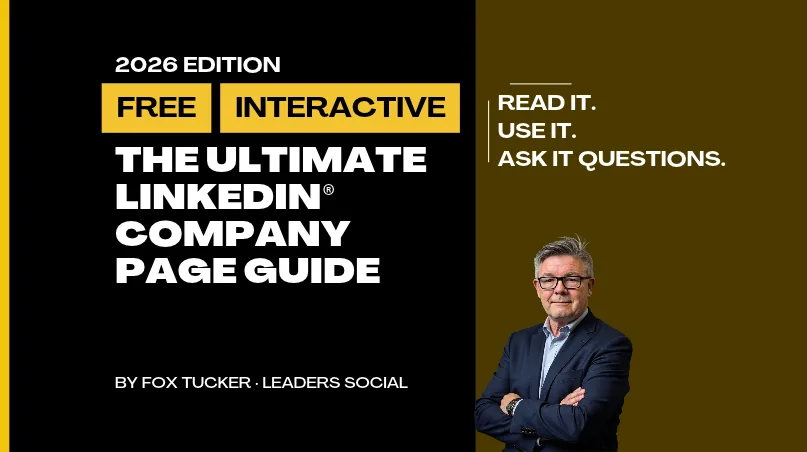
2026 Edition · Living guide
A LinkedIn® Company Page is more than a place to publish company updates. Managed properly, it becomes part of an organisation’s reputation infrastructure: a public record of what the business does, what it knows, who contributes to that expertise, and how consistently it shows up.
This guide explains how to build, optimise and run a LinkedIn® Company Page in 2026. It is designed for established B2B organisations, marketing teams and leaders who want a credible company presence rather than a stream of disconnected social posts.
Interactive guide: read it from start to finish, jump to the section you need, or ask the guide a question using its interactive companion. Created by Fox Tucker and published by Leaders Social.
How to use this guide
- Building or rebuilding a Page? Work through the guide in order.
- Solving a specific problem? Jump straight to the relevant chapter.
- Coming back later? This is a living guide. When LinkedIn materially changes Company Pages, the relevant chapter will be reviewed and the edition history updated.
What this guide covers
- What a LinkedIn® Company Page is actually for
- Ownership, admin access and governance
- Page setup and optimisation
- Content strategy and publishing systems
- Followers, employees and community
- Newsletters, verification and Premium Company Pages
- Analytics, measurement and competitor context
- A practical 30-day improvement plan
What a LinkedIn® Company Page is actually for
A Company Page is the organisation’s owned presence inside LinkedIn. It should make the business easier to understand, easier to verify and easier to follow. It also gives employees, customers, prospects, partners and candidates a shared organisational reference point.
The principle: your Company Page should make the organisation easier to understand, verify and trust.
That makes the Page strategically different from an executive profile. A personal profile represents an individual. A Company Page represents the organisation. The two can reinforce one another, but they are not interchangeable.
For an established B2B company, the Page should answer four basic questions quickly:
- Who is this organisation?
- What does it do?
- What does it know?
- Why should I trust that this is an active, credible organisation?
The strongest Company Pages do not try to behave like a corporate noticeboard. They provide a useful stream of evidence: expertise, customer context, people, projects, research, ideas and organisational activity.