



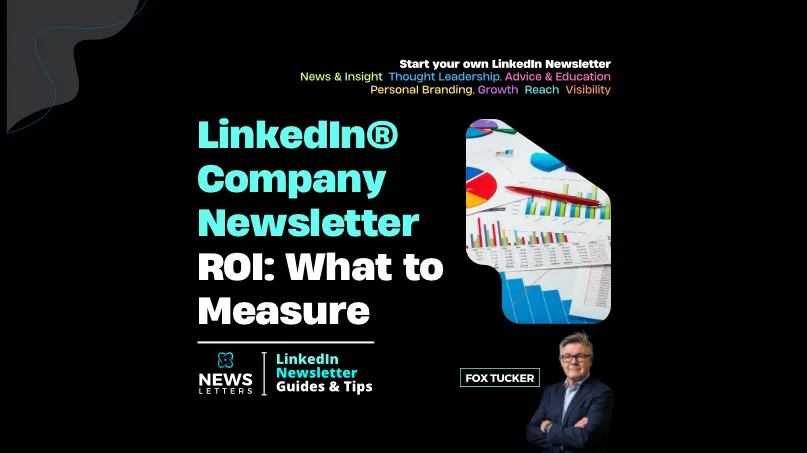
A subscriber count is not a business result. For a B2B Company Page newsletter, the useful question is whether the publication reaches the right professionals, earns their attention and contributes to the organisation’s wider objectives.
Start with the business purpose
Decide whether the newsletter is intended to explain complex services, maintain relationships with buyers, demonstrate expertise, support recruitment or give existing customers better information. Those goals require different evidence. A newsletter can be worthwhile without producing an attributable enquiry after every edition.
What LinkedIn® can tell you
Review the newsletter and article analytics actually available to your Page, such as views, engagement, subscriber growth and audience characteristics. Availability and definitions can change. Do not treat a notification or an email send as proof that somebody read an edition. Nor should an email-open metric, where available historically, be treated as a reliable measure of business value.
Measure audience relevance, not just size
Compare subscriber demographics with the people the company wants to reach. A thousand subscribers in relevant buying organisations may be more useful than ten thousand people with no connection to the market. Treat demographic breakdowns as directional rather than as a complete list of identifiable readers.
Look beyond LinkedIn®
Use appropriately tagged links to relevant website resources, and inspect landing-page engagement and meaningful enquiries where consent and analytics permit. Ask prospects how they discovered the business. Record occasions when an edition helps an existing sales conversation. These are useful signals, but they do not prove the newsletter caused a sale.
A practical monthly scorecard
- Editorial objective and editions published
- Subscriber growth and relevant audience characteristics
- Views and engagement for each edition, with trends rather than isolated totals
- Website visits and meaningful actions from tagged newsletter links
- Qualitative evidence from prospects, customers and colleagues
- Publishing effort, editorial quality and next month’s decisions
What a newsletter cannot promise
LinkedIn controls feed distribution, notifications, reporting and platform features. Subscribers are not an exportable email list that the company owns independently of LinkedIn. Search indexing and AI citations are possible research questions, not guaranteed outcomes. A responsible reporting process separates observable results, reasonable interpretation and speculation.
Should you continue?
Review the audience fit and editorial proposition before changing frequency. If subscribers are growing but commercially irrelevant, more publishing may compound the wrong problem. If engagement is modest but the newsletter repeatedly supports important customer conversations, reach alone understates its value.
For launch planning, read how to launch a Company Page newsletter properly. For implementation and ongoing editorial management, see my Company Newsletter Service.