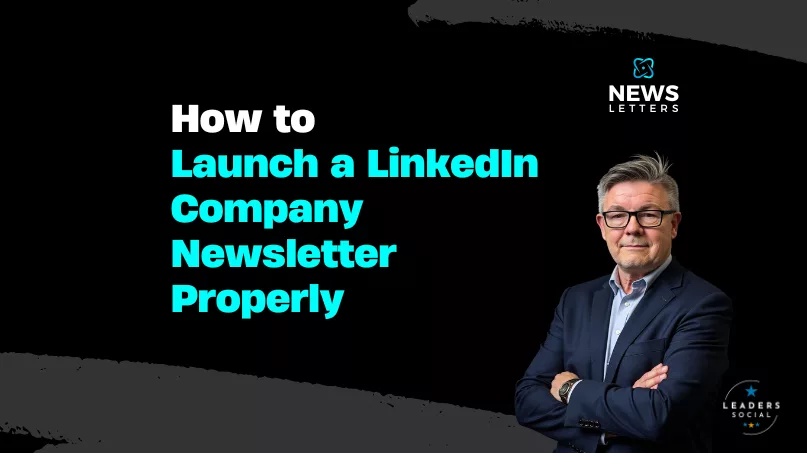
How to Launch a LinkedIn® Company Page Newsletter Properly
ByFox Tucker- Digital Marketing Director · Founder, Leaders Social
18 Min Read
A LinkedIn® Company Page newsletter can give a business something that ordinary Page posts cannot: a named, subscribable publication with its own identity, archive and audience.
But the feature is only the container.
The value comes from what the company chooses to publish, who it is for and whether the business can sustain it.
This is where many newsletter launches go wrong. Someone notices that the feature is available, chooses a broad title, writes a quick introduction and presses publish. The newsletter technically exists—but there is no clear editorial proposition behind it and no practical plan for the second edition.
A better launch starts before anyone opens LinkedIn®’s publishing tool.
It begins with a business question:
What can this company publish regularly that a specific professional audience will genuinely want to receive?
Once that is clear, the name, description, first edition, visuals, frequency and promotion can all support the same idea.
A LinkedIn® newsletter is a series of articles published regularly around a defined topic. When it is created by a Company Page, the company – not an individual employee- is the publisher.
Each newsletter has its own page where people can understand the subject, see previous editions, subscribe and share it. That newsletter page is separate from the Company Page itself.
Subscribers can encounter new editions in their LinkedIn® feed and, depending on their settings, receive LinkedIn® notifications and email alerts. LinkedIn® also provides newsletter analytics, including article views, new subscribers and subscriber demographics.
That makes a Company Page newsletter different from a standard LinkedIn® post. It is not merely a longer format. It is a recurring publication people can actively choose to follow.
This distinction matters.
A post may deliver a moment of visibility. A well-run newsletter can build a body of useful thinking associated with the company over time.
Why might a B2B company launch one?
For the right business, a newsletter can help turn a passive Company Page into a more useful editorial asset.
It may give the company a consistent way to:
explain developments in its market;
share specialist knowledge that does not fit comfortably into a short post;
bring together perspectives from leaders and subject-matter experts;
develop a recognisable point of view;
create an archive of substantial content;
stay connected with people who have chosen to subscribe; and
direct readers towards relevant resources, events, reports or services.
That does not mean every business needs one.
If the company has no clear subject, no access to expertise and no realistic capacity to publish beyond the launch, another content format may be more appropriate.
The question is not, “Can we create a newsletter?”
It is, “Do we have a newsletter worth creating?”
The first edition is part of the launch
This is the point companies most often underestimate.
LinkedIn® does not treat newsletter setup and the first edition as two completely separate stages. The newsletter page is created when the first edition is published. At that point, the Page’s followers are invited by notification to subscribe.
In other words, the launch does not happen when you choose the newsletter name or upload its image.
It happens when you publish the first edition.
That first edition may be the first meaningful encounter many existing followers have with the newsletter. It therefore needs to do more than announce that a newsletter now exists.
It should:
make the subject immediately clear;
demonstrate the quality and usefulness readers can expect;
establish the company’s point of view;
give people a reason to subscribe;
set an honest expectation for future editions; and
feel complete in its own right.
A thin “welcome to our new newsletter” article wastes the most important moment in the launch.
The first edition should be a proper edition.
What should be ready before launch?
Before the newsletter is created, I recommend having seven things agreed.
1. The audience
“Our customers and prospects” is usually too broad to guide an editorial decision.
Be more specific. Are you writing for managing directors in owner-led manufacturing businesses? Communications leaders in global organisations? HR teams dealing with a particular workforce issue? Investors following a defined market?
The clearer the audience, the easier it is to decide what belongs in the newsletter—and what does not.
2. The editorial promise
The editorial promise is the value readers should expect in every edition.
It does not need to be elaborate. It does need to be distinct.
For example:
a practical interpretation of regulatory changes;
a monthly view of developments affecting a particular sector;
lessons from the company’s work across a specialist field; or
informed commentary from several experts inside the business.
The strongest promises sit at the intersection of three things:
what the audience cares about;
what the company genuinely knows; and
what the company can keep producing.
3. The subject boundary
A newsletter needs enough room to develop, but not so much that it becomes an inbox for everything the company wants to say.
“Business insights” is not a useful subject boundary. Neither is “our latest news.”
A defined subject makes the publication easier to understand, easier to remember and easier to manage.
Ask whether a prospective edition can be clearly judged as inside or outside the newsletter’s remit. If every possible topic qualifies, the remit is too loose.
4. The name and description
The name should help the intended reader recognise relevance quickly. Cleverness is optional. Clarity is not.
The description then needs to answer three questions:
Who is it for?
What will it cover?
Why is this company a credible source?
Avoid a description made entirely from vague aspirations. Readers need to know what they are subscribing to.
5. The publishing frequency
LinkedIn® asks publishers to choose a cadence, but the right cadence is the one the company can maintain at the required standard.
For many B2B companies, monthly is a sensible starting point. It creates continuity without forcing the business to manufacture something substantial every week.
Twice monthly can work where there is a strong flow of expertise, timely subject matter and enough editorial support.
Weekly is not inherently better. A missed or weak edition does more harm than a deliberate monthly rhythm.
Choose the frequency based on substance and operational reality—not enthusiasm on launch day.
6. The visual identity
The newsletter needs a simple, recognisable identity that sits comfortably within the company brand.
That normally means:
a clear newsletter cover image;
a reusable visual template for editions;
legible text at the sizes used on LinkedIn®; and
enough consistency for readers to recognise the publication.
It does not require an elaborate new brand system. The identity should support the editorial idea, not overpower it.
7. The first edition and launch plan
The first edition should be written, reviewed and approved before anyone commits to the launch date.
The accompanying LinkedIn® post should also be prepared, along with any sensible support from leaders, employees, email communications and the company website.
This prevents the technical act of creating the newsletter from getting ahead of the work that gives it value.
How long should an edition be?
There is no useful universal word count.
The edition should be long enough to deliver the promised value and short enough to respect the reader’s time.
For many specialist B2B newsletters, around 800 to 1,200 words is a practical working range. It provides enough space to develop an argument without turning every edition into a report.
Some subjects will need less. Occasionally, a substantial analysis will need more.
Word count should be a boundary, not a target to fill.
What matters more is structure:
a clear opening that establishes relevance;
useful subheadings;
short, readable paragraphs;
evidence or examples where needed;
a definite conclusion; and
a relevant next step rather than a forced sales pitch.
How the newsletter should connect to the company website
LinkedIn® is a valuable publishing and distribution environment, but it should not automatically become the only home for the company’s best thinking.
The website and newsletter should have different but connected jobs.
The company website is the owned platform. It gives the business control over structure, search visibility, internal links, calls to action and long-term access to its content.
The LinkedIn® newsletter brings a subscribable format and LinkedIn®’s distribution mechanics.
A practical model is to decide which content deserves a definitive version on the website, then use the LinkedIn® edition to present the thinking in a form suited to LinkedIn® readers. That may mean adapting rather than duplicating the article word for word.
The relationship can work in both directions:
a website article can invite relevant visitors to subscribe to the LinkedIn® newsletter;
a newsletter edition can direct readers to deeper resources on the website;
related service pages can answer commercial questions without making the edition feel like an advert; and
the website can maintain an organised archive around the newsletter’s subject.
The aim is not to funnel every reader immediately towards an enquiry.
It is to build a connected body of useful content around the company’s expertise.
Who should write the newsletter?
A Company Page may be the publisher, but the thinking still needs to come from people.
The most effective model depends on the organisation. The content might be led by one senior expert, developed from interviews with several specialists, written by an internal communications team or produced with external editorial support.
Whatever the arrangement, ownership needs to be clear.
Someone must be responsible for:
maintaining the editorial direction;
securing subject-matter input;
shaping that input for the intended audience;
managing review and approval;
publishing on time;
supporting each edition; and
learning from performance without chasing superficial metrics.
“The marketing team will sort it” is not an operating model.
Seven Common LinkedIn® Company Page newsletter mistakes
Launching before the proposition is clear
If the team cannot explain the newsletter in one plain-English sentence, readers are unlikely to understand it either.
If the team cannot explain the newsletter in one plain-English sentence, readers are unlikely to understand it either.
Using the first edition as an announcement
The first edition should deliver value. An administrative welcome message gives followers little reason to subscribe.
Choosing an unsustainable frequency
A weekly promise made during a burst of enthusiasm can quickly become a production problem. Start with a cadence the business can maintain.
Making it a company news dump
Internal milestones may matter to the business without being useful to the reader. A newsletter requires an editorial filter.
Relying on one person without a process
A subject expert may have excellent ideas and no time to turn them into a polished edition. Define how insight will be captured, drafted, reviewed and approved.
Treating subscriber numbers as the only measure
Subscriber growth matters, but it is not the whole story. Consider who is subscribing, whether the right people are reading, what discussion the editions create and how the newsletter supports wider business objectives.
Publishing on LinkedIn® in isolation
The newsletter should connect sensibly with the Company Page, leaders and employees, relevant website content and other communications. It should feel like part of the company’s presence, not a detached content experiment.
What happens after launch?
The second edition is the first real test of whether the newsletter has been designed as a serviceable publication rather than a one-off project.
Before launch, the business should already have a short pipeline of viable topics and a clear route for producing them.
A straightforward monthly cycle might include:
agreeing the subject and angle;
gathering insight from the right people;
drafting and structuring the edition;
completing a consolidated review;
preparing the cover and accompanying post;
publishing and supporting the edition; and
reviewing useful performance signals.
Over time, the newsletter can improve. Topics can become sharper. Internal contributors can become more comfortable. The relationship with the website and wider Company Page activity can become more deliberate.
Consistency should not mean repeating the same formula indefinitely. It means maintaining a recognisable promise while exercising editorial judgement.
Should you manage it internally or get specialist support?
An internal team can run a strong LinkedIn® Company Page newsletter when it has the time, editorial capability, platform knowledge and authority to coordinate contributors.
Specialist support becomes useful when the company has expertise worth publishing but needs help turning it into a coherent newsletter and keeping the work moving.
That support may be limited to setup and launch, or continue into ongoing management.
The important distinction is between technical assistance and editorial ownership.
Creating the newsletter fields inside LinkedIn® is a small part of the job. The harder work is defining a viable proposition, producing a credible first edition and establishing a process the company can sustain.
LinkedIn® Company Newsletter Setup & Launch from Fox Tucker
I help established B2B companies turn newsletter access into a properly positioned publication – not simply another LinkedIn® feature that has been switched on.
The LinkedIn® Company Newsletter Setup & Launch service is £950. It includes:
newsletter proposition and subject definition;
audience, name and description development;
publishing cadence and launch planning;
a simple branded newsletter identity;
a reusable Canva cover template;
writing and shaping the first edition, up to 1,200 words;
the first edition cover;
two rounds of consolidated revisions;
setup and launch on the Company Page; and
practical next-step guidance for future editions.
Ongoing monthly management is also available, either as a standalone newsletter service or as an addition for a limited number of Company Page management clients.
I do the work personally. There is no hand-off to a junior account team.
If you are considering a newsletter for an individual executive rather than a Company Page, you can browse the LinkedIn® newsletters articles. Personal newsletter management is not currently offered as a Leaders Social service.
Final thought
A Company Page newsletter can become a valuable business publication.
But it earns that status through its editorial proposition, usefulness and consistency—not through the LinkedIn® feature alone.
Get the audience, subject and operating model clear. Prepare a first edition worth subscribing for. Then launch with enough substance and structure to publish the next one.
That is the difference between creating a newsletter and building one.
Digital Marketing Director · Founder, Leaders Social
Follow:
Fox Tucker is Digital Marketing Director at Outlook Publishing and founder of Leaders Social. He specialises in LinkedIn® Company Pages, company newsletters and the connection between organisations and the people who represent them. He has created more than 120 Company Pages, optimised more than 265 Pages and helped improve more than 300 LinkedIn® profiles.
I use cookies and similar technologies for website analytics and, with your permission, marketing measurement. You can accept all, reject non-essential technologies, or choose your preferences.
Privacy Policy
Cookies are small text files that can be used by websites to make a user\'s experience more efficient. The law states that we can store cookies on your device if they are strictly necessary for the operation of this site. For all other types of cookies we need your permission. This site uses different types of cookies. Some cookies are placed by third party services that appear on our pages.
For more information on how Google\'s third party cookies operate and handle your data, see:
Google\'s Privacy Settings
Necessary cookies help make a website usable by enabling basic functions like page navigation and access to secure areas of the website. The website cannot function properly without these cookies.
Marketing cookies are used to track visitors across websites. The intention is to display ads that are relevant and engaging for the individual user and thereby more valuable for publishers and third party advertisers.
Preference cookies enable a website to remember information that changes the way the website behaves or looks, like your preferred language or the region that you are in.