How Do You Build a Professional Reputation That AI Can Recognise?
AI visibility begins with making your earned expertise clear, consistent and verifiable.
ByFox Tucker- Digital Marketing Director & Founder of Leaders Social
12 Min Read
AI systems can only work with the evidence they can access. If your expertise lives mainly in meetings, private conversations and work carried out behind the scenes, it may be highly valued by the people who know you and almost invisible to everyone else.
Becoming visible in AI-generated answers is not simply a matter of publishing more LinkedIn® posts. It requires a coherent body of public evidence connecting your name with the subjects you genuinely understand. Your profile, articles, posts, company presence, website and independent coverage should reinforce rather than contradict one another.
That is not an AI optimisation trick. It is reputation infrastructure.
Why doesn’t genuine expertise automatically lead to AI visibility?
Many senior leaders have spent years building expertise without building much of a public record of it.
Their credibility is clear inside the organisation. Colleagues seek their judgment. Clients trust their advice. Their decisions carry weight.
But little of that is visible beyond the people who have worked with them directly.
The knowledge sits in meetings, presentations, emails, internal documents and private conversations. Search engines cannot index most of it. AI systems cannot reliably associate it with the person who holds it.
This creates a growing gap between earned expertise and visible expertise.
You may be credible in the room. But AI can only work with the evidence you leave outside it.
That does not make the public evidence more important than the expertise itself. It means the evidence is what allows other people—and the systems they use for research—to discover, understand and verify it.
Why does this matter now?
B2B research is changing, although not quite in the breathless way some commentary suggests.
Research from 6sense found that 94 percent of B2B buyers use large language models during their buying journey. Crucially, the same research found that buyers still interact with vendors and verify important information. AI is being added to the research process rather than replacing human judgment altogether.
The objective is not to manipulate a machine into declaring you an expert. It is to ensure that when somebody uses AI to investigate a subject, compare possible partners or understand who has relevant experience, there is enough credible material for your expertise to be considered.
Davang Shah’s recent LinkedIn® guide, How B2B Marketers Can Dominate AI Search on LinkedIn®, makes the case that LinkedIn® has become an important source for professional AI-search queries. The guide also reports that individual member profiles account for 75 percent of LinkedIn® citations in the analysis it references.
That should make leaders pay attention. But it should not lead them to conclude that the answer is simply to post more often.
What does AI need in order to associate your name with a subject?
An AI system does not inspect your career, form a considered opinion and award you authority.
It retrieves and combines available information. Different systems do this in different ways, and their answers can change according to the model, query, sources and timing. There is no single switch that makes a person “AI visible”.
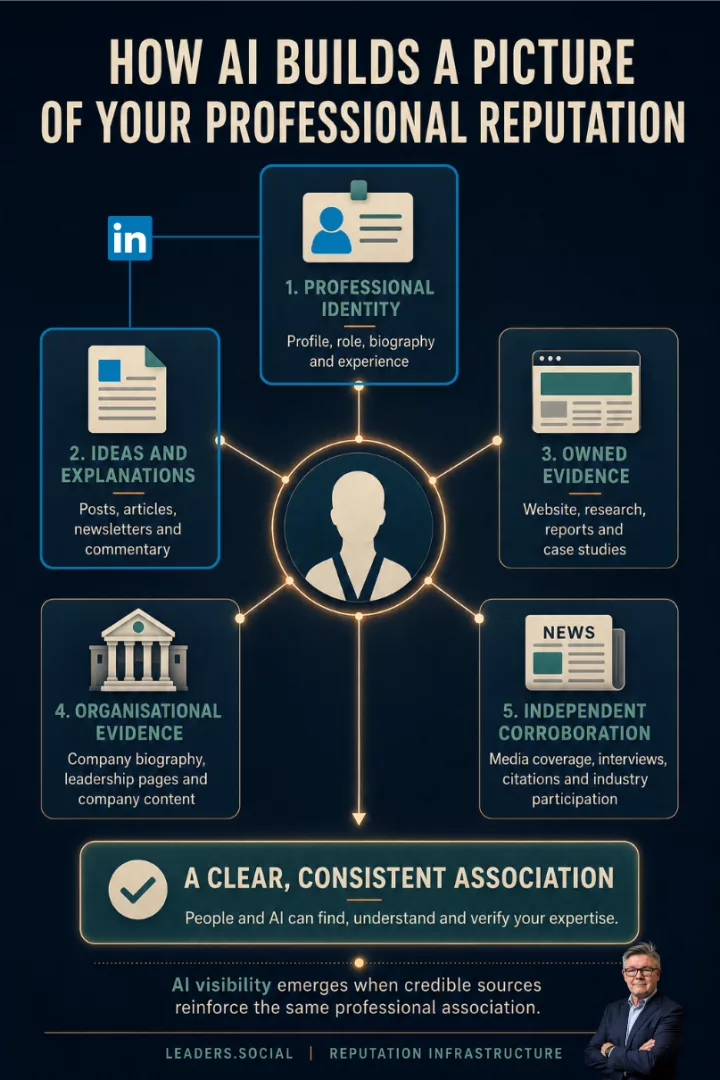
However, a clear public association is more likely to form when multiple credible sources repeatedly connect:
your identity;
your organisation and role;
the subjects you understand;
the experience that gives you standing to discuss them;
your distinctive point of view; and
evidence or third-party corroboration supporting that position.
One article can introduce an idea. A connected body of evidence makes the association easier to recognise and verify.
For example, suppose a manufacturing leader wants to become known for modernising legacy operations without disrupting production. Their profile says one thing, their company biography says another, and their occasional posts range from leadership quotes to general technology news. The relevant expertise may be real, but the public evidence is weak and scattered.
Now imagine that the same leader has a clear profile, an article explaining their approach, several posts examining specific decisions, an interview in a respected industry publication and a company biography that accurately reflects their remit. Each source does a different job, but together they present a coherent picture.
That coherence is the asset.
Why isn’t posting regularly enough?
Publishing activity and building a reputation are not the same thing.
Someone can post three times a week without becoming clearly associated with anything. If every post follows a different trend, repeats generic advice or borrows the prevailing language of LinkedIn®, the result may be visible without being distinctive.
This is where the usual advice about consistency becomes misleading.
Consistency is not merely appearing at the same time every week. It is becoming consistently associated with something worth knowing.
That does not mean repeating one opinion indefinitely. It means exploring a defined area of expertise from enough useful angles that a recognisable body of work begins to form.
A credible leader should be able to identify three or four subjects at the intersection of:
what they genuinely know;
what they have earned the right to say;
what they care enough to keep examining; and
what they want their reputation to lead towards.
Those subjects create boundaries. The boundaries make the work more coherent. They also prevent a content programme from becoming a weekly hunt for something—anything—to post.
What role should LinkedIn® play?
LinkedIn® is an important part of the system because professional identities, organisations, conversations and expertise already intersect there.
But its different formats perform different jobs.
Your profile establishes who you are, what you do and the experience behind your point of view.
Your posts isolate individual ideas, respond to developments and reveal which distinctions prompt useful discussion.
Your articles give those ideas enough depth to become substantial explanations rather than passing observations. Shah’s guide reports that articles generate roughly 60 percent of LinkedIn® content citations, with posts accounting for the remaining 40 percent. Whether that precise split holds across every subject is less important than the strategic point: depth and distribution are complementary.
Your newsletter creates continuity around a recognisable subject and gives interested readers a reason to return.
Your comments and conversations show active participation in the professional community surrounding the topic.
The objective is not to use every format for its own sake. It is to let each format contribute to the same credible association.
Why should your reputation extend beyond LinkedIn®?
If your entire professional reputation exists on one platform, it is neither fully owned nor independently corroborated.
AI systems draw information from multiple sources. More importantly, so do people.
A robust public reputation might also include:
an accurate biography on your organisation’s website;
substantial articles on a website you control;
interviews and contributed commentary in credible publications;
research, reports, presentations or case studies;
podcast, conference and industry participation;
consistent information about your work across company channels; and
independent references from people and organisations with relevant standing.
This is why the definitive version of this article sits on leaders.social rather than existing only as a LinkedIn® article.
LinkedIn® can distribute the argument and connect it with a professional audience. An owned website gives it a permanent home within a wider body of work. Independent sources can then test, support or extend the claims being made.
None of those elements proves expertise alone. Together, they make real expertise easier to find and evaluate.
How do you start building reputation infrastructure?
Begin with an audit, not a publishing target.
1. Decide what you should be known for
Choose three or four subjects grounded in your actual experience. Avoid broad labels such as leadership, innovation or transformation unless you can define the specific perspective you bring to them.
2. Examine the evidence that exists today
Search your name alongside each subject. Review your LinkedIn® profile, company biography, author pages, interviews, articles and other public references. Ask whether a stranger could understand why your name belongs in that conversation.
3. Correct the foundations
Remove conflicting descriptions. Make your role, experience and areas of expertise clear. Ensure important biographies and profiles agree on the basic facts.
4. Answer one real question properly
Write one substantial article addressing a question your clients, colleagues or peers genuinely ask. Make it specific enough to demonstrate judgment, not merely knowledge.
5. Develop the argument across different formats
Extract several standalone ideas from the article. Turn them into posts, examples, answers and conversations. Do not simply publish promotional snippets pointing back to the original.
6. Add evidence beyond your own channels
Contribute to relevant publications, research, interviews and industry discussions where you have something useful to add. Third-party presence should corroborate expertise, not manufacture it.
7. Measure the association, not just the attention
Impressions and engagement can show whether content is circulating. They do not tell you whether your professional association is becoming clearer.
Over time, look for changes in the questions people ask you, the opportunities you receive, the language others use when introducing you, relevant search visibility and whether AI-generated answers begin to reference or reflect your work. Because results vary between prompts and systems, record a consistent set of test questions and review the pattern rather than treating one answer as proof.
The aim is to make earned expertise legible
There will be no shortage of tactics promising to make content more extractable, quotable or attractive to AI systems. Some will be useful. Clear titles, direct answers, logical structure and precise language also make content better for human readers.
But structure cannot rescue an empty point of view. Publishing volume cannot substitute for experience. Repetition across channels cannot turn an unsupported claim into earned authority.
The starting point must remain the same: genuine expertise, expressed clearly and supported by evidence.
The leaders most likely to become visible in AI-assisted research will not necessarily be those who publish the most. They will be those who leave the clearest, most consistent and most credible evidence of what they know—and why their perspective deserves consideration.
Digital Marketing Director & Founder of Leaders Social
Follow:
Fox Tucker is Digital Marketing Director at Outlook Publishing and founder of Leaders Social. He specialises in LinkedIn® Company Pages, company newsletters and the connection between organisations and the people who represent them. He has created more than 120 Company Pages, optimised more than 265 Pages and helped improve more than 300 LinkedIn® profiles.