




Why are you still shouting into a digital void whilst your competitors seem to command the room with half the effort? If you’ve noticed your organic reach plummeting despite a consistent posting schedule, you aren’t alone. The 2026 “360brew” algorithm has fundamentally changed the game, prioritising topical depth over the superficial engagement of years past. You might be asking yourself: is a LinkedIn® coach worth it in this new era of AI-driven visibility? It’s a valid question when the line between a genuine strategist and a generic profile polisher has never been thinner.
- Key Takeaways
- Beyond Profile Polishing: What a LinkedIn® Coach Actually Does in 2026
- Calculating the ROI: Is the Investment in Authority Justified?
- Vetting the Experts: How to Spot a Strategic Mentor Amongst the Gurus
- Transitioning from User to Thought Leader: Your Next Steps
- Owning Your Authority in the Age of 360brew
- Frequently Asked Questions
You likely feel the frustration of being an expert who remains invisible to the 61 million senior-level influencers on the platform. This guide will show you how to calculate the true ROI of executive-level coaching and distinguish between tactical fluff and strategic authority. We’ll provide a clear framework to vet potential mentors, ensuring your investment translates into the industry-leading influence your expertise deserves.
Key Takeaways
- Recognise the shift from technical profile polishing to strategic authority building, ensuring your content aligns with the latest algorithm demands for depth and consistency.
- Calculate the tangible and intangible returns of professional mentorship to determine if a LinkedIn® coach is worth it for your specific business goals and career trajectory.
- Use a rigorous vetting framework to separate high-value strategic mentors from generic gurus who rely on dangerous automation or viral-obsessed tactics.
- Map out your evolution from a passive user to a recognised thought leader through structured coaching or executive ghostwriting solutions that protect your time.
Beyond Profile Polishing: What a LinkedIn® Coach Actually Does in 2026
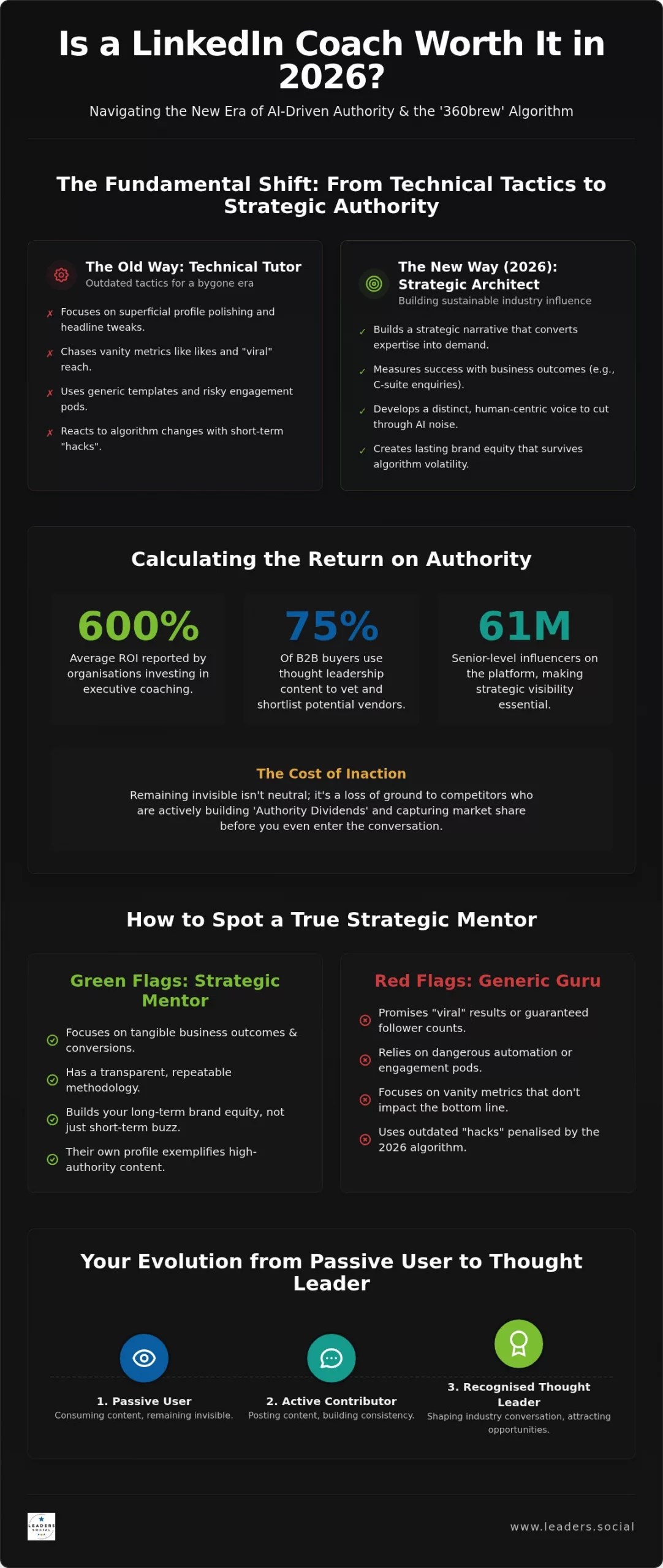
In 2026, the definition of professional influence has shifted. If you think a coach is someone who simply tweaks your banner or rewrites your “About” section, you’re stuck in the past. Today, a LinkedIn® coach acts as a strategic architect of your professional authority. Whilst a technical tutor might show you how to use the professional networking platform, a strategic partner builds a narrative that converts your expertise into market demand. Optimising your headline is now a baseline requirement; your strategic narrative is the true differentiator.
The introduction of the “360brew” algorithm has made this distinction critical. This AI-powered ranking system prioritises topical consistency and depth over superficial engagement metrics like likes. If your content is scattered or lacks a clear authority signal, your organic reach will vanish. This is where you must decide: is a LinkedIn® coach worth it for your specific growth goals? For those aiming to dominate a niche rather than just “use” the site, the answer lies in professional positioning that survives algorithm volatility.
The Shift from Tactics to Strategy
Generic templates and engagement pods are no longer just ineffective; they are actively penalised. The 2026 algorithm audits your profile to ensure your content aligns with your stated expertise. Tactical coaches might promise you clicks or “viral” reach, but these are vanity metrics that don’t pay bills. A strategic mentor focuses on conversion and influence, ensuring every post reinforces your status as a thought leader. They move you away from chasing the algorithm and towards building a sustainable brand equity.
Navigating AI and Algorithm Volatility
The rise of generative AI has flooded the feed with “grey noise.” A coach helps you integrate these tools to scale your output whilst maintaining a distinct, human-centric voice. They ensure you stay ahead of platform updates that render yesterday’s “hacks” obsolete. If you want to move from being invisible to becoming the go-to authority in your field, you need a guide who understands the underlying mechanics of professional evolution. You don’t need a tutor; you need a strategist who can rebuild your authority after a reach drop.
Calculating the ROI: Is the Investment in Authority Justified?
Determining if a LinkedIn® coach is worth it requires moving beyond the cost of the session to the value of the outcome. For a C-suite executive or business owner, ROI isn’t measured in likes; it’s measured in the calibre of enquiries landing in your inbox. When you invest in a LinkedIn® 1:1 coaching session, you aren’t paying for technical tips. You’re paying for rapid problem-solving that bypasses months of trial and error. Industry data from June 2026 suggests that organisations investing in coaching report an average ROI of 600%, a figure that reflects the transformative power of expert-led development.
Consider the “Cost of Inaction.” Staying invisible amongst your competitors means losing ground to those who are actively building “Authority Dividends.” A strong, expert-led presence reduces the sales cycle because trust is established before the first meeting even begins. Research indicates that 75% of buyers use thought leadership content to shortlist vendors. If you aren’t visible, you aren’t even in the room. This makes a bespoke authority strategy a necessity rather than a luxury for those serious about market share.
Time as a Currency: The Case for Ghostwriting
For time-poor leaders, the case for a professional ghostwriter is purely economic. Compare your hourly rate against the hours spent struggling to draft a post that might miss the mark. High-level management of a profile ensures the consistency required to beat the algorithm whilst freeing you to focus on high-level decision-making. Consistency is the foundation of trust, and most executives simply cannot achieve it alone without sacrificing their primary responsibilities.

Quantifying Influence in Your Industry
ROI in the context of personal branding is the delta between your current reach and your potential influence. Stop tracking vanity metrics like likes and comments. Instead, focus on business metrics such as C-suite enquiries and partnership invitations. High-value visibility is about being seen by the right people, not the most people. When your content attracts a decision-maker rather than a peer, the investment has already paid for itself.
Vetting the Experts: How to Spot a Strategic Mentor Amongst the Gurus
The marketplace is crowded with self-proclaimed experts who treat LinkedIn® like a game of numbers rather than a tool for influence. To determine if a LinkedIn® coach is worth it, you must look past the follower count and examine their strategic depth. Whilst a technical tutor might focus on vanity metrics, a strategic architect focuses on conversion. If a consultant relies on automation or promises “viral” results, they are using outdated tactics that the 2026 algorithm actively penalises. Look for Green Flags such as a transparent methodology and a focus on business outcomes that align with your specific industry.
Strategic mentors “walk the walk.” Their own profile should be a masterclass in high-authority content that successfully navigates the nuances of the 360brew reach drop. If they cannot sustain their own visibility, they certainly cannot sustain yours. You need a partner who understands that professional presence is built on expertise rather than shortcuts. To find the right fit for your career, you can explore professional authority-building services that prioritise genuine substance over superficial hacks.
Key Questions to Ask Before You Hire
- What is your specific strategy for navigating the latest 360brew algorithm shifts?
- How do you ensure my authentic voice is maintained if we move toward ghostwriting?
- Can you demonstrate a clear link between your coaching and my specific business goals?
The Value of the “Micro-Consultation”
You don’t always need a six-month commitment to see tangible results. A 30-minute high-intensity Q&A session is often more valuable than a generic course because it addresses your specific hurdles in real-time. Use a single session to test a coach’s ability to solve a complex problem or refine a narrative. This low-friction entry point is the ultimate test of whether a LinkedIn® coach is worth it for your long-term goals. If they can’t provide clarity in half an hour, they won’t provide it in half a year.
Transitioning from User to Thought Leader: Your Next Steps
The journey from a passive observer to a recognised thought leader follows a predictable trajectory. It begins with a comprehensive audit to strip away outdated tactics and ends with a consistent, authority-driven presence that commands attention. At Leaders Social, we structure this evolution to meet your specific needs, whether that’s through rapid-fire strategic fixes or long-term ghostwriting partnerships for time-poor executives. Ultimately, the question of whether is a LinkedIn® coach worth it depends on your readiness to implement a strategic shift. If you treat the platform as a secondary task, your results will remain secondary.
Think of your profile as the digital lobby of your professional life. It’s the first place high-level decision-makers “enter” before they decide to do business with you. Professional management of this space is no longer optional; it’s a requirement for those who value their reputation. Since 89% of B2B marketers already use the platform for lead generation, the competition for attention is fierce. You aren’t just competing with other posts; you’re competing for the limited “dwell time” that the 360brew algorithm now prioritises.
Immediate Actions You Can Take Today
Start by auditing your current engagement. Are your posts reaching your ideal target audience, or are they simply circulating amongst your existing circle of peers? If you aren’t seeing new C-suite enquiries, your content isn’t working hard enough. Identify your primary hurdle: is it a lack of reach, poor content quality, or a failure to convert visibility into conversations? Understanding where the friction lies is the first step toward a high-ROI strategy.
Finding the Right Fit for Your Ambition
Deciding on the right support depends on your scale. Corporate team training is excellent for aligning employees with a brand’s mission, whilst individual executive coaching provides the surgical precision needed for personal authority. If you’re serious about cutting through the noise and accelerating your professional evolution, you can book a 1:1 session with Leaders Social to begin your transition. The investment is a LinkedIn® coach worth it only when it aligns with an ambition to lead your industry rather than follow it.
Owning Your Authority in the Age of 360brew
The transition from a passive professional to an industry thought leader requires more than just occasional posting. It demands a sophisticated understanding of the 360brew algorithm and a commitment to strategic narrative over tactical hacks. By focusing on topical depth and authentic engagement, you ensure your expertise isn’t just seen, but respected by the decision-makers who matter most. When you weigh the cost of remaining invisible against the potential for 600% ROI, the question of whether is a LinkedIn® coach worth it becomes a matter of professional survival.
Led by Fox Tucker, a seasoned LinkedIn® strategist and Digital Marketing Director, Leaders Social specialises in C-suite ghostwriting and high-level authority building. We’ve proven our ability to navigate the reach drops of 2026, helping executives reclaim their visibility and influence. You don’t have to navigate these shifts alone. It’s time to stop guessing and start leading with a strategy built on genuine substance. Invest in your strategic authority with a 1:1 consultation at Leaders Social and take the first step toward dominating your niche with confidence.
Frequently Asked Questions
How much does a LinkedIn® coach typically cost?
Rates in the US vary significantly based on the strategist’s depth of expertise; individual sessions often average around $250 per hour. For high-level executive programmes focused on the C-suite, fees can range from $500 to over $3,000 per hour for specialised authority building. When asking yourself, is a LinkedIn® coach worth it, you must weigh the upfront cost against the value of the network and the calibre of opportunities being unlocked.
Can a LinkedIn® coach help if my organic reach has dropped significantly?
Reversing a reach drop is a core focus for strategists navigating the 360brew algorithm. They assist in shifting your content from engagement-chasing to topical depth, which the current AI ranking system rewards. By aligning your posts with your specific expertise, a coach ensures your profile signals the necessary authority to bypass the grey noise on the feed and reach the decision-makers who matter.
Is there a difference between a career coach and a LinkedIn® thought leadership coach?
Career coaches primarily focus on the mechanics of landing a job, such as CV writing and interview preparation. In contrast, a LinkedIn® thought leadership coach acts as a strategic architect of your professional reputation. Their goal is to build long-term brand equity so that high-value partnerships and board-level enquiries find you, rather than you having to hunt for them.
How long does it take to see results from LinkedIn® coaching?
Whilst profile optimisations provide an immediate uplift in professional appearance, building genuine influence takes consistent effort over several months. The 2026 algorithm prioritises dwell time and topical consistency over viral spikes. Most leaders begin to notice a shift in the quality of their network and the seniority of their enquiries within ninety days of implementing a new strategy.
What should I have ready before my first LinkedIn® coaching session?
Come prepared with a clear understanding of your commercial objectives and your target audience’s primary pain points. Having these insights ready allows your coach to skip generic advice and immediately focus on high-impact positioning. Identifying your biggest hurdle, whether it is reach, conversion, or content volume, ensures the session is a high-intensity use of your time.