



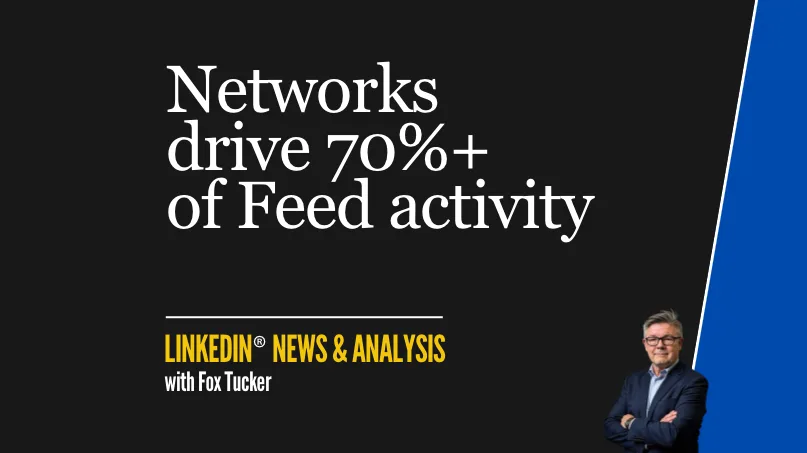
More than 70% of impressions and engagement in the LinkedIn® Feed comes from content generated by a member’s network of connections and follows, according to a new engineering paper authored by LinkedIn® researchers.
The finding appears in Connected Content Retriever: Dense Graph Edge Features Powering Pre-Ranking at LinkedIn, published on 18 September 2026. Although the paper is primarily about the infrastructure needed to rank content at enormous scale, it provides unusually specific evidence about the importance of professional relationships in Feed distribution.
Its central point is straightforward: LinkedIn® does not evaluate a post only as a piece of content. The relationship between the viewer and the person responsible for bringing that post into the viewer’s network also matters.
What LinkedIn® means by connected content
The paper describes two main routes through which content enters the connected-content system.
The first is the first-degree network: posts originating from people a member has connected with or follows.
The second is the second-degree network: posts that a first-degree connection has reacted to, commented on or reshared, even though that connection did not originally author the post. LinkedIn® refers to this internally as “stranger viral” content.
This means a member’s activity can help a post travel beyond the original author’s immediate audience. A thoughtful comment, reaction or reshare can create a route into other professional networks, subject to LinkedIn®’s wider retrieval and ranking decisions.
That does not mean every interaction automatically produces more reach. It does show that LinkedIn® has built second-degree network activity into the candidate-retrieval process itself.
Relationship strength is a first-class signal
Before the final ranking stage, LinkedIn® must reduce tens of thousands of possible connected-content candidates to a few hundred. Its new Connected Content Retriever scores those candidates using three broad feature groups:
More…

- document features, including content information and popularity;
- request features associated with the individual viewer; and
- edge features describing the relationship between the viewer and the author.
Those relationship features include historical engagement across likes, comments, shares, clicks, long dwell and follows, organised by time windows such as the previous hour, day or week.
In practical terms, LinkedIn® is evaluating both what the content is about and how the viewer has previously related to the person behind it.
The researchers describe connection strength as being co-equal with topical interest in this stage of Feed retrieval. When they removed the viewer–author relationship features during testing, retrieval recall fell by 7.86%.
The new system changed Feed behaviour
LinkedIn® moved this pre-ranking work to a GPU-based system capable of using a model with 50 times more parameters than its previous approach.
In online experiments, the new system produced a 2.5% increase in time spent consuming content in the LinkedIn® Feed. The researchers describe that as significantly larger than the gains usually observed in LinkedIn® Feed experiments.
This is an engineering result rather than a creator benchmark. It does not tell us that a particular posting technique will produce a 2.5% improvement, nor does it reveal the complete Feed ranking system.
It does, however, confirm that LinkedIn® continues to invest heavily in modelling professional relationships before content reaches the final ranking stage.
What this means for leaders
For an individual leader, the practical lesson is not to collect interactions indiscriminately. It is to build relevant professional relationships before expecting consistent distribution.
If somebody has repeatedly chosen to follow, click, read, comment on or share a leader’s contributions, LinkedIn® has a richer history from which to infer the strength of that relationship. Publishing useful material and participating intelligently in other people’s discussions are therefore connected activities, not separate tactics.
The paper also helps explain why a credible comment can matter beyond the comment thread. First-degree activity can become part of the route through which another author’s post reaches a second-degree audience.
That makes comments part of professional visibility—but only when they add enough value to strengthen the relationship or help somebody understand why the underlying post is relevant.
What this means for Company Pages
The paper focuses on member networks and does not provide a separate breakdown for LinkedIn® Company Pages. It would therefore be wrong to present the 70% figure as a Company Page performance benchmark.
The broader implication is still important for organisations. A Company Page does not operate in isolation from the people around it. Employees, leaders, customers and other informed participants can introduce company content and ideas into professional networks through genuine engagement and conversation.
That supports a joined-up model: the Page supplies an authoritative organisational source, while identifiable people supply expertise, context and routes into relationship-based networks.
It also reinforces the value of LinkedIn® Collaborative Posts, which formally bring a Company Page and a person into the same piece of content. The technical paper does not assess Collaborative Posts, but both developments point towards the same strategic reality: organisational visibility and human relationships increasingly need to work together.
What the paper does not prove
Several limits matter.
- The 70% figure describes aggregate Feed impressions and engagement; it is not a guaranteed share for every member, market or content type.
- The research explains connected-content retrieval, not every later decision in the complete Feed-ranking process.
- It does not establish that comments, reactions or reshares always increase distribution.
- It does not compare Company Page content with personal-profile content.
- Time spent in the Feed is LinkedIn®’s measured system outcome, not proof of business value for the author.
The strongest conclusion is therefore narrower and more useful: LinkedIn® has confirmed that professional-graph relationships are fundamental to how most Feed impressions and engagement are assembled, and that content relevance alone cannot reproduce those signals.
The practical conclusion
Content and network cannot sensibly be treated as two unrelated parts of a LinkedIn® strategy.
Strong content gives people a reason to pay attention. Relevant professional relationships give that content credible routes through the network. Neither substitutes for the other.
For leaders and organisations, the durable approach is to publish material grounded in real expertise, build relationships with the people for whom it is relevant, and participate meaningfully in the professional conversations surrounding it.