




Your seniority in the boardroom is no longer a guarantee of visibility on the feed. With the 360Brew algorithm now prioritising genuine expertise over superficial likes, the old “post and pray” method has officially expired. You’ve likely noticed your engagement stalling whilst less experienced voices seem to capture the spotlight. It’s a common frustration to feel that your hard-earned insights are being throttled by a digital landscape that changes every week. Mastering LinkedIn content pillars for thought leaders is the only way to ensure your professional presence reflects your real-world authority.
- Key Takeaways
- Why is your LinkedIn engagement dropping in 2026?
- The 4 essential LinkedIn content pillars for thought leaders
- How to organise your pillars into a consistent strategy
- Scaling your influence: Ghostwriting and advanced coaching
- Future-Proof Your Professional Authority
- Frequently Asked Questions
I understand the hesitation to post when the risk of sounding “cringe” feels high and the rewards seem to be dwindling. However, the 2026 shift actually favours those with depth, provided you have a repeatable system to package it. This article promises to hand you that system, allowing you to bypass reach drops and rebuild your strategic visibility. We’ll explore a clear, four-pillar content architecture designed to turn your profile into a stage for genuine influence. By the end of this briefing, you’ll have a predictable framework to grow your authority and ensure your digital footprint finally matches your seniority.
Key Takeaways
- Understand the mechanics of the 360Brew algorithm to stop generic, AI-generated content from sabotaging your professional reach.
- Identify the four essential LinkedIn content pillars for thought leaders that transform a static profile into a dynamic stage for industry influence.
- Adopt a 12-week Authority Cycle to organise your insights into a repeatable, high-impact posting schedule that maintains momentum.
- Apply the 80/20 rule to balance deep, value-driven expertise with personal updates that humanise your seniority without sounding “cringe”.
- Learn how to leverage ghostwriting as a strategic tool for consistency whilst protecting the authentic voice that underpins your reputation.
Why is your LinkedIn engagement dropping in 2026?
If you’ve noticed your reach plummeting lately, you aren’t imagining it. The 2026 “360brew” algorithm update has fundamentally altered how content is distributed. This shift is designed to penalise the flood of generic, AI-generated “tips” that have cluttered the platform. LinkedIn now prioritises genuine, human-led insights that demonstrate deep expertise. If your content sounds like a polished corporate brochure, the algorithm will likely bury it.
Many senior professionals still use a “CV approach,” treating their feed as a static record of achievements. This is the quickest way to lose visibility amongst your peers. Without clear LinkedIn content pillars for thought leaders, you risk “Context Collapse.” This occurs when your content is so broad or disconnected that the algorithm cannot categorise your expertise. This confusion leads to a distribution death spiral where your posts reach fewer and fewer of the right people.
The 360brew effect on professional reach
The platform has moved towards signal-based distribution. It looks for a specific Point of View (POV) rather than simple information sharing. To be recognised as a true thought leader, your content must provide consistent signals that the algorithm can track. By using a structured pillar framework, you provide these signals reliably. This helps the platform understand exactly who should see your posts, shifting your focus from vanity likes to the strategic reach that attracts genuine C-suite opportunities.
Signs your LinkedIn strategy needs a pivot
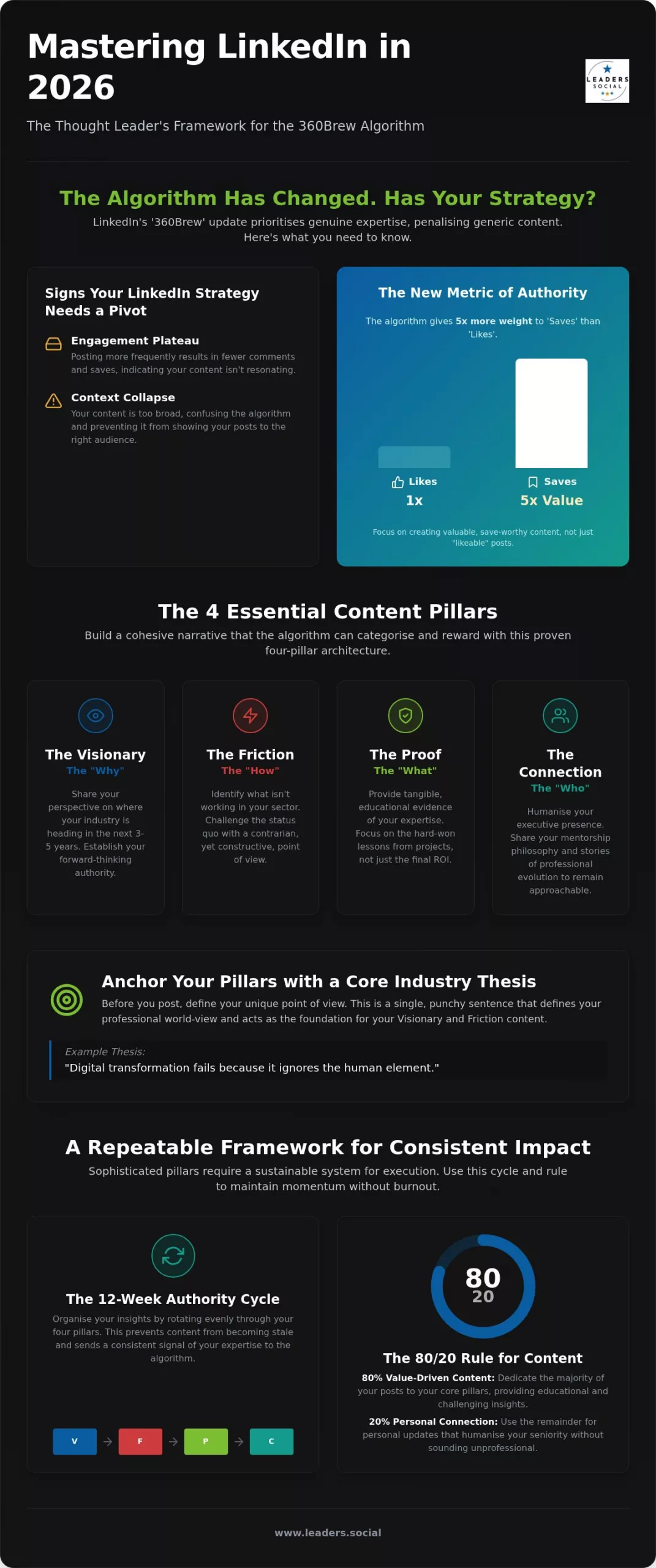
An “Engagement Plateau” is the most common symptom of a failing strategy. If you’re posting more frequently but seeing fewer comments or saves, your current approach isn’t working. In 2026, the algorithm gives five times more weight to “saves” than “likes,” according to recent platform data. You should audit your feed for pillar clarity. If a stranger can’t identify your core areas of expertise within ten seconds of scrolling, you’re losing your audience to the noise. Posting more is rarely the solution; posting with better architecture is.
The 4 essential LinkedIn content pillars for thought leaders
To survive the algorithmic shifts discussed earlier, your feed needs a structural backbone. It’s no longer enough to share industry news or occasional updates. You must own a specific territory. A robust framework of LinkedIn content pillars for thought leaders ensures you aren’t just adding to the noise. Instead, you’re building a cohesive narrative that the algorithm can categorise and reward. This architecture consists of four distinct quadrants:
- The Visionary (The “Why”): Your perspective on where your industry is heading over the next three to five years.
- The Friction (The “How”): Identifying what isn’t working in your sector and challenging the status quo.
- The Proof (The “What”): Tangible evidence of your expertise, focusing on the mechanics of your results.
- The Connection (The “Who”): The personal values and professional evolution that humanise your executive presence.
Sharing personal experiences, such as the unique insights gained from a guided urban exploration with citydrifts.com, is a perfect example of how to fuel the Connection pillar with authentic stories.
Building the “Visionary” and “Friction” pillars
Leadership requires a stance. If you don’t have a contrarian view, you likely don’t have a unique point of view. However, avoid being provocative for the sake of it. To anchor these pillars, you need a core industry thesis. This is a single, punchy sentence that defines your professional world-view. For example: “Digital transformation fails because it ignores the human element.” Once you’ve defined this thesis, every Visionary or Friction post should reinforce it, creating a “signal” that both your peers and the algorithm can easily identify.
More…

Balancing “Proof” with “Connection”
Proof isn’t bragging. In 2026, the algorithm prioritises “saves,” which means your Proof pillar must be educational. Focus on the hard-won lesson learned during a project rather than just the final ROI. This builds deep authority whilst providing genuine value to your network. Simultaneously, use the Connection pillar to bridge the gap between high-level strategy and human relatability. Share your mentorship philosophy or a story of professional evolution using a “professional-casual” register. This ensures you remain approachable whilst maintaining your seniority. If you’re struggling to define these for your own profile, our LinkedIn Advanced Coaching can help you architect a bespoke strategy that reflects your real-world influence.
How to organise your pillars into a consistent strategy
Execution is where most leaders falter. You can have the most sophisticated LinkedIn content pillars for thought leaders in your industry, but they won’t drive results without a repeatable system. I recommend mapping your insights to a 12-week “Authority Cycle.” This ensures that you rotate through your four pillars evenly, preventing any single topic from becoming stale whilst maintaining a consistent signal for the 360Brew algorithm.
Sustainability depends on the 80/20 Rule. Dedicate 80% of your schedule to value-driven pillar content that educates or challenges; use the remaining 20% for direct business updates or personal milestones. To maximise efficiency, employ “Content Layering.” A single visionary insight from your first pillar can be transformed into a high-impact carousel, a punchy long-form post, and a brief video. To ensure your event footage is edited into a compelling professional narrative, you can check out See More Edits. This approach respects the 2026 preference for dwell time without requiring you to reinvent the wheel every morning.
If you’ve recently completed a LinkedIn 1:1 coaching session, you should integrate those bespoke insights directly into your weekly calendar. This ensures your high-level strategy isn’t just a document on your hard drive, but a living part of your digital presence.
The 90-day visibility framework
Consistency doesn’t mean rigidity. You should audit your pillars every 30 days to check for “Topic Fatigue.” If a specific angle is no longer generating “saves,” it’s time to pivot. Monitor your Social Selling Index (SSI) feedback to understand how the platform perceives your authority. Adjust your pillar weightings based on these metrics to keep your reach optimal. If you need a more tailored approach to these adjustments, our LinkedIn Advanced Coaching provides the granular feedback required for sustained growth.
Tools for organising your thought leadership
Don’t over-complicate your workflow. For personal branding, a simple spreadsheet often beats complex project management tools. It allows for a “Straight-Talk” review before anything goes live. Ask yourself: “Does this sound like me, or a corporate AI?” If it’s the latter, strip it back. Authenticity is the only currency that hasn’t devalued in 2026.
Scaling your influence: Ghostwriting and advanced coaching
Scaling your influence isn’t about working harder; it’s about delegating the execution whilst retaining the strategy. For many senior executives, the transition from DIY posting to professional management is the only way to maintain the consistency required by the 360Brew algorithm. The common fear is that a LinkedIn Ghostwriter will dilute your authentic voice. However, when you have established robust LinkedIn content pillars for thought leaders, you provide a map that ensures every post resonates with your specific expertise. Pillars are the secret sauce that allows a professional writer to sound exactly like you because they are rooted in your unique industry thesis.
Maintaining authenticity in a managed profile
We use the “Interview Method” at Leaders Social to ensure your voice remains central. This involves regular briefings where we extract your raw insights, anecdotes, and opinions to fuel your pillars. This process ensures that your “Connection” pillar remains genuinely yours, reflecting your personal mentorship style and professional evolution. It’s a collaborative partnership, not an automated broadcast. LinkedIn Advanced Coaching further refines these pillars, sharpening your message to attract board-level opportunities and high-value speaking invitations.
The ROI of a pillar-led strategy
Success in 2026 is measured by the quality of your inbox, not the count of your likes. A strategy built on LinkedIn content pillars for thought leaders moves you beyond vanity metrics and towards tangible business outcomes. This includes inbound enquiries from potential partners, invitations to join industry panels, and a stronger employer brand that attracts top-tier talent. You’re no longer just a user; you’re a recognised authority. If you’re ready to stop guessing and start leading, the first step is a strategic review of your current framework. You can book a 1:1 session to audit your current pillars and ensure your digital presence is working as hard as you are.
Future-Proof Your Professional Authority
The shift toward the 360Brew algorithm isn’t a hurdle to be cleared; it’s a filter that rewards genuine depth over superficial noise. By implementing robust LinkedIn content pillars for thought leaders, you ensure your expertise is categorised and distributed to the peers who matter most. You’ve seen how the Visionary, Friction, Proof, and Connection pillars work together to build a presence that reflects your real-world seniority whilst bypassing the reach drops that plague generic profiles.
Leaders Social, led by Fox Tucker, specialises in this exact transition for C-suite executives who need their digital footprint to match their professional reputation. We focus on the latest 2026 algorithm shifts to keep you ahead of the curve. If you’re ready to stop reacting to reach drops and start leading the conversation, it’s time to refine your strategy. Transform your LinkedIn presence with a bespoke 1:1 coaching session and reclaim your stage. Your insights are too valuable to be lost in the feed. Build the framework that protects them.
Frequently Asked Questions
What are LinkedIn content pillars for thought leaders?
LinkedIn content pillars for thought leaders are the strategic themes that anchor your professional narrative and ensure your feed provides a consistent signal to the algorithm. Instead of posting random updates, pillars allow you to categorise your expertise into distinct areas such as industry vision or technical friction. This structure helps the platform identify you as an authority in your niche, ensuring your content reaches the right C-suite audience whilst maintaining a cohesive brand identity.
How many content pillars should I have on LinkedIn?
Four pillars is the ideal number for maintaining variety without diluting your core message. This architecture allows you to cover vision, proof, friction, and personal connection without overwhelming your audience or confusing the algorithm. Having too few pillars can lead to “Topic Fatigue,” whilst having too many creates “Context Collapse,” where your expertise becomes too broad to be recognised as authoritative by the current 360Brew AI model.
Why has my LinkedIn reach dropped in 2026?
Your reach has likely dropped due to the 360Brew algorithm update, which now penalises generic, AI-generated advice in favour of deep, human-led insights. LinkedIn has shifted its focus toward “saves” and dwell time, weighting a save five times more than a standard like. If your posts lack a unique point of view or fail to provide tangible value that users want to reference later, the platform will restrict your distribution to prioritise quality conversations.
Can a ghostwriter really capture my professional voice?
A professional ghostwriter can capture your voice perfectly if they utilise a structured pillar framework and a regular interview-based workflow. By extracting your raw insights and unique industry thesis during briefings, a writer can mirror your expert-to-peer connection whilst handling the execution. This ensures your content remains authentic and authoritative, allowing you to scale your influence without the time-intensive burden of drafting every post yourself.
How often should a thought leader post on LinkedIn?
A consistent schedule of three times a week is the recommended starting point for most thought leaders in 2026. This frequency allows you to maintain visibility without sacrificing the quality that the current algorithm demands. It’s far better to post three high-impact pieces aligned with your LinkedIn content pillars for thought leaders than to post daily updates that offer little substance and risk being flagged as engagement bait.