



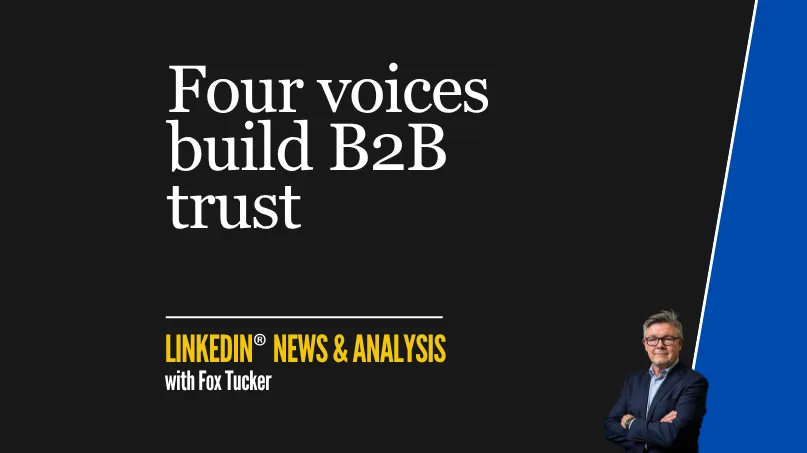
Research briefing · Analysis by Fox Tucker
New research from LinkedIn®’s B2B Institute and Ipsos argues that B2B brands do not lose many opportunities through lack of awareness alone. They lose them because buyers do not feel confident enough to act.
The Credibility Code describes four reinforcing sources of trust: the brand, employees, customers and creators. LinkedIn®’s argument is that these voices become more persuasive when they support one another rather than operating as isolated campaigns.
The important word is reinforcing
Companies often treat brand content, employee advocacy, customer evidence and creator partnerships as separate channels owned by separate teams. The research suggests their combined effect matters more than any single stream.
A Company Page can establish the organisation’s position and provide a reliable public record. Employees can add specialist knowledge and lived experience. Customers make claims easier to believe. Independent creators interpret the subject for audiences that the company may not reach directly.
Why the Company Page still matters
The conclusion is not that the corporate voice has become irrelevant. It is that the Page should act as the stable centre of a wider credibility network.
When managed properly, it holds the official narrative together, publishes evidence, credits contributors and connects related perspectives. When neglected, the company leaves employees, customers and partners to create disconnected signals around an underdeveloped organisational presence.
Activity is not the same as confidence
LinkedIn® highlights a familiar B2B problem: buying groups can know a brand and still delay a decision. More reach does not automatically make a choice feel defensible. Buyers need several forms of reassurance, often from different voices, before confidence accumulates.
That changes the editorial question. Instead of asking only how frequently the Page should post, companies should ask what evidence a buyer needs, which voice can provide it most credibly and how those contributions connect.
Leaders Social assessment
The Credibility Code strongly supports a Company Page model built around coordination rather than broadcasting. The Page is most valuable when it brings organisational authority, internal expertise and external validation into one coherent body of evidence.
That is also why Page management cannot be reduced to filling a calendar. The work is deciding which stories matter, who belongs in them, what proof supports them and how each publication strengthens the reputation already being built.
Original source
Alejandro Garcia Medina of LinkedIn®’s B2B Institute published The Credibility Code: How B2B Brands Win Trust that Converts on 5 August 2026.